- Animals
- ›Chordates
- ›Vertebrates
- ›Mammals
- ›Therians
- ›Placental Mammals
- ›Primates, Rodents, and Allies
- ›Rodents
- ›Squirrels, Dormice, and Mountain Beavers
- ›Squirrels
- ›Ground and African Tree Squirrels
- ›Chipmunks
- ›Neotamias
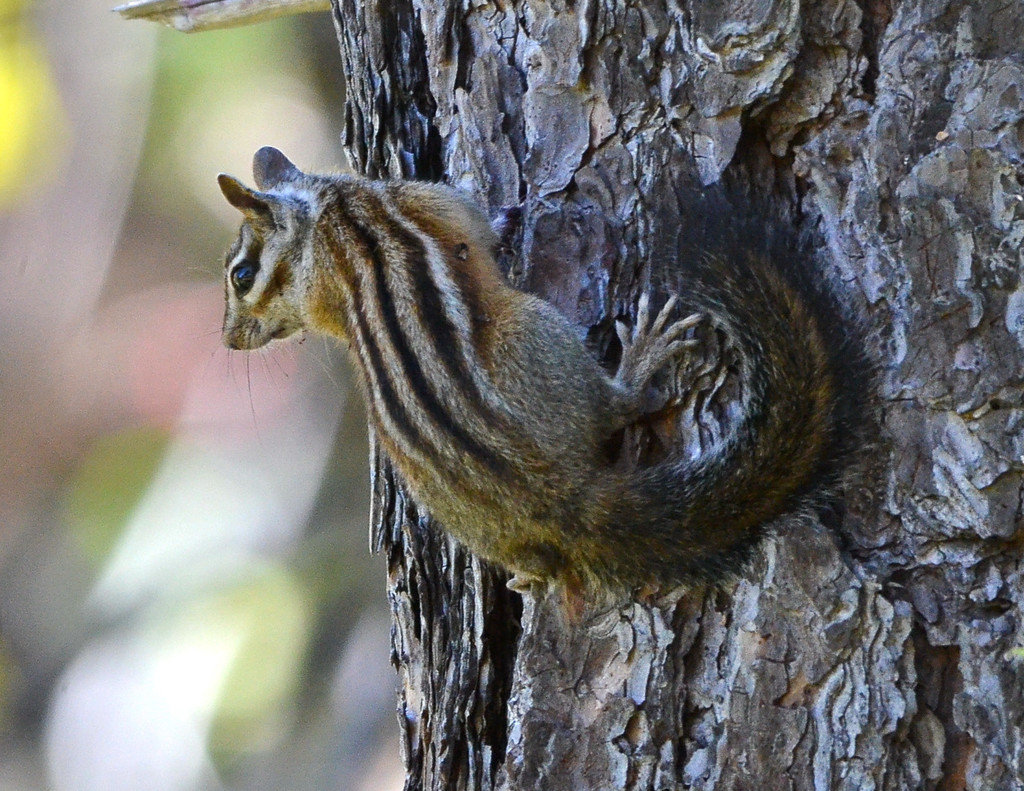
Sonoma Chipmunk
Neotamias sonomae
The Sonoma chipmunk (Tamias sonomae) is a species of rodent in the squirrel family Sciuridae. It is endemic to northwestern California in the United States. T. sonomae is 1 of 25 species of chipmunk. These 25 species are organized into 3 subgenera. T. sonomae belongs to the subgenus Neotamias. Members of Neotamias are characterized by having 2 premolars. T. sonomae has 2 subspecies: T. s. alleni and T. s. sonomae.
From the article Sonoma chipmunk on Wikipedia (CC BY-SA), quoted section by section
Range & habitat
The Sonoma chipmunk is only found in California, north of the San Francisco Bay. Most of its range is within Sonoma and Marin counties.
Wikipedia: “Distribution”
What it does
Sonoma chipmunks typically forage on the ground or climb along small branches in brush. They eat seeds, fruits, herbs, buds of woody plants, as well as insects and bird eggs, and primarily consume the reproductive products of shrubs. Food is collected in their cheek pouches and stored in their burrows. These chipmunks will find elevated places to eat and rest so they can watch the surrounding area for predators. Sonoma chipmunks have high-pitched, bird-like alarm calls that are distinct from other chipmunks and are emitted in response to potential threats. Females are usually the ones to make alarm calls. These alarm calls likely evolved due to kin selection, as the chipmunks nearby that hear the alarm calls are typically related to the individual making the alarm call. When an alarm call is heard, the chipmunk will quickly move along a direct path to a covered, protected area and become still. These chipmunks undergo torpor in winter but arise periodically to eat from their food cache, since they do not accumulate fat stores. Sonoma chipmunks may also hibernate in winter, and they don't have migratory patterns. They are also diurnal animals, meaning they are active during the day time and inactive or have periods of rest during the night time.
Wikipedia: “Diet and behavior”
Listen
Looking for field recordings…
Where it lives
Recorded sightings
—
geo-referenced records in GBIF, from museums, herbaria and field observers.
Drag the globe to turn it. Dots are where records exist, not a range map; darker means more records.
In the stacks
Searching the stacks…
Every page naming Neotamias sonomae in the Biodiversity Heritage Library →
This page is assembled live from iNaturalist, GBIF, Wikipedia, the Source Library and the Internet Archive. It is not yet part of the hand-edited codex. iNaturalist taxon 225754.