- Animals
- ›Chordates
- ›Vertebrates
- ›Mammals
- ›Therians
- ›Placental Mammals
- ›Primates, Rodents, and Allies
- ›Rodents
- ›Squirrels, Dormice, and Mountain Beavers
- ›Squirrels
- ›Ground and African Tree Squirrels
- ›Chipmunks
- ›Neotamias
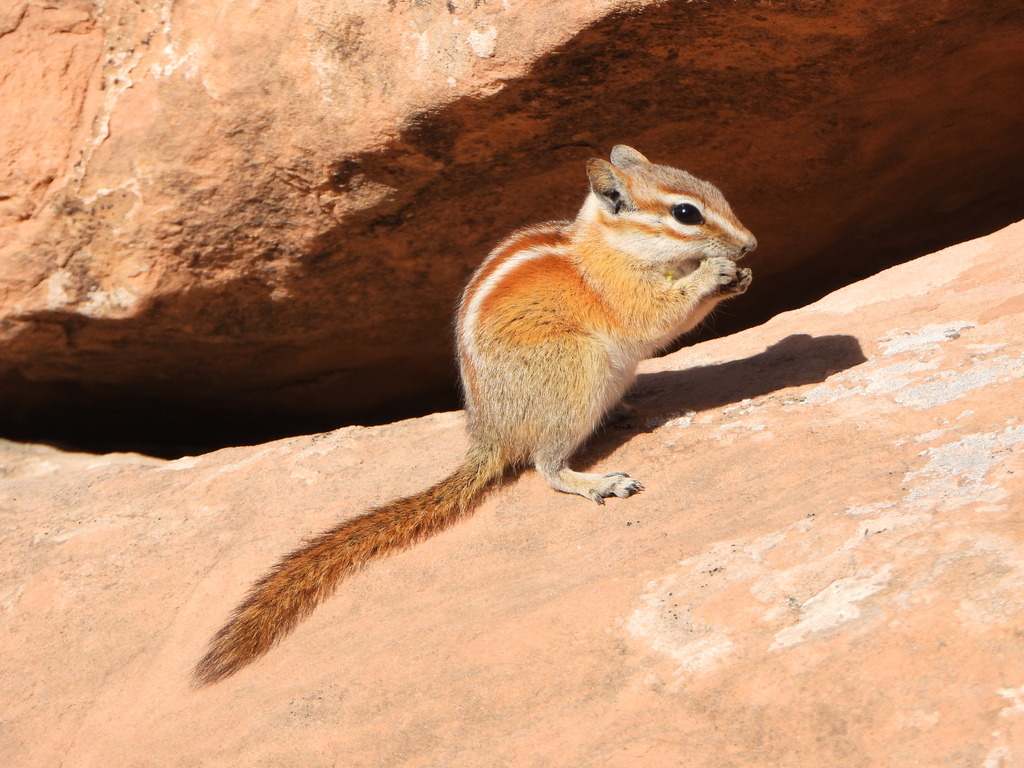
Hopi Chipmunk
Neotamias rufus
The Hopi chipmunk (Neotamias rufus) is a small chipmunk found in Colorado, Utah and Arizona in the southwestern United States. It was previously grouped with the Colorado chipmunk (N. quadrivittatus). This species is listed as "Least Concern" on the IUCN Red List as it is common, widespread, and without any major threats. It was last evaluated in 2016.
From the article Hopi chipmunk on Wikipedia (CC BY-SA), quoted section by section
Description
This species is distinguished by somewhat smaller size and a dorsal pelage that generally lacks significant amounts of black in the stripes, resulting in a more orange red to buff pelage. Measurements are: total length 190–235 mm; length of tail 83–95 mm; length of hindfoot 31–35 mm; length of ear 15–22 mm; weight 52–62 g. Females are slightly larger than males.
Range & habitat
Hopi chipmunks prefer rocky areas with pinion and juniper pines and feed mostly on nuts, seeds and fruits. Food gathered is stored in cheek pouches and taken elsewhere for consumption or storage. They nest in rock piles or crevices. This is the common chipmunk of much of the canyon and slickrock piñon-juniper country in western Colorado. Population densities appear to be highest in areas with an abundance of broken rock or rubble at the base of cliff faces or in rock formations with deep fissures and crevices suitable for den sites. In Colorado, the Hopi chipmunk occurs in the west from the Yampa River south. It ranges eastward along the Colorado River to Eagle County and along the Gunnison to the western end of the Black Canyon.
Wikipedia: “Habitat”
What it does
The diet includes seeds of Indian ricegrass and penstemon are eagerly sought as are seeds of junipers, piñon, oak, skunkbrush, and other shrubs.
Wikipedia: “Diet”
Listen
Looking for field recordings…
Where it lives
Recorded sightings
—
geo-referenced records in GBIF, from museums, herbaria and field observers.
Drag the globe to turn it. Dots are where records exist, not a range map; darker means more records.
In the stacks
Searching the stacks…
Every page naming Neotamias rufus in the Biodiversity Heritage Library →
This page is assembled live from iNaturalist, GBIF, Wikipedia, the Source Library and the Internet Archive. It is not yet part of the hand-edited codex. iNaturalist taxon 225751.