- Animals
- ›Chordates
- ›Vertebrates
- ›Amphibians
- ›Frogs and Toads
- ›Terraranas
- ›Rain Frogs
- ›Eleutherodactylinae
- ›Eleutherodactylus
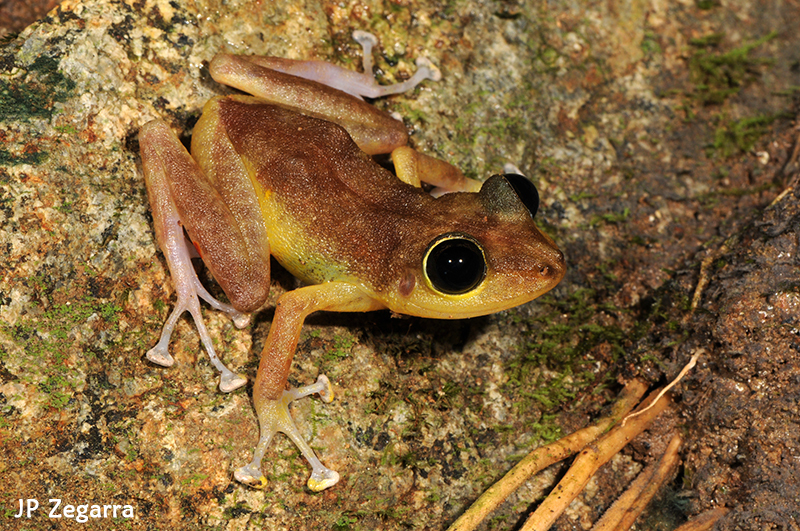
Cook's Robber Frog
Eleutherodactylus cooki
The Puerto Rican rock frog (Eleutherodactylus cooki), also known as the Puerto Rican cave-dwelling frog or rock coquí, and locally as coquí guajón, or guajón for brevity, is a threatened frog species from the coqui genus. This unique species of tropical frogs dwells primarily in crevices and grottos in the Cuchilla de Panduras mountain range in southeastern Puerto Rico. The native name guajón is derived from its habitat, guajonales, which are caves formed by rock formations between huge stones. Despite being the state animal and considered emblematic of the region, of the 17 species of coquí, three are believed to be extinct and the rest are rare and declining in numbers. The Puerto Rican rock frog is extremely restricted in geographical distribution. The frog is threatened due to deforestation, agricultural, rural, and industrial development, and the associated infrastructure. It is sometimes called the "demon of Puerto Rico" (demonio de Puerto Rico in Spanish) because of its eerie call and phantom-like appearance. The species was first described by American herpetologist, Chapman Grant in 1932.
From the article Puerto Rican rock frog on Wikipedia (CC BY-SA), quoted section by section
Description
Females are slightly larger than males, reaching a mean size of 2.01 in (51 mm) in length, whereas the males reach about 1.7 in. They are solid brown with whitish under parts, and large, white-rimmed eyes, giving them a phantom-like appearance. Breeding males and some females may have yellow throats and abdomens, and it is the only Eleutherodactylus species which exhibits sexual dimorphism in color and size. The species is characterized by large truncated discs under the frogs' feet, and a peculiar, melodious, low voice completely different from any other coquí in Puerto Rico.
Range & habitat
This species is restricted to the Cuchilla de Panduras mountain range (Maunabo, San Lorenzo, and Yabucoa), and in the municipalities of Patillas, Humacao, and Las Piedras in Puerto Rico. It occurs at low and intermediate elevations from 18 to 1,183 ft (361 m) above sea level, where they inhabit caves formed by large boulders of granite rock ("granodiorite", Geologic Map of the Yabucoa Quadrangle, USGS, 1977) known as guajonales or streams with patches of rocks without cave systems. It is believed to be limited in distribution by the rock formations where it occurs.
Wikipedia: “Distribution and habitat”
Listen
Looking for field recordings…
Where it lives
Recorded sightings
—
geo-referenced records in GBIF, from museums, herbaria and field observers.
Drag the globe to turn it. Dots are where records exist, not a range map; darker means more records.
In the stacks
Searching the stacks…
Every page naming Eleutherodactylus cooki in the Biodiversity Heritage Library →
This page is assembled live from iNaturalist, GBIF, Wikipedia, the Source Library and the Internet Archive. It is not yet part of the hand-edited codex. iNaturalist taxon 22369.