- Plants
- ›Vascular Plants
- ›flowering plants
- ›monocots
- ›lilies, supplejacks, and allies
- ›lily family
- ›true lily subfamily
- ›true lilies and allies
- ›Lilium
- ›Leucolirion
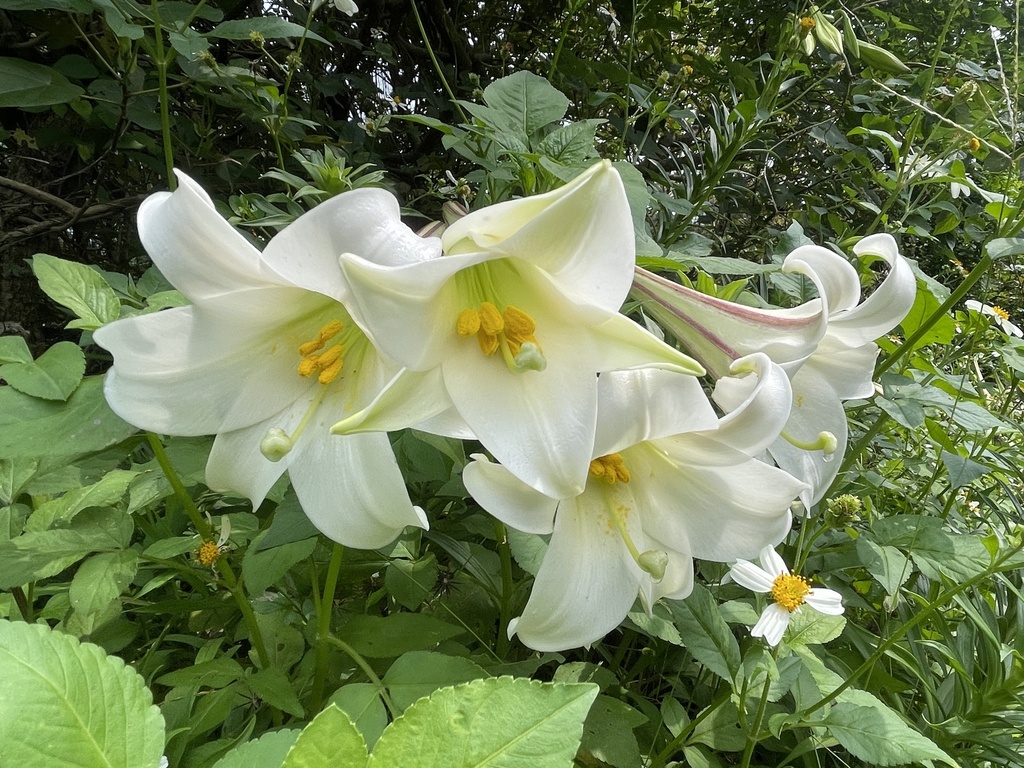
Easter lily
Lilium longiflorum
Lilium longiflorum, often called the Easter lily, is a species of plant endemic to both Taiwan and Ryukyu Islands (Japan). Lilium formosanum, a closely related species from Taiwan, has been treated as a variety of Easter lily in the past. It is a stem rooting lily, growing up to 1 m (3 ft 3 in) high. It bears a number of trumpet-shaped, white, fragrant, and outward-facing flowers. This species, along with most other true lilies, are highly toxic to cats.
From the article Lilium longiflorum on Wikipedia (CC BY-SA), quoted section by section
Toxicity
L. longiflorum is toxic to cats. The true mechanism of toxicity is undetermined, but it involves damage to the renal tubular epithelium (composing the substance of the kidney and secreting, collecting, and conducting urine), which can cause acute kidney injury. Veterinary help should be sought, as a matter of urgency, for any cat that is suspected of eating any part of the lily – including licking pollen that may have brushed onto its coat.
How it is grown
A variety of it, L. longiflorum var. eximium, native to the Ryukyu Islands, is taller and more vigorous. It is extensively cultivated for cut flowers. It has irregular blooming periods in nature, and this is exploited in cultivation, allowing it to be forced for flowering at particular periods, such as Easter. However, it can be induced to flower over a much wider period. This variety is sometimes called the Bermuda lily because it has been much cultivated in Bermuda.
Wikipedia: “Cultivation”
In human culture
Lilium longiflorum is known as the Easter lily because in Christianity, it is a symbol of the resurrection of Christ, which is celebrated during Eastertide. The "lily has always been highly regarded in the Church", as Jesus referenced the flower. Furthermore, "after Jesus' death and resurrection, some of these beautiful flowers were found growing in the Garden of Gethsemane, where Jesus went to pray the night before His crucifixion. Legend has it that these flowers sprung up where drops of Jesus' sweat fell as he prayed". In many Christian churches, the chancel is adorned with Easter lilies throughout the Paschal season.
Wikipedia: “Use in Christian symbolism”
Where it lives
Recorded sightings
—
geo-referenced records in GBIF, from museums, herbaria and field observers.
Drag the globe to turn it. Dots are where records exist, not a range map; darker means more records.
In the stacks
Searching the stacks…
Every page naming Lilium longiflorum in the Biodiversity Heritage Library →
This page is assembled live from iNaturalist, GBIF, Wikipedia, the Source Library and the Internet Archive. It is not yet part of the hand-edited codex. iNaturalist taxon 223669.