- Plants
- ›Vascular Plants
- ›flowering plants
- ›monocots
- ›lilies, supplejacks, and allies
- ›lily family
- ›true lily subfamily
- ›true lilies and allies
- ›Lilium
- ›Pseudolirium
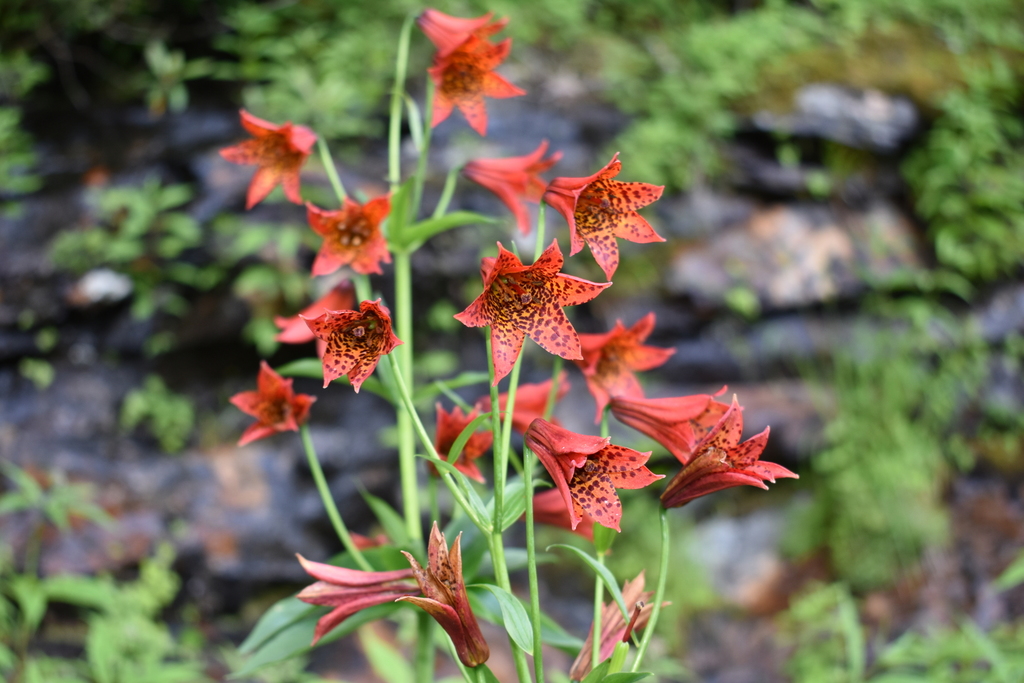
Gray's lily
Lilium grayi
Lilium grayi (Gray's lily, Orange bell lily, Roan lily) is a perennial plant that is endemic to the eastern US states of North Carolina, Virginia, and Tennessee, growing in moist, acid soil in the Appalachian mountains on higher elevation meadows, bogs, and seeps. The plant was introduced to Royal Botanic Gardens, Kew in 1890 and was featured in the Kew Bulletin in 1892.
From the article Lilium grayi on Wikipedia (CC BY-SA), quoted section by section
Description
Lilium grayi reaches 2 to 5 ft (0.61 to 1.52 m) tall. The 2 to 3 in (5.1 to 7.6 cm) leaves are lanceolate to oblong-lanceolate and carried around the stem in whorls. The 2.5 in (6.4 cm) reddish-orange bell-shaped flowers bloom in early summer and are carried on several umbels in a tiered style. Sepals and petals have purple spots. Lilium grayi is closely allied to Lilium canadense, the Canada lily, and was originally thought to be that plant. L. grayi tends to have smaller flowers that are less pendulous, more open at bottom, and more suddenly narrowed at the apex.
Range & habitat
Lilium grayi is native to mountainous regions in only three U.S. states: North Carolina, Virginia, and Tennessee. It grows in sandstone and acidic soils, meadows, open areas near summits, forest meadows, and bluff outcrops. It grows in full sunlight. Habitat is threatened by overgrazing by cattle, European wild boars, and rabbits. Increase of tree canopy also decreases available open habitat. The plant has also been reduced by illegal collecting and is susceptible to fungal infections.
Wikipedia: “Habitat”
Where it lives
Recorded sightings
—
geo-referenced records in GBIF, from museums, herbaria and field observers.
Drag the globe to turn it. Dots are where records exist, not a range map; darker means more records.
In the stacks
Searching the stacks…
Every page naming Lilium grayi in the Biodiversity Heritage Library →
This page is assembled live from iNaturalist, GBIF, Wikipedia, the Source Library and the Internet Archive. It is not yet part of the hand-edited codex. iNaturalist taxon 223667.