- Animals
- ›Chordates
- ›Vertebrates
- ›Amphibians
- ›Frogs and Toads
- ›Australian Ground Frogs
- ›Foam-nesting Ground Frogs
- ›Adelotus
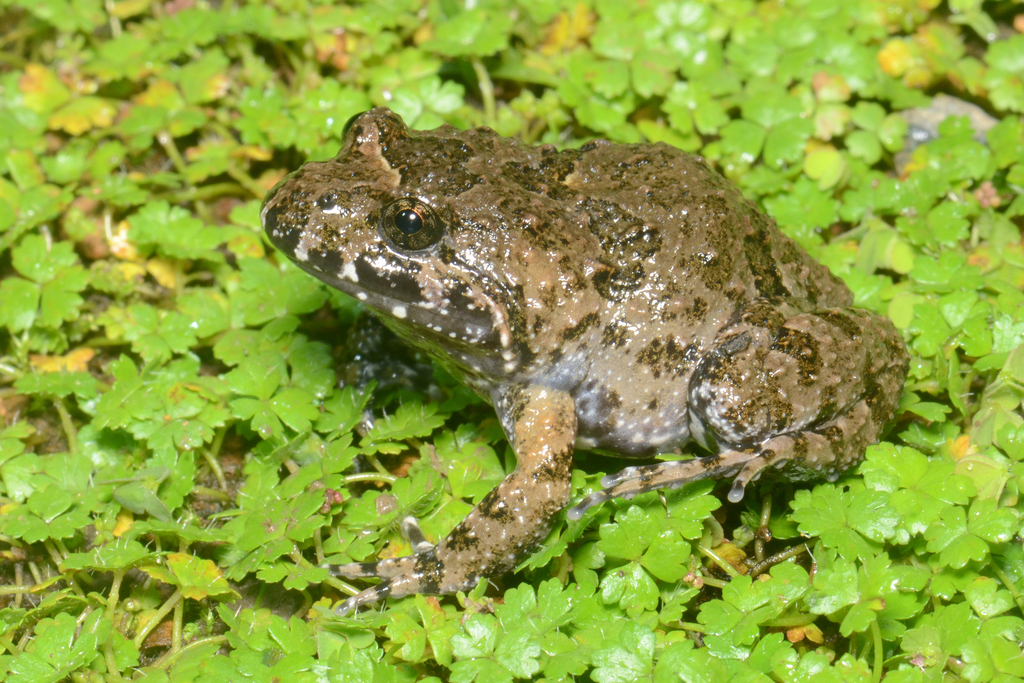
Tusked Frog
Adelotus brevis
The tusked frog (Adelotus brevis) is a species of ground-dwelling frog native to eastern Australia from Eungella National Park, Queensland south to Ourimbah, New South Wales. It is the only species in the Adelotus genus - adelotus meaning "unseen" and brevis meaning "short".
From the article Tusked frog on Wikipedia (CC BY-SA), quoted section by section
Description
The tusked frog is a unique frog within Australia, as it is the only species where the female is smaller than male. Males can reach a maximum length of about 5 centimetres (2.0 in), while females reach 4 centimetres (1.6 in). The common name of "tusked frog" derives from the small protrusions on the lower jaw, similar in position to tusks, which can reach about 5 millimetres (0.20 in) in length in males (only visible when the mouth is open). The pair of bony tusks are modified teeth that protrude from the middle of the lower jaw and fit into special grooves on the upper jaw when the mouth is closed. They are slightly curved and sharply pointed, and are present in both males and females, although they are larger in males. Males have been observed 'locking jaws' with each other, in a similar way to male deer locking antlers in the struggle to exert dominance over each other. Male tusked frogs have a disproportionally large-sized head, compared to the body, and females have a smaller proportioned sized head than males. The males have been known to fight, biting each other under the head, and around the neck. …
What it does
A. brevis is associated with dams, ditches, flooded grassland and creeks in rainforest, wet sclerophyll forest and woodland. It is known from coastal and highland areas, however it has suffered declines in many highland areas, particularly the New England Tablelands of New South Wales. Males create hidden nest sites in leaf litter and vegetation in streams and the edges of dams. This species has a call like "tok-tok", males call from the nest site and can be difficult to find. Breeding takes place in spring and summer and eggs are laid as a foamy mass in the nest, hidden from sunlight. The eggs are white in colour and lack pigment. In the breeding season (October - December), males build nests out of foam hidden from direct sunlight in ponds and swamps. Over 600 eggs may be laid in each floating mass of foam, and are guarded by the male until they hatch into tadpoles. The tadpoles grow over a period of two to three months to around 3 to 3.5 cm, when they undergo metamorphosis into 'mini adult' froglets.
Wikipedia: “Ecology and behaviour”
Listen
Looking for field recordings…
Where it lives
Recorded sightings
—
geo-referenced records in GBIF, from museums, herbaria and field observers.
Drag the globe to turn it. Dots are where records exist, not a range map; darker means more records.
In the stacks
Searching the stacks…
Every page naming Adelotus brevis in the Biodiversity Heritage Library →
This page is assembled live from iNaturalist, GBIF, Wikipedia, the Source Library and the Internet Archive. It is not yet part of the hand-edited codex. iNaturalist taxon 22084.