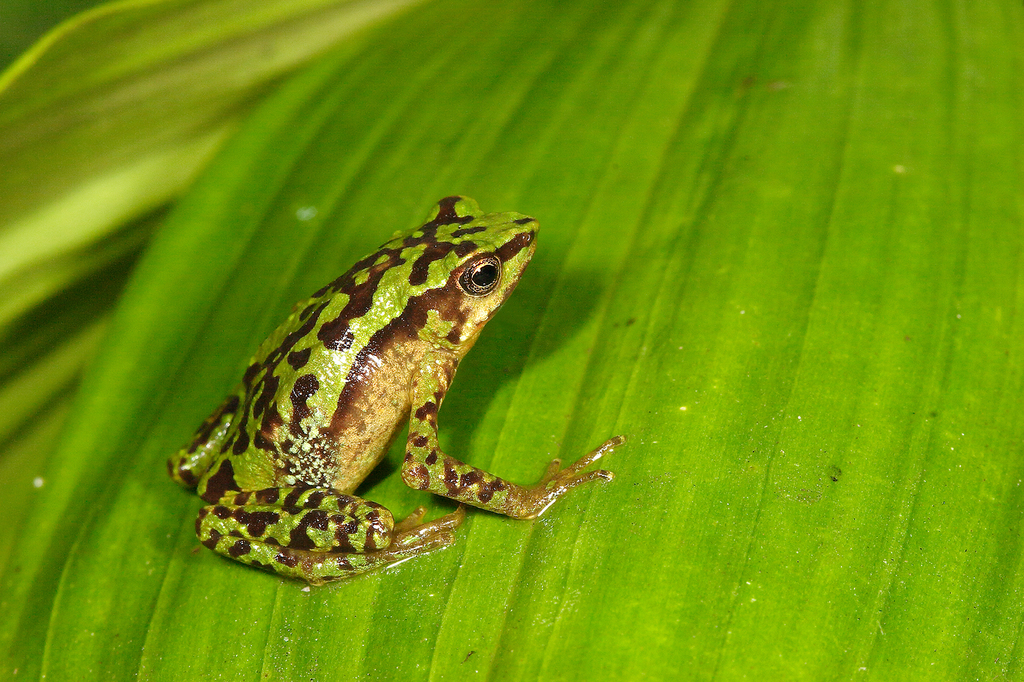
Andersson's stubfoot toad
Atelopus palmatus
Atelopus palmatus (common name: Andersson's stubfoot toad) is a species of toad in the family Bufonidae. It is endemic to the Cordillera Oriental of eastern Ecuador and is known from the Napo and Pastaza Provinces at elevations of 1,150–1,740 m (3,770–5,710 ft) above sea level. Its type locality is "Rio Pastaza".
From the article Atelopus palmatus on Wikipedia (CC BY-SA), quoted section by section
Description
Males measure 20–21 mm (0.79–0.83 in) and females 28–31 mm (1.1–1.2 in) in snout–vent length.
Range & habitat
Its natural habitats are humid montane forests. It is a diurnal species. Males have been observed during the night on dry leaves by a marsh, and during the day between rocks and sand by water. A female has been observed during the day in flooded leaf litter on a swamp. Gravid females carrying about 80 eggs have been found between March and July. It is most threatened by the fungal infectious disease chytridiomycosis which causes dramatic decline and affects other species of its genus. Other threats include habitat loss through agriculture (both crops and livestock), logging, planned mining and wood plantations.
== References ==
Wikipedia: “Habitat and conservation”
Listen
Looking for field recordings…
Where it lives
Recorded sightings
—
geo-referenced records in GBIF, from museums, herbaria and field observers.
Drag the globe to turn it. Dots are where records exist, not a range map; darker means more records.
In the stacks
Searching the stacks…
Every page naming Atelopus palmatus in the Biodiversity Heritage Library →
This page is assembled live from iNaturalist, GBIF, Wikipedia, the Source Library and the Internet Archive. It is not yet part of the hand-edited codex. iNaturalist taxon 21700.