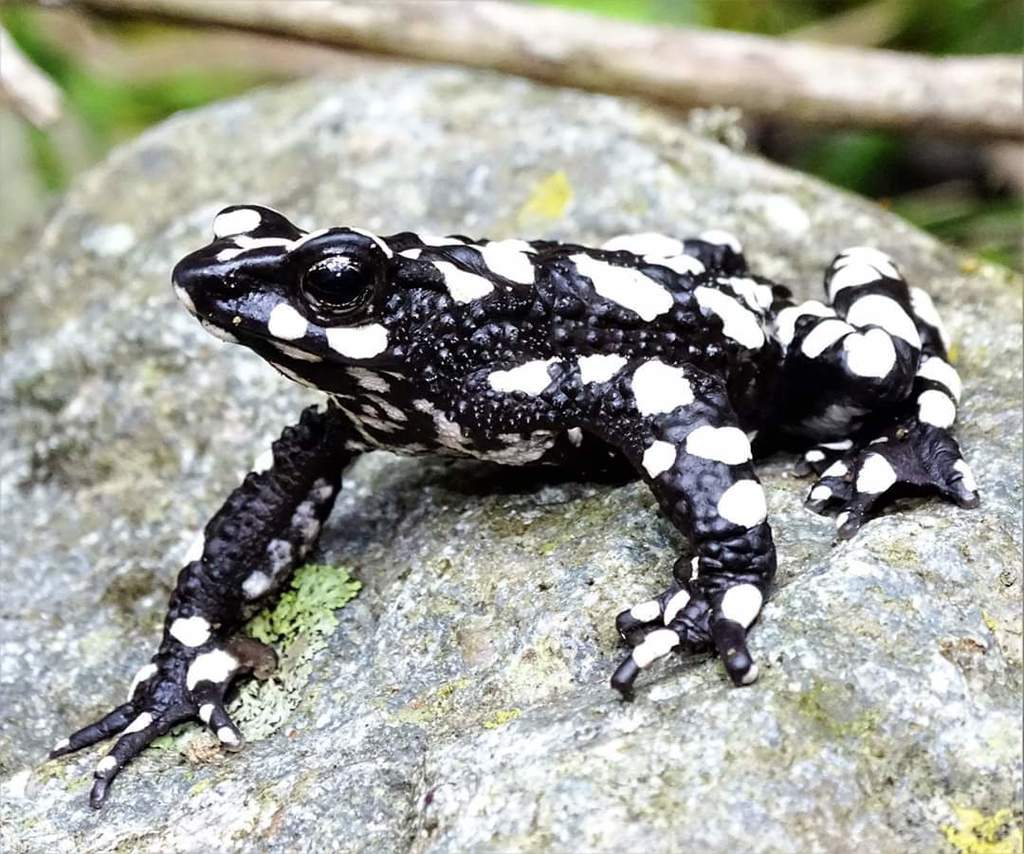
Starry Night Harlequin Toad
Atelopus arsyecue
The starry night harlequin toad (Atelopus arsyecue) is a species of toad in the family Bufonidae endemic to the Sierra Nevada de Santa Marta, Colombia. Its natural habitats are sub-Andean and Andean forests, sub-páramo and páramo at 2,000–3,500 m (6,600–11,500 ft) above sea level. It is named after its unique coloration, being largely black with white spots.
Atelopus arsyecue is primarily threatened by habitat loss, with assumptions on decline by chytridiomycosis. Coupled with the inaccessibility of the preservation that the toad calls home, the species was feared extinct for over 30 years. However, its continued existence was known to the Arhuaco community in Sogrome, who referred to the animal as gouna and considered its habitat a sacred location. In 2019, the tribe consented to collaboration with researchers and showed them the living population, marking the first scientific documentation of this species in over 30 years.
From the article Starry night toad on Wikipedia (CC BY-SA), quoted section by section
Description
This diminutive toad is less than 5 cm (2 in) in length. The starry night toad's coloration consists of irregular white patches dappled across a black background. The white markings can present as separate spots or as an interconnected mosaic. Their skin texture is defined by even coverage of warts.
Wikipedia: “Anatomy and morphology”
Range & habitat
Starry night harlequin toads seek habitat consisting of montane forest, high-altitude grasslands, and inland wetlands. As documented, the toad only occurs in a single defined location. Its range is specifically limited to the Sierra Nevada de Santa Marta National Park of Colombia, with an estimated extent of occurrence of 80 km² across the mountains. A. arsyecue seems to be exclusive to the sacred homelands of the Arhuaco people living in the Sogrome community. This area is primarily cloud forest with plentiful water resources as fed by high volumes of rainfall- which, consequently, has made the region ideal for agriculture. The toad is heavily reliant upon the integrity of the stream network running through the mountain range, both for its regular habitation and reproduction. Reproduction takes place in fast-flowing rivers, where chains of eggs are laid post-amplexus.
Wikipedia: “Distribution and habitat”
Listen
Looking for field recordings…
Where it lives
Recorded sightings
—
geo-referenced records in GBIF, from museums, herbaria and field observers.
Drag the globe to turn it. Dots are where records exist, not a range map; darker means more records.
In the stacks
Searching the stacks…
Every page naming Atelopus arsyecue in the Biodiversity Heritage Library →
This page is assembled live from iNaturalist, GBIF, Wikipedia, the Source Library and the Internet Archive. It is not yet part of the hand-edited codex. iNaturalist taxon 21674.