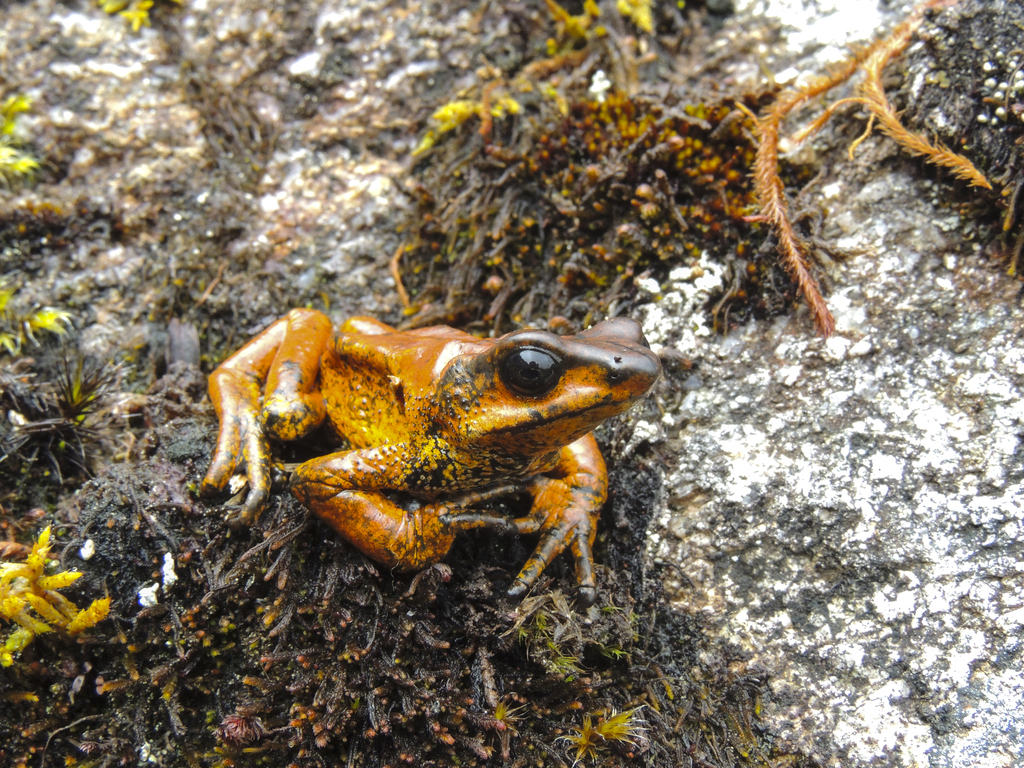
Guajira Stubfoot Toad
Atelopus carrikeri
The Guajira stubfoot toad or Carrikeri harlequin frog (Atelopus carrikeri) is a species of toad in the family Bufonidae. It is about 5 cm (2.0 in) long and typically black, though some populations have orange coloration. This species is endemic to the Sierra Nevada de Santa Marta mountain range of northern Colombia. It is critically endangered because of the chytrid fungus, Batrachochytrium dendrobatidis, and habitat destruction due to agriculture. The species had not been seen from 1994 until it was rediscovered in early 2008.
From the article Guajira stubfoot toad on Wikipedia (CC BY-SA), quoted section by section
Description
The frog is about 5.0 cm long. It has at least two color phases, with the rarer orange population being the one recently rediscovered. However, the frog is typically all black, although it is a slightly lighter shade on its belly. In adults, the skin is smooth except for a patch of spiny warts on the side. The area that these warts cover varies, with some specimens displaying them from their eyes to their arms and others displaying it from their eyes to their femurs. One specimen even had the warts covering the entire body. The Guajira stubfoot toad has short legs with rounded fingers and toes. While its fingers are unwebbed, its toes are broadly webbed, though its first toe is distinct. Its head is as broad as it is long.
Range & habitat
It is endemic to about 627 km2 (242.1 sq mi) in northern Colombia. Its natural habitats are sub-Andean and Andean cloud forests, and páramo. In addition, it is known to survive in snow-covered areas. It is found at elevations between 2,350 and 4,800 m. It can tolerate some habitat modification, but habitat loss caused by agriculture remains a threat.
Wikipedia: “Distribution and habitat”
What it does
This species lays its eggs in chains in freshwater mountain streams, where its tadpoles develop.
Wikipedia: “Ecology”
Listen
Looking for field recordings…
Where it lives
Recorded sightings
—
geo-referenced records in GBIF, from museums, herbaria and field observers.
Drag the globe to turn it. Dots are where records exist, not a range map; darker means more records.
In the stacks
Searching the stacks…
Every page naming Atelopus carrikeri in the Biodiversity Heritage Library →
This page is assembled live from iNaturalist, GBIF, Wikipedia, the Source Library and the Internet Archive. It is not yet part of the hand-edited codex. iNaturalist taxon 21669.