- Plants
- ›Vascular Plants
- ›flowering plants
- ›Dicots
- ›carrots, ivies, and allies
- ›cheesewood family
- ›Cheiranthera
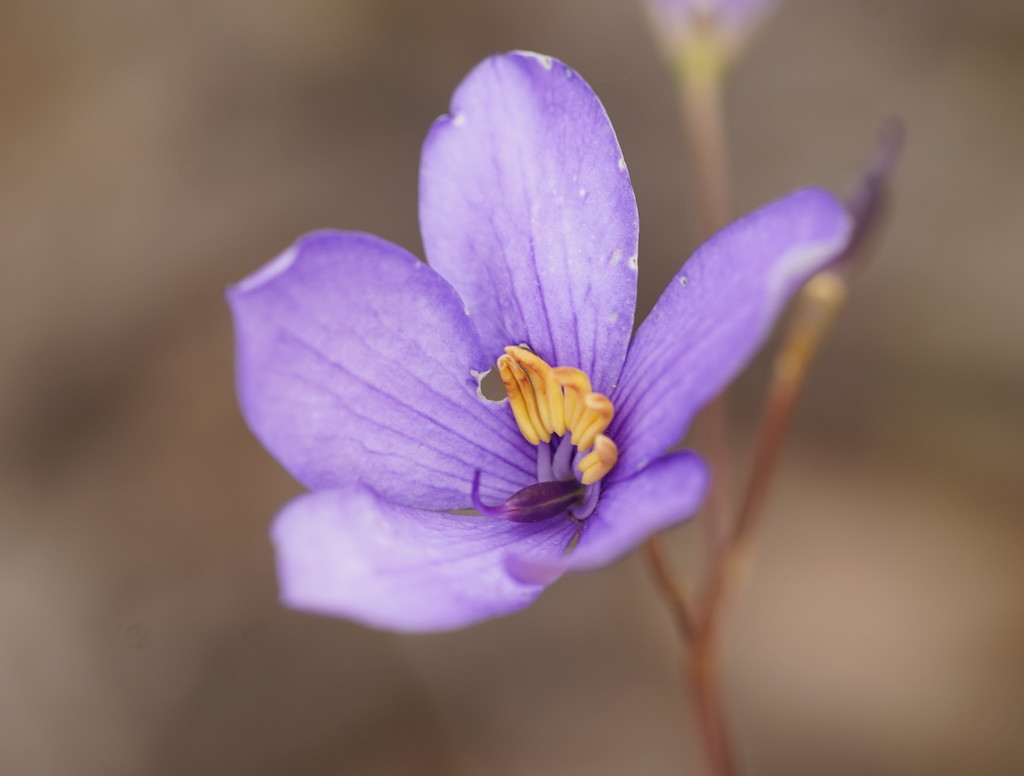
finger flower
Cheiranthera linearis
Cheiranthera linearis, commonly known as finger-flower, is a flowering plant in the family Pittosporaceae. It is a small shrub with deep purple flowers, yellow stamens and dull green linear shaped leaves. It is found growing in New South Wales, Victoria and Queensland.
From the article Cheiranthera linearis on Wikipedia (CC BY-SA), quoted section by section
Description
Cheiranthera linearis is a small upright shrub to 50 cm (20 in) with smooth stems. The leaves are sessile, arranged alternately, more or less clustered on the stem, leaf blade mostly linear, 2–5 cm (0.79–1.97 in) long, 2–4 cm (0.79–1.57 in) wide, edges curved under, smooth, toothed or with lobes about 3 mm (0.12 in) long. The flowers may be single or in clusters of 2–5 on a short upright stems and 5 yellow stamens. The flower petals are egg-shaped, 15–20 mm (0.59–0.79 in) long and a blue to deep purple. The fruit capsules are more or less oblong to egg-shaped, 12–18 mm (0.47–0.71 in) long and flattened. Flowering occurs in summer and autumn.
Range & habitat
Finger-flower is a widespread species found growing in woodland and forests on rocky or sandy locations in Queensland, New South Wales and Victoria.
== References ==
Wikipedia: “Distribution and habitat”
Where it lives
Recorded sightings
—
geo-referenced records in GBIF, from museums, herbaria and field observers.
Drag the globe to turn it. Dots are where records exist, not a range map; darker means more records.
In the stacks
Searching the stacks…
Every page naming Cheiranthera linearis in the Biodiversity Heritage Library →
This page is assembled live from iNaturalist, GBIF, Wikipedia, the Source Library and the Internet Archive. It is not yet part of the hand-edited codex. iNaturalist taxon 210433.