- Plants
- ›Vascular Plants
- ›flowering plants
- ›Dicots
- ›Nances, Willows, and Allies
- ›willow family
- ›Salix
- ›Protitea
- ›Humboldtianae
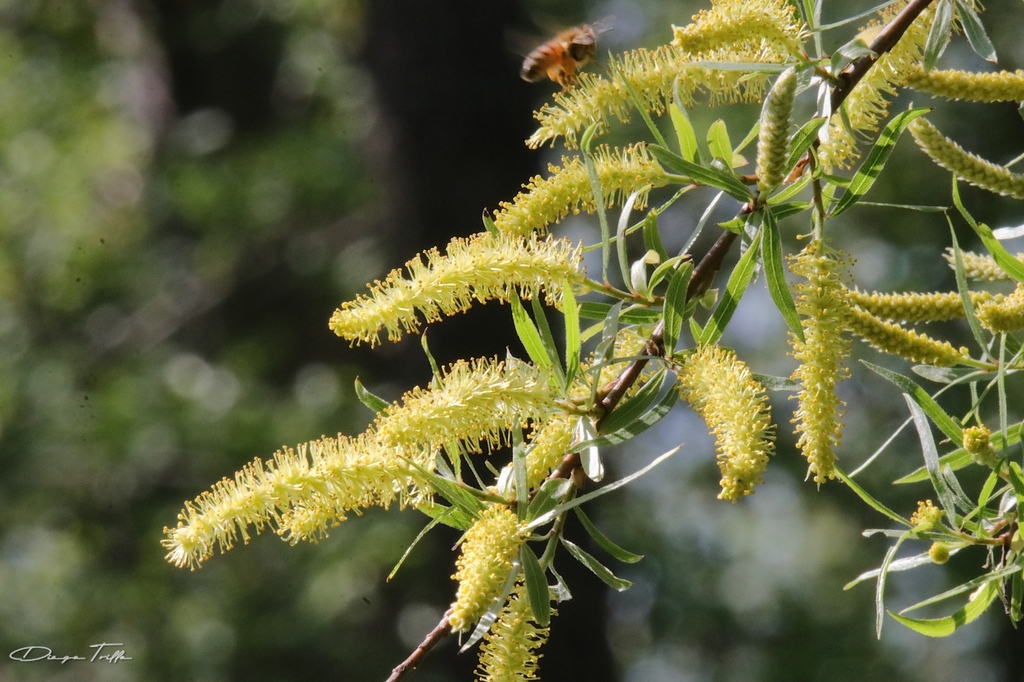
Humboldt's Willow
Salix humboldtiana
Salix humboldtiana, called Humboldt's willow, is a tree species of willow native to North and South America, growing along watercourses. Some authorities consider it a synonym of Salix chilensis, which Molina described in 1782. Willdenow described Salix humboldtiana in 1805.
From the article Salix humboldtiana on Wikipedia (CC BY-SA), quoted section by section
Description
The species is evergreen or deciduous, depending on climate. It can grow up to 25 meters tall, with a narrow triangular or columnar crown shape. The trunk has a maximum d.b.h. of 80 cm and dark brown to gray fissured bark. Other characteristics are: narrow lanceolate leaves up to 15 cm long, with serrate margin and light green color, that in temperate climates, turn yellow in autumn; catkins 4–10 cm long; male flowers yellowish green, with an ovate-lanceolate bract, six stamens; and female flowers green.
Range & habitat
The natural range of Salix humboldtiana spans from central Mexico to southern Chile and Argentina, growing in areas with tropical, subtropical and temperate climate between near sea level to 3,300 metres (10,800 ft) of elevation.
== References ==
Wikipedia: “Distribution and habitat”
Where it lives
Recorded sightings
—
geo-referenced records in GBIF, from museums, herbaria and field observers.
Drag the globe to turn it. Dots are where records exist, not a range map; darker means more records.
In the stacks
Searching the stacks…
Every page naming Salix humboldtiana in the Biodiversity Heritage Library →
This page is assembled live from iNaturalist, GBIF, Wikipedia, the Source Library and the Internet Archive. It is not yet part of the hand-edited codex. iNaturalist taxon 209991.