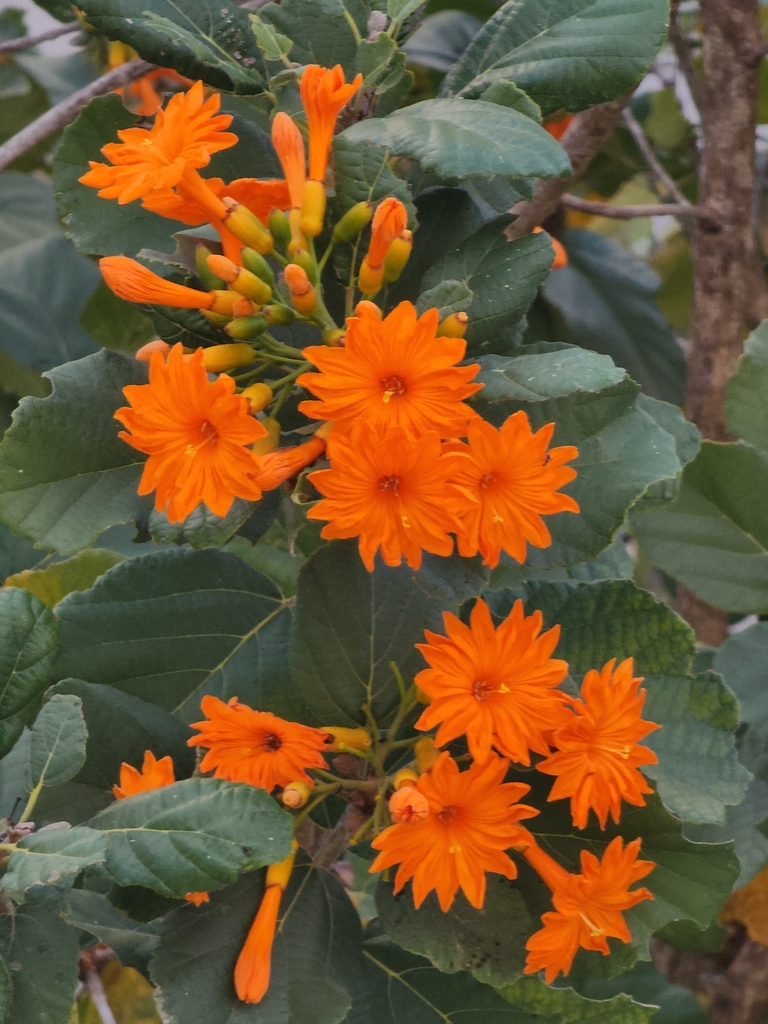
ziricote
Cordia dodecandra
Cordia dodecandra (common name: ziricote) is a small tree in the family Cordiaceae native to southern Mexico, Central America, and the Caribbean.
From the article Cordia dodecandra on Wikipedia (CC BY-SA), quoted section by section
Description
Cordia dodecandra grows to a maximum height of 7.5–9 m (25–30 ft) at maturity. Flowers are produced in clusters at branch ends from February to May. Each flower is 50 mm (2 in) wide, bright orange in color, tubular, flaring (salverform) with 11–18 lobes, bearing 13–18 stamens that are not equal in length. Short stamens are intercalated between long ones, resulting in two levels of stamens. The species is heterostylous and has been shown to be self-incompatible. White fruits follow the flowers, averaging 50 mm (2 in) in length. The fruits are locally made into sweets which are traditionally used to celebrate Day of the Dead.
At the table
Ziricote wood is dark brown in color and has a Janka hardness of 8.8 kN (1,970 lbf). It is used for furniture, veneer, cabinetry, flooring, gun stocks, musical instruments (including guitars and ukuleles), entrance doors, turnings, decorative beams, trim, and small specialty items.
Wikipedia: “Uses”
Where it lives
Recorded sightings
—
geo-referenced records in GBIF, from museums, herbaria and field observers.
Drag the globe to turn it. Dots are where records exist, not a range map; darker means more records.
In the stacks
Searching the stacks…
Every page naming Cordia dodecandra in the Biodiversity Heritage Library →
This page is assembled live from iNaturalist, GBIF, Wikipedia, the Source Library and the Internet Archive. It is not yet part of the hand-edited codex. iNaturalist taxon 209898.