- Animals
- ›Chordates
- ›Vertebrates
- ›Mammals
- ›Therians
- ›Placental Mammals
- ›Ungulates, Carnivorans, and Allies
- ›Odd-toed Ungulates
- ›Equines
- ›Equus
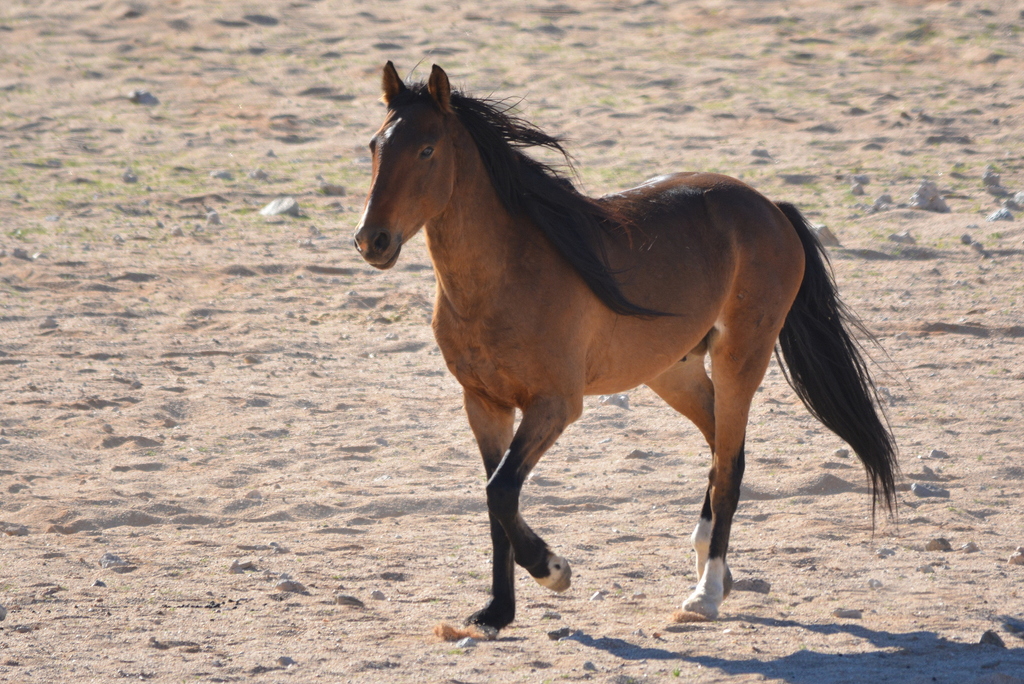
Domestic Horse
Equus caballus
The horse (Equus ferus caballus) is a domesticated, one-toed, hoofed mammal. It belongs to the taxonomic family Equidae and is one of two extant subspecies of Equus ferus. The horse has evolved over the past 45 to 55 million years from a small multi-toed creature, Eohippus, into the large single-toed animal of today, originally in North America. Humans began domesticating horses around 4000 BCE in Central Asia, primarily associated with the Botai culture; their domestication is believed to have been widespread by 3000 BCE. However, contemporary genetic evidence indicates that modern domesticated breeds do not descend from this lineage, instead pointing to the Western Eurasian steppes in the lower Volga-Don region as the homeland of modern domestic horses. The modern horse breed replaced the local populations through their rapid expansion across Eurasia from 2000 BCE. Horses in the subspecies caballus are domesticated, although some domesticated populations live in the wild as feral horses. These feral populations are not true wild horses, which are horses that have never been domesticated. There is an extensive, specialized vocabulary used to describe equine-related concepts, covering everything from anatomy to life stages, size, colors, markings, breeds, locomotion, and behavior.
Horses are adapted to run, allowing them to quickly escape predators, and possess a good sense of balance and a strong fight-or-flight response.
From the article Horse on Wikipedia (CC BY-SA), quoted section by section
What it does
Gestation lasts approximately 340 days, with an average range 320–370 days, and usually results in one foal; twins are rare. Horses are a precocial species, and foals are capable of standing and running within a short time following birth. Foals are usually born in the spring. The estrous cycle of a mare occurs roughly every 19–22 days and occurs from early spring into autumn. Most mares enter an anestrus period during the winter and thus do not cycle in this period. Foals are generally weaned from their mothers between four and six months of age. Horses, particularly colts, are sometimes physically capable of reproduction at about 18 months, but domesticated horses are rarely allowed to breed before the age of three, especially females. Horses four years old are considered mature, although the skeleton normally continues to develop until the age of six; maturation also depends on the horse's size, breed, sex, and quality of care. Larger horses have larger bones; therefore, not only do the bones take longer to form bone tissue, but the epiphyseal plates are larger and take longer to convert from cartilage to bone. These plates convert after the other parts of the bones, and are crucial to development. Depending on maturity, breed, and work expected, horses are usually put under saddle and trained to be ridden between the ages of two and four. …
Wikipedia: “Reproduction and development”
In medicine
People of all ages with physical and mental disabilities obtain beneficial results from an association with horses. Therapeutic riding is used to mentally and physically stimulate disabled persons and help them improve their lives through improved balance and coordination, increased self-confidence, and a greater feeling of freedom and independence. The benefits of equestrian activity for people with disabilities has also been recognized with the addition of equestrian events to the Paralympic Games and recognition of para-equestrian events by the International Federation for Equestrian Sports (FEI). Hippotherapy and therapeutic horseback riding are names for different physical, occupational, and speech therapy treatment strategies that use equine movement. In hippotherapy, a therapist uses the horse's movement to improve their patient's cognitive, coordination, balance, and fine motor skills, whereas therapeutic horseback riding uses specific riding skills. Horses also provide psychological benefits to people whether they actually ride or not. "Equine-assisted" or "equine-facilitated" therapy is a form of experiential psychotherapy that uses horses as companion animals to assist people with mental illness, including anxiety disorders, psychotic disorders, mood disorders, behavioral difficulties, and those who are going through major life changes. …
Wikipedia: “Therapeutic use”
In human culture
Domestication of the horse most likely took place in central Asia prior to 3500 BCE. Two major sources of information are used to determine where and when the horse was first domesticated and how the domesticated horse spread around the world. The first source is based on palaeological and archaeological discoveries; the second source is a comparison of DNA obtained from modern horses to that from bones and teeth of ancient horse remains. The earliest archaeological evidence for attempted domestication of the horse comes from sites in the Western Eurasian Steppes, particularly the lower Volga-Don region, dating to approximately 4000–3500 BCE. However the horses domesticated at the Botai culture in Kazakhstan were Przewalski's horses and not the ancestors of modern horses. By 3000 BCE, the horse was completely domesticated, and by 2000 BCE, there was a sharp increase in the number of horse bones found in human settlements in northwestern Europe, indicating the spread of domesticated horses throughout the continent. The most recent, but most irrefutable evidence of domestication comes from sites where horse remains were interred with chariots in graves of the Indo-European Sintashta and Petrovka cultures c. 2100 BCE. The genetic makeup of modern domesticated horses all carry the DOM2 gene, which first emerged in West Eurasia towards the end of the 3rd millennium BCE. …
Wikipedia: “Domestication and history”
Listen
Looking for field recordings…
Where it lives
Recorded sightings
—
geo-referenced records in GBIF, from museums, herbaria and field observers.
Drag the globe to turn it. Dots are where records exist, not a range map; darker means more records.
In the stacks
Searching the stacks…
Every page naming Equus caballus in the Biodiversity Heritage Library →
This page is assembled live from iNaturalist, GBIF, Wikipedia, the Source Library and the Internet Archive. It is not yet part of the hand-edited codex. iNaturalist taxon 209233.