- Plants
- ›Vascular Plants
- ›flowering plants
- ›Dicots
- ›Heathers, Balsams, Primroses, and Allies
- ›ocotillo family
- ›Fouquieria
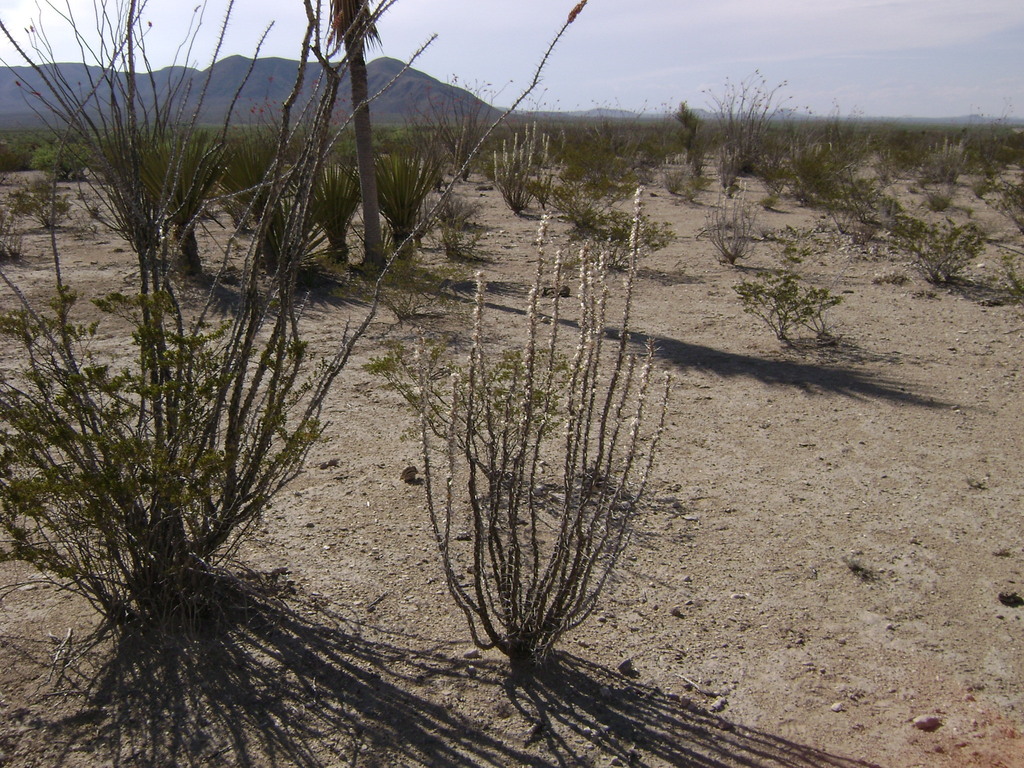
Fouquieria shrevei
Fouquieria shrevei is a plant species native to the States of Coahuila and Durango states of northeastern Mexico. It is simply referred to as an ocotillo. It is endemic to some scattered gypsum outcroppings in the Bolsón de Mapimí, where the low rainfall, hot climate and gypseous soil work to create a restrictive environment. It has flowers with short, white corollas that distinguish it from the nearby Fouquieria splendens.
From the article Fouquieria shrevei on Wikipedia (CC BY-SA), quoted section by section
Description
Fouquieria shrevei is a shrub up to 3 m (9.8 ft) tall, branching repeatedly near the base but hardly at all above. Leaves are ovate to oblanceolate, up to 3 cm (1 in) long and 2.5 cm (0.98 in) wide, with scarious (thin, dry and brown) margins. Flowers are white, born in short racemes in the axils of the leaves. The board leaves plus the axillary racemes of white flowers make this a distinctive and unusual member of the genus.
Etymology. Because this species occurs sympatric with Fouquieria splendens, the plant is not distinguished and is simply referred to as an "ocotillo" by the local people. The specific epithet is named after Forrest Shreve, a desert ecologist who accompanied I. M. Johnston when he discovered the species.
Range & habitat
It can be found in the Cuatro Ciénegas Basin in Coahuila, approximately 50 km (about 31 miles) west of Monclova, at an elevation of about 740 meters (2,430 feet). There are several natural springs in the region, allowing an estimated 150 species of endemic plants and animals to survive in this desert oasis. The species has also been reported from other sites in the same state plus one locale in the neighboring State of Durango.
Wikipedia: “Distribution and habitat”
Where it lives
Recorded sightings
—
geo-referenced records in GBIF, from museums, herbaria and field observers.
Drag the globe to turn it. Dots are where records exist, not a range map; darker means more records.
In the stacks
Searching the stacks…
Every page naming Fouquieria shrevei in the Biodiversity Heritage Library →
This page is assembled live from iNaturalist, GBIF, Wikipedia, the Source Library and the Internet Archive. It is not yet part of the hand-edited codex. iNaturalist taxon 207343.