- Plants
- ›Vascular Plants
- ›flowering plants
- ›monocots
- ›Aroids, Water Plantains, Seagrass, and allies
- ›Arum Family
- ›Aroideae
- ›Spathicarpeae
- ›Dieffenbachia
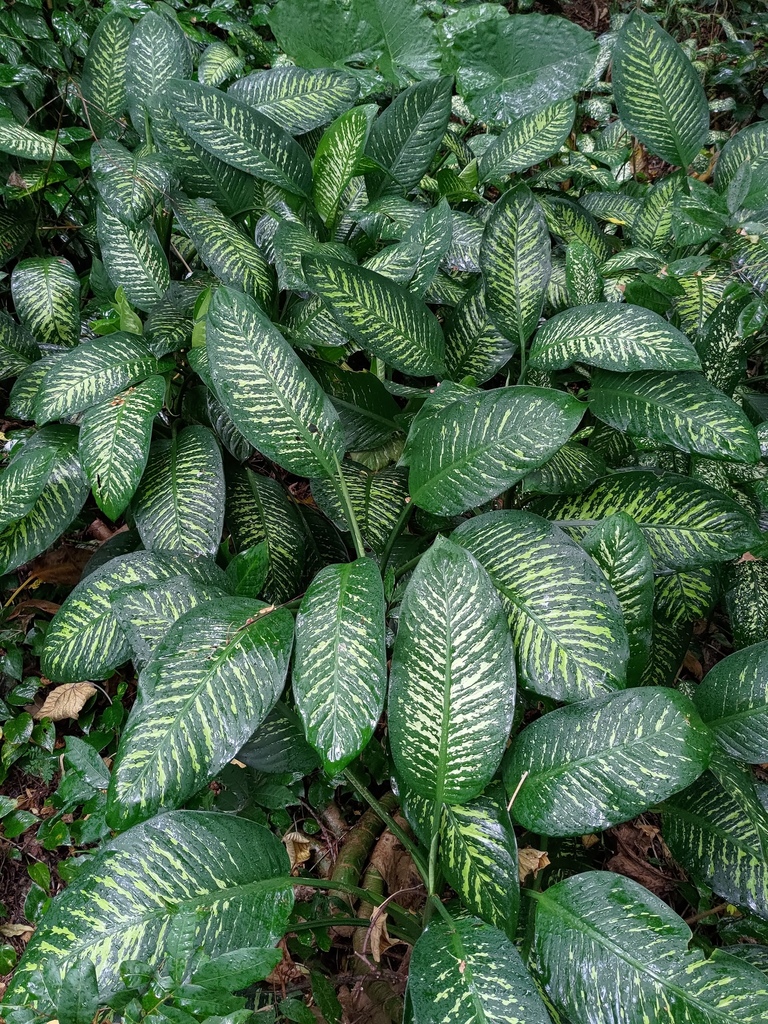
tuftroot
Dieffenbachia seguine
Dieffenbachia seguine, widely known as dumbcane, as well as leopard lily or tuftroot, is a species of Dieffenbachia, a flowering aroid plant of the family Araceae (the arums). It is native to the neotropical realm of the Americas, from extreme southern Mexico and Belize and much of Central America, as well as the northern half of South America (it is typically absent in Argentina, Chile, Paraguay and Uruguay). It is found on many Caribbean islands and territories, including Cuba, Grand Bahama, Grenada, Guadeloupe, Hispaniola, Îles des Saintes, Jamaica, Martinique, Puerto Rico, Saba, Saint Kitts and Trinidad and Tobago. D. seguine is also found on the Galápagos islands of Santa Cruz and San Cristóbal, where it was likely introduced by humans.
From the article Dieffenbachia seguine on Wikipedia (CC BY-SA), quoted section by section
Description
Within the aroid family—which contains other iconic genera such as Alocasia, Monstera and Philodendron—Dieffenbachia seguine and its relatives, interestingly, do not grow as a vine or from a tuber, instead growing vertically into a "bamboo"- or "cane"-like shrub (hence the common name dumbcane). Smaller or juvenile plants may only grow to 3 feet (0.91 m) tall, while mature specimens can attain heights of up to 10 feet (3.0 m), and 2 feet (0.61 m) to 3 feet (0.91 m) in trunk width. The plant's leaves are large and green, often with variegated white patterns. Like the entire Araceae family, and indeed all Dieffenbachias, the sap is toxic; the entire plant contains a high concentration of calcium oxalate crystals which may produce negative side effects if ingested, potentially ranging from anaphylactic shock and respiratory failure to even death. The plant produces the typical whitish inflorescence seen amongst aroids, visually-similar to those found on the common 'calla lily' (Zantedeschia aethiopica) or the 'peace lily' (Spathiphyllum wallisii), distinguished by a whitish bract (spathe) containing an inner spadix.
How it is grown
Dieffenbachia seguine is cultivated as an ornamental plant in temperate shade gardens and as a potted house plant. Cultivars emphasize different patterns of variegation.
Wikipedia: “Cultivation”
Where it lives
Recorded sightings
—
geo-referenced records in GBIF, from museums, herbaria and field observers.
Drag the globe to turn it. Dots are where records exist, not a range map; darker means more records.
In the stacks
Searching the stacks…
Every page naming Dieffenbachia seguine in the Biodiversity Heritage Library →
This page is assembled live from iNaturalist, GBIF, Wikipedia, the Source Library and the Internet Archive. It is not yet part of the hand-edited codex. iNaturalist taxon 206266.