- Plants
- ›Vascular Plants
- ›flowering plants
- ›monocots
- ›palms, bullanocks, and allies
- ›palms
- ›Coryphoideae
- ›Phoeniceae
- ›Phoenix
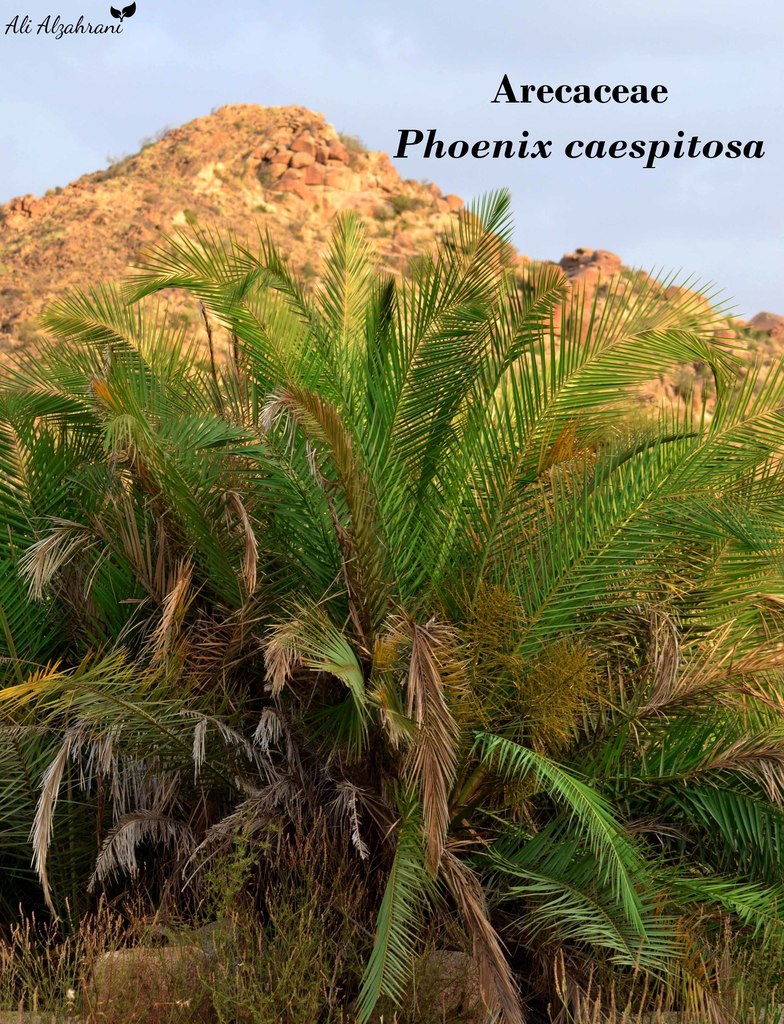
Phoenix caespitosa
Phoenix caespitosa (caespitosa - Latin, clumped or tufted) is a species of flowering plant in the palm family native to the Arabian Peninsula and the deserts of Somalia. This species grows in large clumps near oases or underground springs. The trunks are short, often subterranean, in readily clumping clusters with 3 m leaves divided into 15 to 45 cm, bluish-green leaflets.
From the article Phoenix caespitosa on Wikipedia (CC BY-SA), quoted section by section
Description
Phoenix caespitosa is a stemless dwarf palm that often grows in clusters. The stiff, hairless leaves grow to 3 m (9.8 ft) long. The inflorescences measure around 40 cm (16 in) long. Fruits are spherical to egg-shaped, orange to purplish-brown in colour, and measure 10–16 mm (0.39–0.63 in) by 8–12 mm (0.31–0.47 in).
== References ==
Range & habitat
Phoenix caespitosa can be found in Djibouti, Somalia, Saudi Arabia, and Yemen, where it grows in dry wadis, semi-desert bushland, rocky crevices, and ravines. In Somalia it occurs at elevations as high as 900 m (3,000 ft) above sea level, and it may occur at elevations as high as 1,950 m (6,400 ft) in Saudi Arabia. In Yemen it is widespread, though scattered, across the escarpment at elevations between 400–1,200 m (1,300–3,900 ft) above sea level. It may be locally abundant in marshes, valleys, and alongside streams in dry areas.
Wikipedia: “Distribution and habitat”
Where it lives
Recorded sightings
—
geo-referenced records in GBIF, from museums, herbaria and field observers.
Drag the globe to turn it. Dots are where records exist, not a range map; darker means more records.
In the stacks
Searching the stacks…
Every page naming Phoenix caespitosa in the Biodiversity Heritage Library →
This page is assembled live from iNaturalist, GBIF, Wikipedia, the Source Library and the Internet Archive. It is not yet part of the hand-edited codex. iNaturalist taxon 205332.