- Plants
- ›Vascular Plants
- ›flowering plants
- ›monocots
- ›Agaves, Orchids, Irises, and Allies
- ›Orchids
- ›Orchidoid Orchids
- ›Diurideae
- ›Diuridinae
- ›Diuris
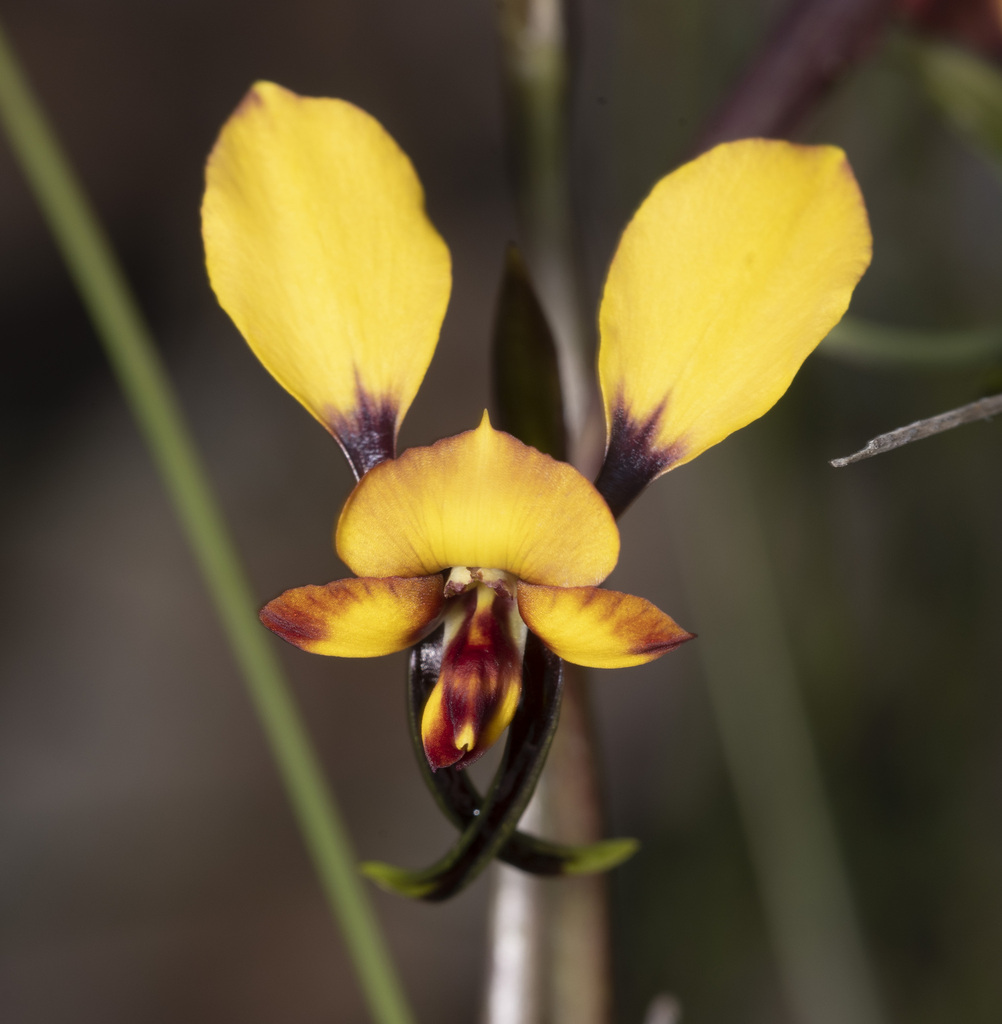
Common Donkey Orchid
Diuris corymbosa
Diuris corymbosa, commonly called common donkey orchid or wallflower orchid, is a species of orchid which is endemic to the south-west of Western Australia. It is similar to the purple pansy orchid (Diuris longifolia), but its flowers are yellow rather than purple or mauve, and it flowers earlier in the year. It also resembles the winter donkey orchid (Diuris brumalis) but flowers later than that species. It is one of the most common orchid species in the Perth area, often forming extensive colonies and usually having numerous flowers on the one spike.
From the article Diuris corymbosa on Wikipedia (CC BY-SA), quoted section by section
Description
Diuris corymbosa is a tuberous, perennial herb, usually growing to a height of 20–40 cm (8–20 in) with two or three leaves emerging at the base, 120–250 mm (5–10 in) long and 5–10 mm (0.2–0.4 in) wide. There are up to eight yellow flowers with purple and brown blotches, 20 mm (0.8 in) long and 20–30 mm (0.8–1 in) wide. The flowers have long, wide donkey ear-like petals, a short, wide erect dorsal sepal and narrow, hanging, sometimes crossed lateral sepals. The labellum has three lobes, the lateral ones broad and spreading and the middle lobe short, inverted V-shaped or flattened. Flowering occurs from September, sometimes August, to October.
Range & habitat
The Common donkey orchid occurs between Dongara and Albany where it grows in woodland, often on the margins of swamps.
Wikipedia: “Distribution and habitat”
Where it lives
Recorded sightings
—
geo-referenced records in GBIF, from museums, herbaria and field observers.
Drag the globe to turn it. Dots are where records exist, not a range map; darker means more records.
In the stacks
Searching the stacks…
Every page naming Diuris corymbosa in the Biodiversity Heritage Library →
This page is assembled live from iNaturalist, GBIF, Wikipedia, the Source Library and the Internet Archive. It is not yet part of the hand-edited codex. iNaturalist taxon 205091.