- Plants
- ›Vascular Plants
- ›flowering plants
- ›monocots
- ›Agaves, Orchids, Irises, and Allies
- ›agave and allies
- ›Century plant subfamily
- ›Anthericum
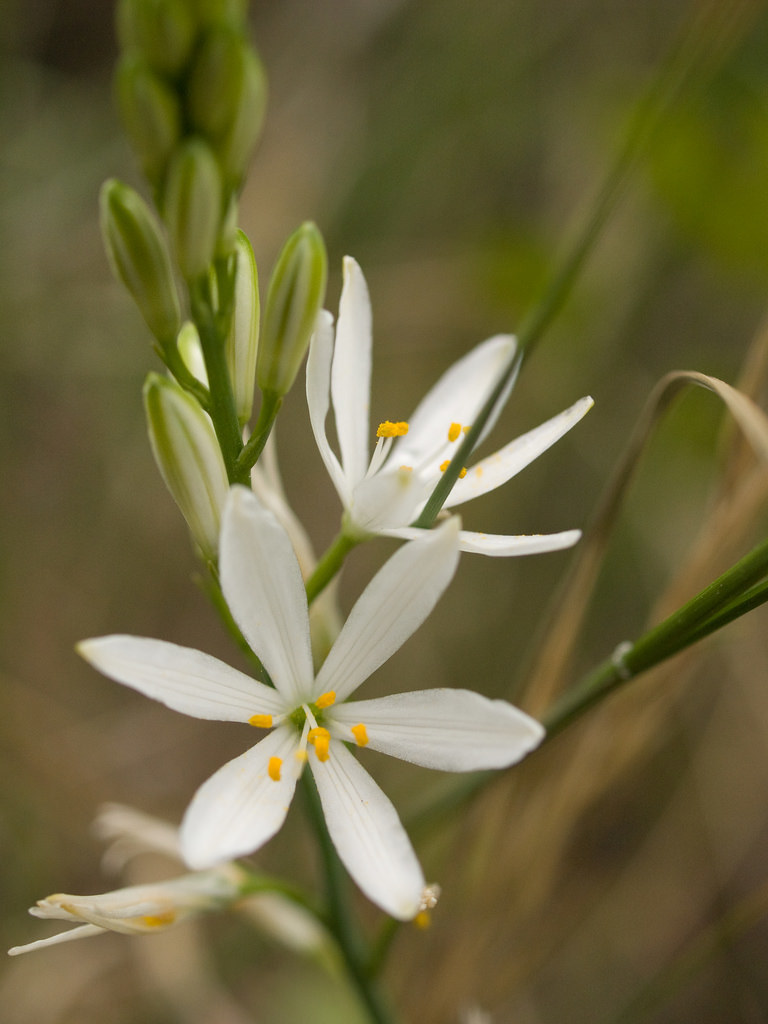
St Bernard's Lily
Anthericum liliago
Anthericum liliago, the St Bernard's lily, is a species of flowering plant in the family Asparagaceae. It is native to mainland Europe (not the British Isles) and Turkey, growing in dry pastures, stony places and open woods and flowering in early summer. In Sweden, the northernmost stable populations grows along the rocky shores of Lake Sommen (58° N), albeit on occasions it has been found as far north as Uppland (60° N).
From the article Anthericum liliago on Wikipedia (CC BY-SA), quoted section by section
Description
It is a vigorous herbaceous flowering perennial with tuberous roots, 60–90 cm (2.0–3.0 ft) high, with leaves narrowly linear, 12–40 cm (4.7–15.7 in) and producing racemes of 6-10 lily-like white flowers in Spring and Summer.
How it is grown
Best grown in well-drained soil in a sunny position, A. liliago can be propagated by seed or by division of the rootstock every 3 to 4 years. It is a slow starter but forms large clumps with time (USDA Zone 6). The cultivar 'Major' has gained the Royal Horticultural Society's Award of Garden Merit.
Wikipedia: “Cultivation”
In human culture
The specific epithet liliago means lily-like or lily-carrier. Like many plants whose common names include "lily", it is not closely related to the true lilies.
Wikipedia: “Etymology”
Where it lives
Recorded sightings
—
geo-referenced records in GBIF, from museums, herbaria and field observers.
Drag the globe to turn it. Dots are where records exist, not a range map; darker means more records.
In the stacks
Searching the stacks…
Every page naming Anthericum liliago in the Biodiversity Heritage Library →
This page is assembled live from iNaturalist, GBIF, Wikipedia, the Source Library and the Internet Archive. It is not yet part of the hand-edited codex. iNaturalist taxon 202500.