- Plants
- ›Vascular Plants
- ›flowering plants
- ›Dicots
- ›proteas, lotuses, planes, and allies
- ›Protea family
- ›Paired Proteas
- ›Banksieae
- ›Banksiinae
- ›Banksia
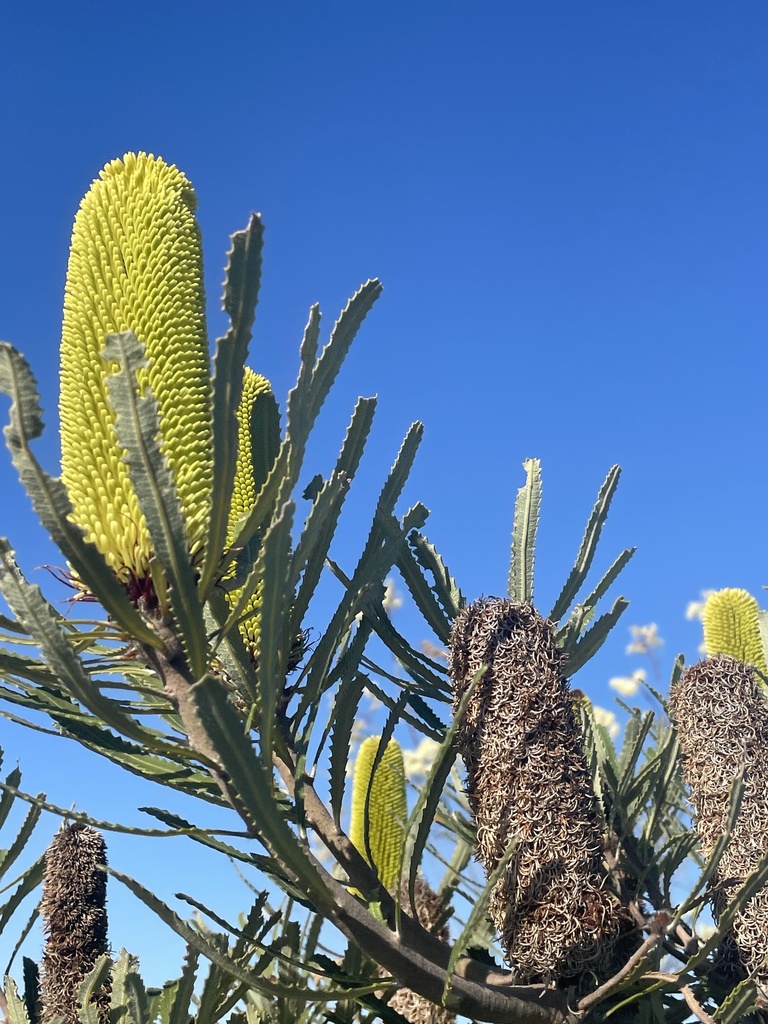
Candlestick Banksia
Banksia attenuata
Banksia attenuata, commonly known as the candlestick banksia, slender banksia, or biara to the Noongar people, is a species of plant in the family Proteaceae. Commonly a tree, it reaches 10 m (33 ft) high, but it is often a shrub in drier areas 0.4 to 2 m (1.3 to 6.6 ft) high. It has long, narrow, serrated leaves and bright yellow inflorescences, or flower spikes, held above the foliage, which appear in spring and summer. The flower spikes age to grey and swell with the development of the woody follicles. The candlestick banksia is found across much of the southwest of Western Australia, from north of Kalbarri National Park down to Cape Leeuwin and across to Fitzgerald River National Park.
English botanist John Lindley had named material collected by Australian botanist James Drummond Banksia cylindrostachya in 1840, but this proved to be the same as the species named Banksia attenuata by Scottish botanist Robert Brown 30 years earlier in 1810, and thus Brown's name took precedence. Within the genus Banksia, the close relationships and exact position of B. attenuata is unclear.
From the article Banksia attenuata on Wikipedia (CC BY-SA), quoted section by section
Description
Banksia attenuata is generally encountered as a tree up to 10 m (30 ft) tall. In the north of its range as the climate becomes warmer and drier, it is often a stunted multistemmed shrub 0.4 to 2 m (1.3 to 6.6 ft) tall. Both forms occur in the vicinity of Hill River but there is otherwise a marked demarcation.
In the Wheatbelt and east of the Stirling Range, it is a stunted tree. Tree forms have a solid trunk, generally wavy or bent, with 1–2 cm (0.4–0.8 in) thick crumbly orange-grey bark which is a red-brown underneath. It regenerates from fire via lignotuber or epicormic buds from its fire-tolerant trunk. It has long narrow shiny green linear leaves 4 to 27 cm (1.6 to 10.6 in) long and 0.5 to 1.6 cm (0.2 to 0.6 in) wide. The leaf margins have v- or u-shaped serrations along their length. The new growth is a pale grey-green and occurs mainly in the late spring and summer, often after flowering. The brilliant yellow inflorescences (flower spikes) occur from spring into summer and are up 5 cm (2.0 in) wide and up to 25–30 cm (9.8–11.8 in) tall. They are made up of many small individual flowers; a study at Mount Adams 330 km (210 mi) north of Perth revealed a count of 1933 (± a standard error of 88) flowers per inflorescence, and another in the Fitzgerald River National Park yielded a count of 1720 (± 76) flowers. …
Range & habitat
The most widely distributed of all western banksias, Banksia attenuata occurs across a broad swathe of southwest of Western Australia, from Kalbarri National Park and the Murchison River (with an outlying population in Zuytdorp Nature Reserve) southwards right to the southwestern corner of the state at Augusta and Cape Leeuwin, and then eastwards across the south to the western edge of Fitzgerald River National Park. Along the eastern border northwards it is found at Lake Grace, Lake Magenta north of Jerramungup, and the Wongan Hills. It is restricted to various sandy soils, including white, yellow, or brown sands, and sand over either laterite or limestone. It forms an important component of open Eucalyptus woodland as a dominant or understory tree or tall shrub. To the north, it is a shrubby component of shrubland. It does not grow on heavy (clay-based) soils, and is hence only found in sandy pockets. Within open woodland, it is found alongside B. menziesii, B. ilicifolia, B. prionotes, Allocasuarina fraseriana, Eucalyptus marginata, or E. gomphocephala. The annual rainfall within its distribution varies from 300 to 900 mm (12 to 35 in).
Wikipedia: “Distribution and habitat”
What it does
Like many plants in southwest Western Australia, B. attenuata is adapted to an environment in which bushfire events are relatively frequent. Most Banksia species can be placed in one of two broad groups according to their response to fire: reseeders are killed by fire, but fire also triggers the release of their canopy seed bank, thus promoting recruitment of the next generation; resprouters survive fire, resprouting from a lignotuber or, more rarely, epicormic buds protected by thick bark. Bearing epicormic buds and a lignotuber, B. attenuata is one of the latter group, with follicles that may open spontaneously or by fire. It is moderately serotinous, storing only one-tenth the number of seeds in its seed bank as the reseeding B. hookeriana with which it coexists on sand dunes in scrub at Eneabba north of Perth. Even then, many of its follicles do not release seed after a fire, but instead after successive autumn rains. An experiment simulating wet weather following a fire saw a series of Banksia attenuata cones with follicles subjected to twice-weekly immersions in water after being heated in a ring Bunsen flame to around 500–600 °C (932–1,112 °F) for two minutes. …
Wikipedia: “Ecology”
How it is grown
The well-displayed bright yellow spikes are an attractive feature, with shrubby dwarf forms more versatile horticulturally. All forms of Banksia attenuata require good drainage, sandy soil and a sunny position to do well, with a pH between 5.5 and 7.0. They are sensitive to dieback, and do not fare well in humid climates. Seeds do not require any treatment, and take 16 to 49 days to germinate. Seedlings are highly vulnerable to damping off. Plants take from four to six years to flower from seed. There has been little success with other methods of improving adaptability to humid climates such as grafting. Flower spikes in late bud are used in the cut flower industry, primarily in Western Australia. Aboriginal people, particularly the Nyoongar and Yamatji, placed the flower spike in a paperbark-lined hole filled with water to make a sweet drink. Both this species and B. aemula have been credited with the inspiration behind May Gibbs' Big Bad Banksia Men; this species was familiar to Gibbs in her childhood and likely gave her the initial inspiration, although the depictions resemble the latter species. Artist Marianne North produced a highly regarded painting of B. attenuata during her stay in Australia in 1880–1881.
Wikipedia: “Cultivation and cultural use”
Where it lives
Recorded sightings
—
geo-referenced records in GBIF, from museums, herbaria and field observers.
Drag the globe to turn it. Dots are where records exist, not a range map; darker means more records.
In the stacks
Searching the stacks…
Every page naming Banksia attenuata in the Biodiversity Heritage Library →
This page is assembled live from iNaturalist, GBIF, Wikipedia, the Source Library and the Internet Archive. It is not yet part of the hand-edited codex. iNaturalist taxon 202058.