- Animals
- ›Chordates
- ›Vertebrates
- ›Cartilaginous Fishes
- ›Sharks and Rays
- ›Sharks
- ›Squalean Sharks
- ›Squaliform Sharks
- ›Dogfish Sharks
- ›Squalus
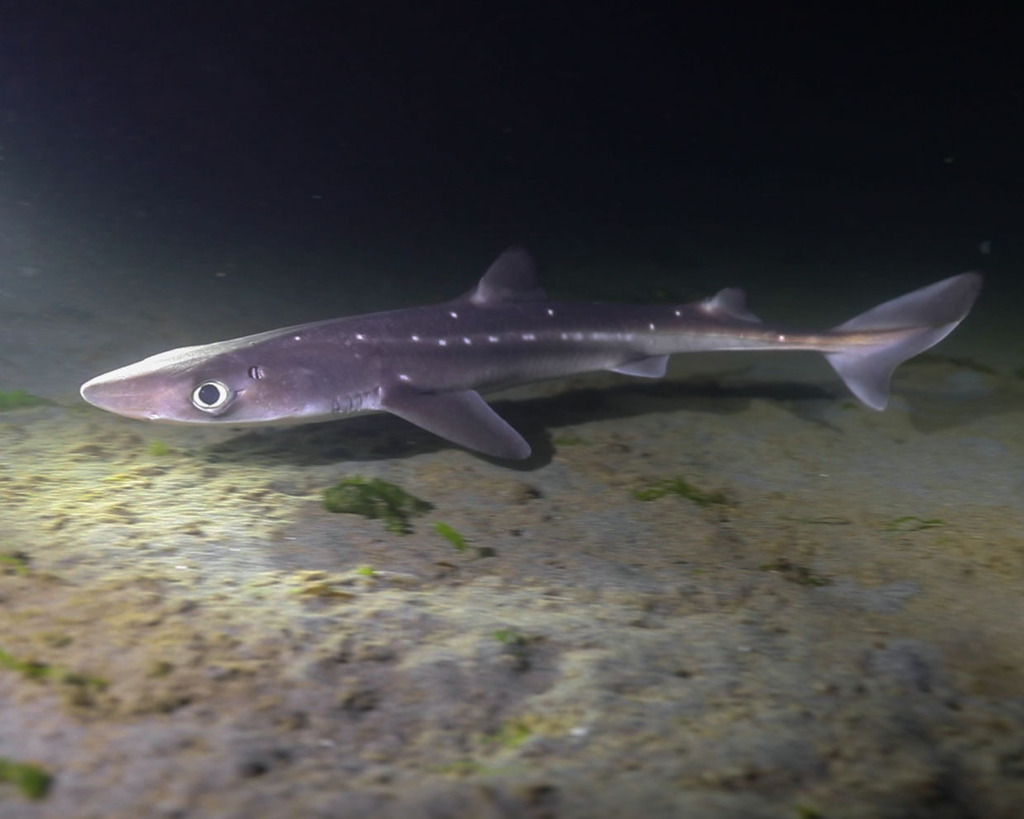
North Pacific Spiny Dogfish
Squalus suckleyi
The Pacific spiny dogfish (Squalus suckleyi) is a common species of the Squalidae (dogfish) family of sharks and are among the most abundant species of sharks in the world. This species is closely related to the Spiny dogfish and for many years they were treated as a single species. Recent research, using meristic, morphological and molecular data led to the resurrection of the Pacific spiny dogfish as a separate species. The American Fisheries Society recommends the common name "Pacific spiny dogfish" for Squalus suckleyi over alternatives such as "spotted spiny dogfish" and "North Pacific spiny dogfish" and "spiny dogfish" for Squalus acanthias.
The maximum length of a Pacific dogfish can be 160 centimetres (63 in), and they can live up to 100 years. Squalus suckleyi has a slower growth rate, larger maximum size, and later maturity compared to Squalus acanthias species. The slower growth rate and time of maturity could be related to the colder temperatures these sharks face. Pacific spiny dogfish prefer to be in temperatures ranging from 7 to 15 °C (45 to 59 °F). Dogfish are found all over the world, but the Pacific spiny dogfish are found mostly in the North Pacific Ocean. These areas range from Korea to Japan and Russia, as well as the gulf of Alaska down to Baja, California. They are known to be piscivores, eating other fish. Additionally, they are known to consume octopus, squid, and crustaceans.
From the article Pacific spiny dogfish on Wikipedia (CC BY-SA), quoted section by section
Description
Its distinctive snout, large eyes, and flattened head are just a few of the physical characteristics that give the Pacific spiny dogfish its distinctive look. The dogfish has a cylindrical shaped body. This type of shark also contains a unique body coloring. The top half of the shark has a gray color with scattered white spots while the bottom half has a white/light gray color. The scales of the dogfish is composed of the same material of shark teeth called dermal denticles, making the skin very hard and durable. The skin of the sharks used to be used as sandpaper once dried to do woodwork or even be used as leather, once the denticles are removed. Lastly, the Pacific spiny dogfish has a set of teeth specialized for grinding instead of tearing by the teeth being flat with sharp edges. If any of the teeth are worn down or broken, new teeth replace them from the two rows that are not being used to prey on other animals.
Wikipedia: “Appearance”
Range & habitat
The Pacific dogfish's habitat consists of bays, including inshore and offshore waters. Female dogfish are usually seen in inshore waters while smalls pups are seen maneuvering in offshore waters. These animals are usually spotted at the bottom of the continental shelf at the bottom of the sea. The Pacific dogfish prefers to live mainly in saltwater, but they can live in and tolerate brackish water (a mix of salt and fresh water).
Wikipedia: “Natural habitat”
What it does
The Pacific dogfish have a longer reproduction rate compared to other sharks, but have the same reproduction characteristics as Squalus acanthias . The gestation period for spiny dogfish is normally 18 to 24 months. Dogfish that live in cooler water may have an increased duration of pregnancy. Females are also known to migrate from deep to shallow water as the pregnancy continues. This migration pattern is known to influence embryonic growth. Baby dogfish, also known as pups, found near Newfoundland had an average of 1.1 cm/month and 24 month pregnancy period, while a warmer area such as Massachusetts had an average of 1.3 cm/month and 20-22 month pregnancy period. The sexual maturity of a dogfish is hard to determine because it varies anywhere from 10–30 years. Food supplies and water temperature also play a role in growth and development of the dogfish. The length of a newborn Pacific dogfish is around 22 to 23 centimeters. Females seem to be significantly larger than male dogfish. At sexual maturity the male dogfish is 60–70 cm while the female is about 70–100 cm. This length difference can be caused by the reproduction process of the female. Their bodies need to be bigger to carry and protect their eggs within their bodies. Pacific dogfish are ovoviviparous. This means that they produce eggs that hatch within the body. The size of the litter ranges from 1 to 20 newborns. …
Wikipedia: “Reproduction”
Where it lives
Recorded sightings
—
geo-referenced records in GBIF, from museums, herbaria and field observers.
Drag the globe to turn it. Dots are where records exist, not a range map; darker means more records.
In the stacks
Searching the stacks…
Every page naming Squalus suckleyi in the Biodiversity Heritage Library →
This page is assembled live from iNaturalist, GBIF, Wikipedia, the Source Library and the Internet Archive. It is not yet part of the hand-edited codex. iNaturalist taxon 201523.