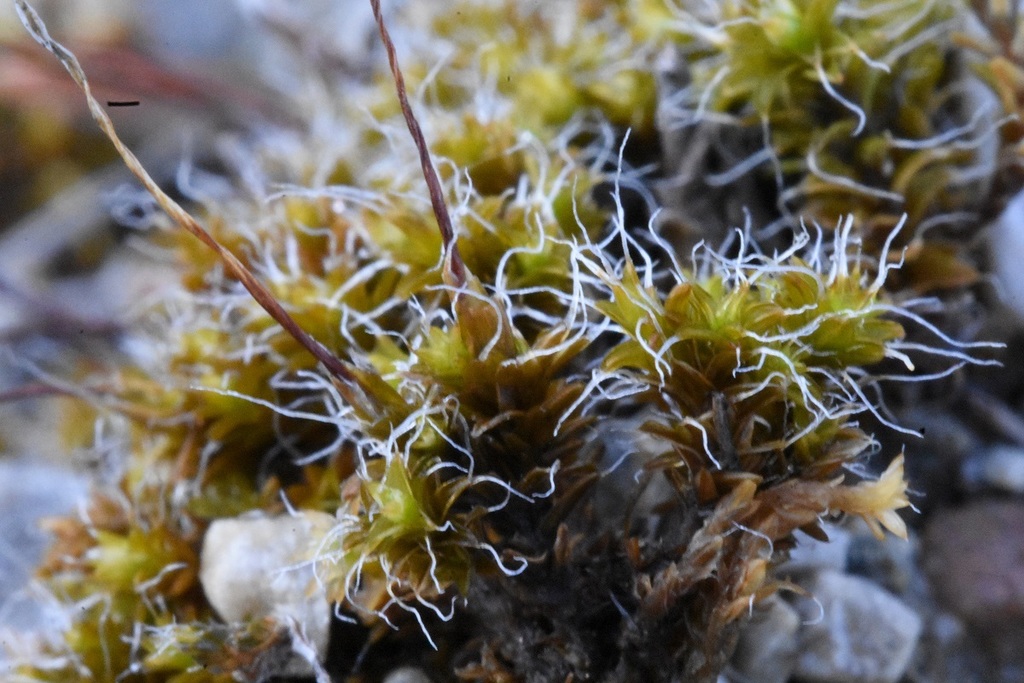
Steppe Screw-Moss
Syntrichia caninervis
Syntrichia caninervis, also known as steppe screw moss, is a desert moss species distributed throughout the world. As an extremophile, it is able to withstand desiccation under dry conditions with little access to water and is commonly found in hypolithic communities. It makes use of a novel adaptation to the desert environment to harvest and collect water sources such as dew, fog, snow, and rain, using tiny hairs instead of roots. In laboratory experiments, S. caninervis has shown the ability to survive in a simulated Martian environment.
From the article Syntrichia caninervis on Wikipedia (CC BY-SA), quoted section by section
Description
The plant was first described by English bryologist William Mitten (1819–1906) to the Linnean Society of London in May 1858, with a description published in their journal in February 1859. It belongs to the Syntrichia genus and the Pottiaceae family. It is commonly known as steppe screw moss.
Range & habitat
S. caninervis has a widespread global distribution and is an extremophile commonly found in extreme desert environments and hypolithic communities with the capacity to withstand desiccation under dry conditions. It has been observed growing in China, Mongolia, Siberia, central and southwestern Asia, Europe, and North America. In Tibet, Antarctica, and circumpolar regions, it is part of the biological soil crust, which is a resilient type of ground cover often found in arid lands. In North America, the plant is found throughout the western and northwestern United States and in two western Canadian provinces. In the United States, it is found as far east as New Mexico, Colorado, Wyoming and Montana, all the way through Idaho, Utah, Arizona, and Nevada, and as far west as California, Oregon, and Washington. Two of the most common plant communities in the United States are found in the Mojave Desert and in the Columbia River drainage basin. In Canada, it is found in British Columbia and Alberta.
Wikipedia: “Distribution and habitat”
Where it lives
Recorded sightings
—
geo-referenced records in GBIF, from museums, herbaria and field observers.
Drag the globe to turn it. Dots are where records exist, not a range map; darker means more records.
In the stacks
Searching the stacks…
Every page naming Syntrichia caninervis in the Biodiversity Heritage Library →
This page is assembled live from iNaturalist, GBIF, Wikipedia, the Source Library and the Internet Archive. It is not yet part of the hand-edited codex. iNaturalist taxon 201419.