- Plants
- ›Vascular Plants
- ›flowering plants
- ›Dicots
- ›carrots, ivies, and allies
- ›cheesewood family
- ›Pittosporum
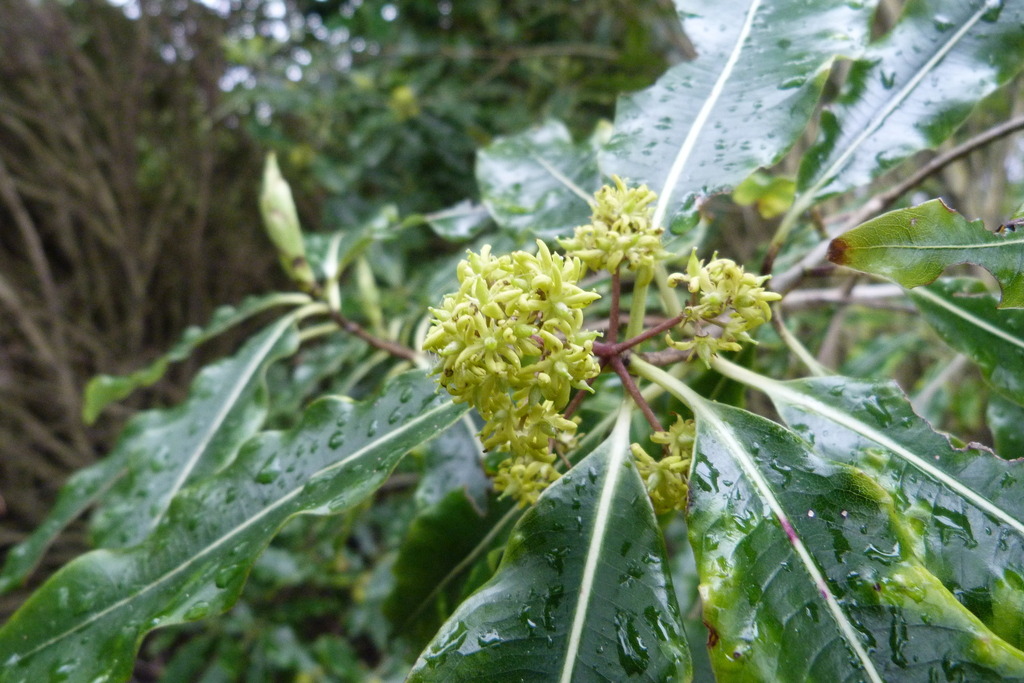
tarata
Pittosporum eugenioides
Pittosporum eugenioides, commonly known as tarata or lemonwood, is a species of evergreen tree endemic to New Zealand. Growing to 12 m (39 ft) tall by 5 m (16 ft) broad, it is conical when young but more rounded in shape when mature. Its leaves are mottled yellow-green with curly edges and a salient bright midrib, and have a strong lemony smell when crushed. It has highly fragrant clusters of attractive yellow-cream flowers in spring, followed by distinctive black seed capsules. It is found throughout New Zealand's North and South Islands along forest margins and stream banks from sea level to 600 m (1,969 ft). It is New Zealand's largest Pittosporum.
The binomial qualifier eugenioides means "resembling Eugenia", a different genus of plants.
From the article Pittosporum eugenioides on Wikipedia (CC BY-SA), quoted section by section
Range & habitat
Pittosporum eugenioides is endemic to New Zealand. There are "about 200 trees and shrubs" in the genus located in neighbouring parts of the world. Places where the genus is found include Africa, Australia, some Pacific islands, southern and eastern Asia, and New Zealand. A reason for this endemic occurrence is due to the isolation of New Zealand over a long period of time.
New Zealand range. Pittosporum eugenioides is found throughout the South Island and North Island in low lying forests. It is found in forest clearings and along forest margins up to 600 m above sea level.
Habitat preferences. Pittosporum eugenioides can be found in a cooler, mature, lowland and subalpine forest climate zone throughout New Zealand. The species can be found in regenerating areas of forest, both young and old. It has proved to be a great plant for establishing a quick canopy. This species, along with other Pittosporum, are making their way in to the average household gardens. Nurseries and garden centres are stocking this native because it is suited to New Zealand conditions where it naturally grew many years ago. At home in the garden, P. eugenioides prefers a sunny to part shade position, does not mind the wind, and thrives in soil with good drainage.
Wikipedia: “Range”
What it does
Pittosporum eugenioides starts out as a small compact tree; as it matures it becomes a tall branched tree. It flowers between October and December. The following year, after flowering, the capsules will open. The capsules open the next year because the fruit of the lemonwood takes between 12 and 14 months to ripen. There is unripe fruit and ripe fruit present on the lemonwood at the same time; this is the current season's fruit and last season's fruit. Lemonwood is pollinated by both insects and birds, with the seeds being dispersed by birds. The seeds of the lemonwood germinate quickly and will become seedlings within a month.
Wikipedia: “Life cycle/phenology”
At the table
Māori traditionally used the gum and crushed leaves and flowers of the tarata for scent, usually mixed with plant oils such as tītoki and kōhia. Māori also used the lemonwood to make hair oils and perfume. For perfume, the oil was mixed with bird fat. The gum from the tree was used for bad breath. They rolled the gum in to a ball and this was thought to last a whole generation. When chewed, the gum was used as a glue.
Wikipedia: “Cultural uses”
How it is grown
The viability of tarata's seeds is affected by moisture levels of the soil. If the moisture levels are too high the seed is likely to become unviable. Like other pittospora, tarata is somewhat drought resistant. P. eugenioides is relatively simple to look after in a domestic setting. It grows well, thriving off regular watering intervals during summer. It enjoys a feed with general tree and shrub fertiliser twice a year during spring and summer while it is growing. Responds well to pruning also, which will assure survival in the forest too if disturbed.
Wikipedia: “Cultivation”
Where it lives
Recorded sightings
—
geo-referenced records in GBIF, from museums, herbaria and field observers.
Drag the globe to turn it. Dots are where records exist, not a range map; darker means more records.
In the stacks
Searching the stacks…
Every page naming Pittosporum eugenioides in the Biodiversity Heritage Library →
This page is assembled live from iNaturalist, GBIF, Wikipedia, the Source Library and the Internet Archive. It is not yet part of the hand-edited codex. iNaturalist taxon 200847.