- Plants
- ›Vascular Plants
- ›flowering plants
- ›Dicots
- ›carrots, ivies, and allies
- ›Griselinia family
- ›Griselinia
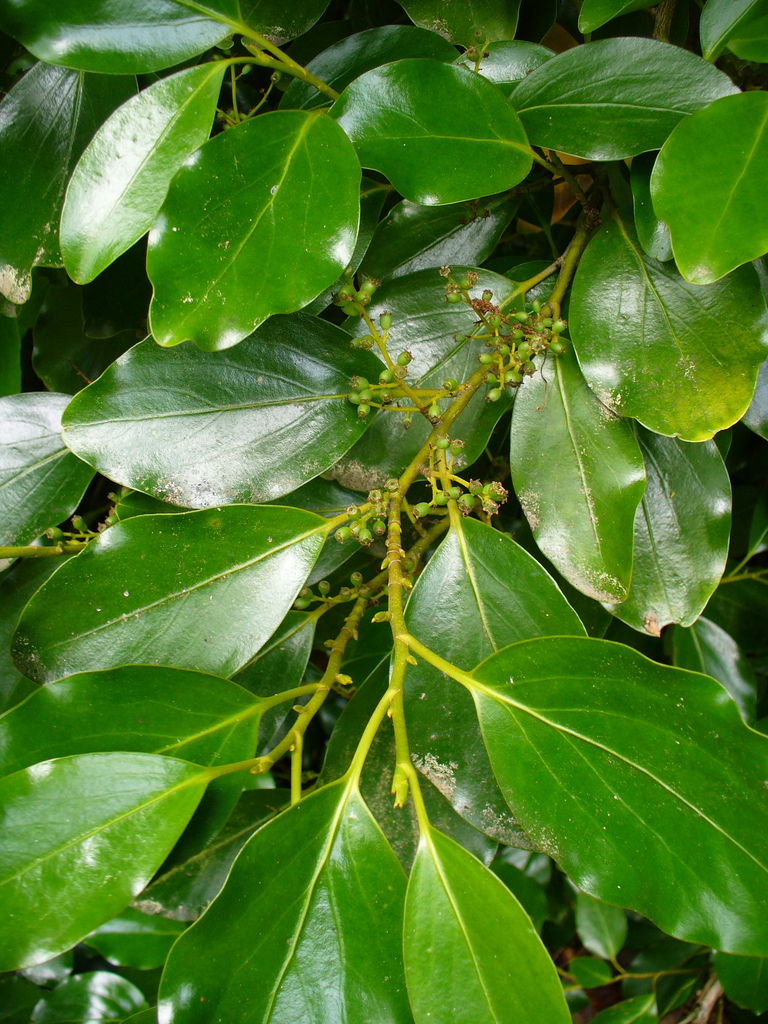
New Zealand Broadleaf
Griselinia littoralis
Griselinia littoralis, commonly known as kapuka or New Zealand broadleaf, is a fast-growing small to medium-sized evergreen tree growing up to 20 m (66 ft) tall, though generally 4–8 m (13–26 ft) particularly in coastal exposure. It is native to New Zealand, where it typically grows in coastal locations (the Latin littoralis means "growing by the sea"). It is widely cultivated both in New Zealand and in other areas with mild oceanic climates such as the south coast of Great...
From the article Griselinia littoralis on Wikipedia (CC BY-SA), quoted section by section
Description
Griselinia littoralis is a hardy evergreen shrub that grows up to about 10 metres tall. Griselinia littoralis is round in shape and has dense foliage. The leaves are alternate, leathery, glossy yellow-green above, paler and matte below, 6–14 cm (2–6 in) long, oval with a smooth margin. This tree also has flowers and berries that grow in particular seasons annually. In general, this tree can grow up to 10 m or longer to 15 m tall. It has rough and short branches which can stretch to 150 cm in diameter. The shape of apical leaf is broad-ovate to ovate-oblong or rounded with smooth margin. The yellow-green leaf is thick and its width can be 5–12 cm long by 4–5 cm wide, the leaf often be glossy and grow as alternative type, one side can be a little longer than the other side at base sometimes, this is one of the typical characters. The greenish flowers are borne on the slim twigs and they are quite small, they always grow up from late spring to mid-summer. The panicles are also small. Five petals are owned by the pistillate flowers. The dark purple or black berries can be 6–7 mm long and appear in mid-summer, ripening from autumn to winter.
Range & habitat
Griselinia littoralis is native to New Zealand, but has also become located in other areas of the world. It is widely cultivated both in New Zealand and in other areas with mild oceanic climates such as the south coast of Great Britain and the Faroe Islands, where it is valued for its tolerance of salt carried on sea gales. The Latin specific epithet littoralis means 'growing by the sea', and in its native New Zealand it is to be found in large numbers in coastal areas. It is frequently grown as a screen to resist wind or other extreme situations.
Wikipedia: “Natural global range”
What it does
The flowering time of Griselinia littoralis is in spring when small greenish yellow flowers appear. The flowers are borne on 2–5 cm (1–2 in) long panicles, each panicle with 50–100 individual flowers, each flower 3–4 mm across, with five sepals and stamens but no petals. Following flowering, small blackish berries are formed, as long as male and female Griselinia littoralis are located in the same area so pollination can occur. Birds are a vector in spreading the seeds around the area, minimizing competition within the same species for water, sunlight and nutrients. Also allowing the Griselinia littoralis to establish in new areas. Germination of the seeds occur when the seeds drop to the ground and reproduction occurs. This plant has a long life span generally over fifty years. There are three phases of the forest growth cycle: the gap phase, the building phase, and the mature phase. It is easier to tell from these three phases. The diameter grow faster during the gap and building phase (0.31 cm per year) that the leaves become bigger and bigger to absorb the sunlight to do photosynthesis than mature phase (just 0.19 cm per year). Broadleaf grow very quickly in building phase than other phases. The gap phase is the period when the colonization forming by the canopy opening. The building phase is the period when the seeding attain canopy status. …
Wikipedia: “Life cycle”
Where it lives
Recorded sightings
—
geo-referenced records in GBIF, from museums, herbaria and field observers.
Drag the globe to turn it. Dots are where records exist, not a range map; darker means more records.
In the stacks
Searching the stacks…
Every page naming Griselinia littoralis in the Biodiversity Heritage Library →
This page is assembled live from iNaturalist, GBIF, Wikipedia, the Source Library and the Internet Archive. It is not yet part of the hand-edited codex. iNaturalist taxon 200843.