- Plants
- ›Vascular Plants
- ›flowering plants
- ›Dicots
- ›Soapberries, Cashews, Mahoganies, and Allies
- ›citrus family
- ›Aurantioideae
- ›Citrus
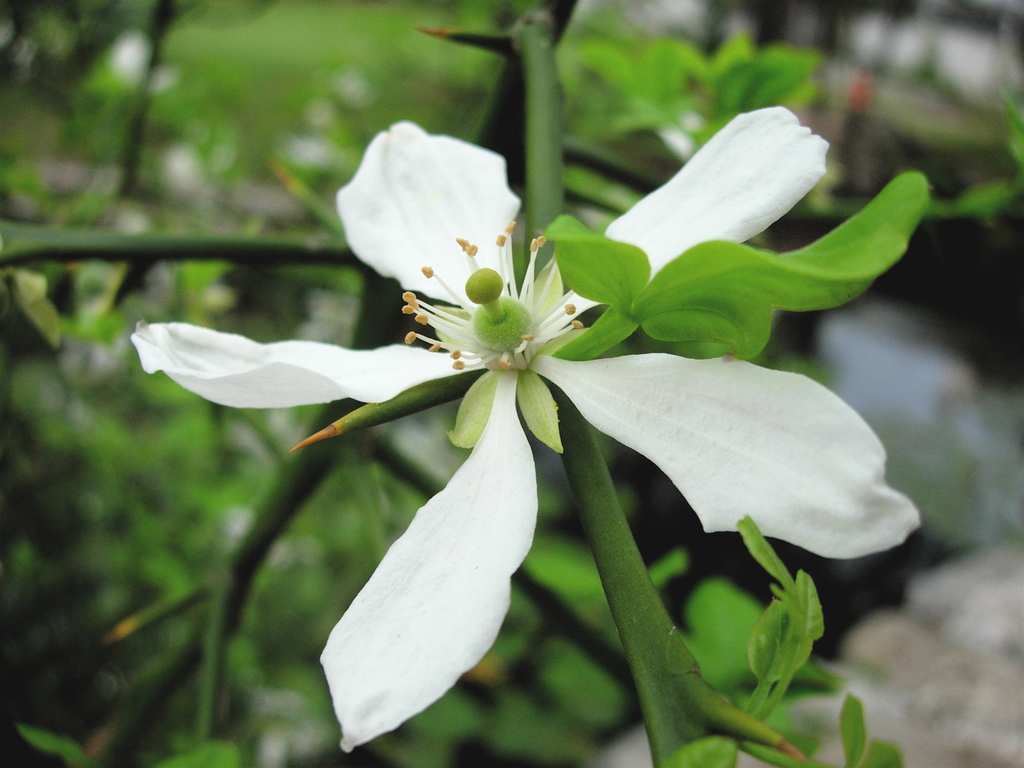
trifoliate orange
Citrus trifoliata
The trifoliate orange, Citrus trifoliata (syn. Poncirus trifoliata), is a member of the family Rutaceae. Whether the trifoliate oranges should be considered to belong to their own genus, Poncirus, or be included in the genus Citrus is debated. The species is unusual among citrus for having deciduous, compound leaves and pubescent (downy) fruit.
It is native to northern China and Korea, and is also known as the Japanese bitter-orange (karatachi), hardy orange or Chinese bitter orange.
From the article Trifoliate orange on Wikipedia (CC BY-SA), quoted section by section
Description
The trifoliate orange is recognizable by the large 3–5 cm (1.2–2.0 in) thorns on the shoots, and its deciduous leaves with three (or rarely, five) leaflets, typically with the middle leaflet 3–5 cm (1.2–2.0 in) long, and the two side leaflets 2–3 cm (0.79–1.18 in) long. The flowers are white, with pink stamens, 3–5 cm (1.2–2.0 in) in diameter, larger than those of true citrus but otherwise closely resembling them, except that the scent is much less pronounced than with true citrus. As with true citrus, the leaves give off a spicy smell when crushed. The fruits are green, ripening to yellow, and 3–4 cm (1.2–1.6 in) in diameter similar in size to a lime and resembling a small orange, but with a finely downy surface and having a fuzzy texture similar to a peach. The fruits also have distinctive smell from other citrus varieties and often contain a high concentration of seeds.
At the table
Trifoliate orange fruits are very bitter, due in part to their poncirin content. Most people consider them inedible fresh, but they can be made into marmalade. When dried and powdered, they can be used as a condiment.
Wikipedia: “As food”
How it is grown
The cultivar 'Flying Dragon' is dwarfed in size, has highly twisted, contorted stems, and has even stronger thorns than the type. It makes an excellent barrier hedge due to its density and strong curved thorns. Such hedges have been grown for over 50 years at Oklahoma State University in Stillwater, and are highly student-proof. The plant is also highly deer-resistant. In central London, mature specimens of the trifoliate orange can be seen in the gardens of St Paul's Cathedral. Trifoliate orange and various of its hybrids with other Citrus are widely used as citrus rootstock, which are valued for their resistance to cold, the tristeza virus, and the oomycete Phytophthora parasitica (root rot). Recent studies have revealed that the trifoliate orange contains auraptene at a high concentration, which is one of the functional components having immunity against citrus tristeza virus (CTV).
Wikipedia: “Cultivation”
Where it lives
Recorded sightings
—
geo-referenced records in GBIF, from museums, herbaria and field observers.
Drag the globe to turn it. Dots are where records exist, not a range map; darker means more records.
In the old herbals & bestiaries


In the stacks
Searching the stacks…
Every page naming Citrus trifoliata in the Biodiversity Heritage Library →
This page is assembled live from iNaturalist, GBIF, Wikipedia, the Source Library and the Internet Archive. It is not yet part of the hand-edited codex. iNaturalist taxon 200071.