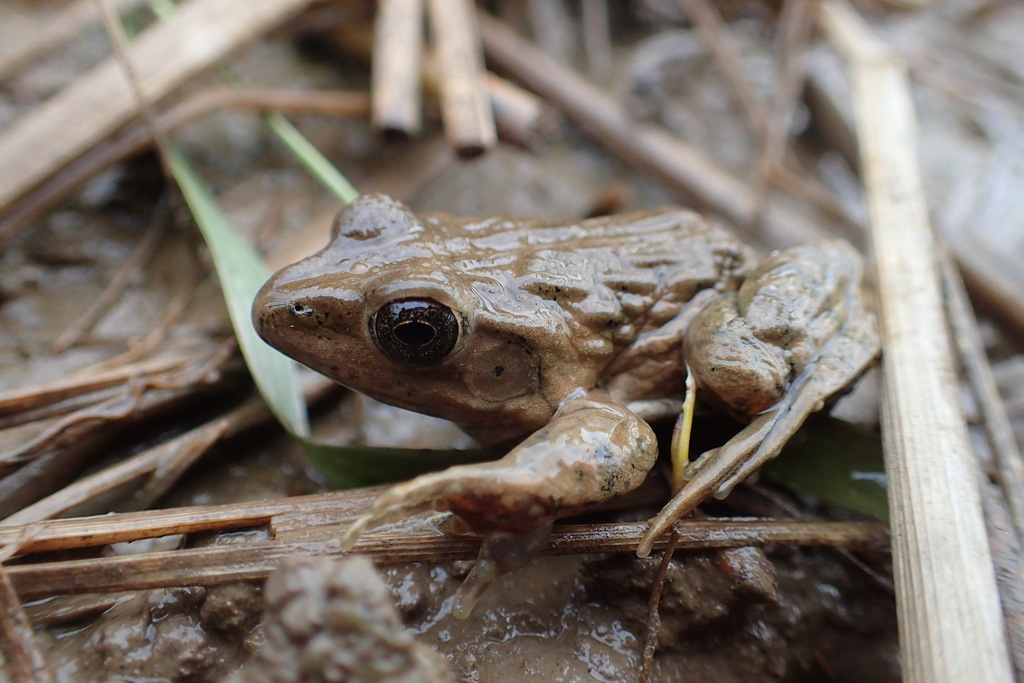
Susurra Gland Frog
Glandirana susurra
Glandirana susurra is a species of frog in the family Ranidae, the "true frogs". It is endemic to Sado Island, Japan. It is the only endemic amphibian of the island. It is genetically close to the widespread Glandirana rugosa, but it is morphologically distinguishable and postzygotically isolated from the latter species.
From the article Glandirana susurra on Wikipedia (CC BY-SA), quoted section by section
Description
Adult males measure 33–44 mm (1.3–1.7 in) and adult females 38–46 mm (1.5–1.8 in) in snout–vent length. The snout is rounded. The tympanum is distinct and the supratympanic fold is well-developed. The fingers and the toes are slender with slightly depressed tips; no webbing is present between the fingers while the toes have well-developed webbing. Dorsal skin has many dermal ridges of varying size. The dorsum is khaki-colored, whereas the abdomen is almost whitish anteriorly and yellow posteriorly. A mid-dorsal stripe is present in some individuals. Males lack vocal sac (present in G. rugosa). Tadpoles of stages 41–42 measure about 23–27 mm (0.9–1.1 in) in body length.
Range & habitat
Glandirana susurra occurs near various bodies of water, such as rice fields, small streams, and ponds. It is known from elevations between 11 and 187 m (36 and 614 ft) above sea level. Spawning occurs in ponds from middle May to early August. Adult frogs and at least some tadpoles spend their winter in the mud under water. As of late 2019, this species has not been included in the IUCN Red List of Threatened Species.
== References ==
Wikipedia: “Habitat and conservation”
In human culture
The specific name susurra is derived from the Latin susurrus meaning "whispering" and refers to the relatively quiet advertisement call of this species compared to those of other sympatric anuran (Hyla japonica and Rhacophorus arboreus).
Wikipedia: “Etymology”
Listen
Looking for field recordings…
Where it lives
Recorded sightings
—
geo-referenced records in GBIF, from museums, herbaria and field observers.
Drag the globe to turn it. Dots are where records exist, not a range map; darker means more records.
In the stacks
Searching the stacks…
Every page naming Glandirana susurra in the Biodiversity Heritage Library →
This page is assembled live from iNaturalist, GBIF, Wikipedia, the Source Library and the Internet Archive. It is not yet part of the hand-edited codex. iNaturalist taxon 199736.