- Plants
- ›Vascular Plants
- ›flowering plants
- ›Dicots
- ›carrots, ivies, and allies
- ›carrot family
- ›Saniculoideae
- ›Saniculeae
- ›Eryngium
- ›Eryngium
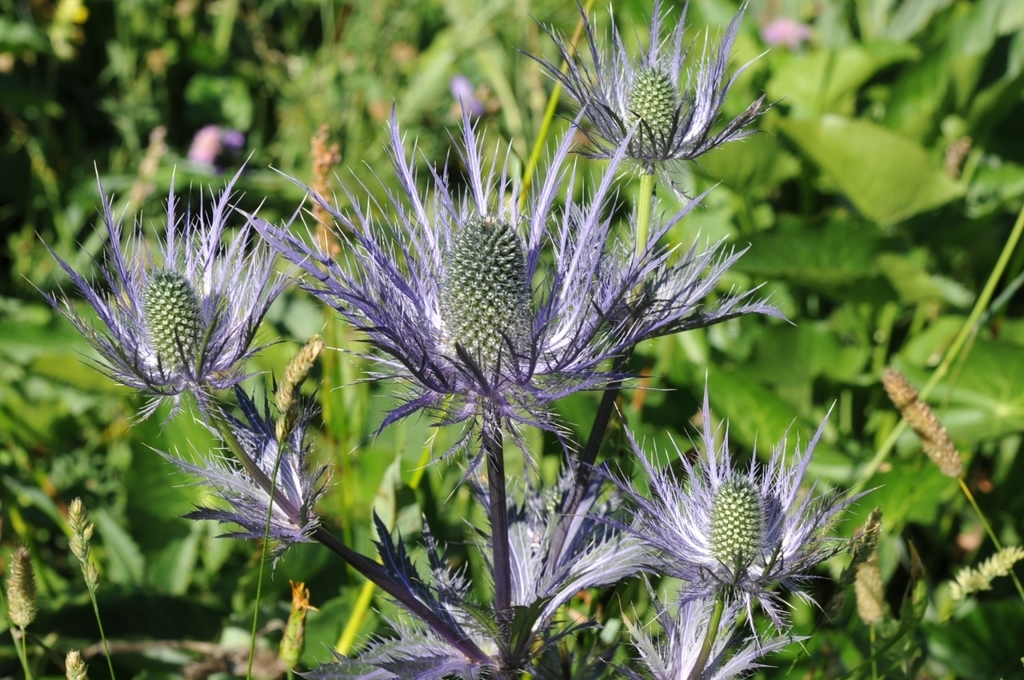
Queen-of-the-Alps
Eryngium alpinum
Eryngium alpinum, the alpine sea holly, alpine eryngo or queen of the Alps, is a herbaceous perennial plant in the family Apiaceae.
From the article Eryngium alpinum on Wikipedia (CC BY-SA), quoted section by section
Description
Eryngium alpinum is a hemicryptophyte, its overwintering buds are situated just below the soil surface and the floral axis more or less erect with a few leaves. The roots are deep and robust. The stems are solitary and erect, usually with three branches on the apex and with longitudinal purple stripes. This plant generally reaches about 30–70 centimetres (12–28 in) in height, with a maximum of 100 centimetres (39 in). The basal leaves are oval or heart-shaped, 10–15 centimetres (3.9–5.9 in) wide and 13–17 centimetres (5.1–6.7 in) long, with toothed hedges and a long petiole. The cauline leaves are sessile and progressively more divided. The inflorescences are dense umbels at the top of the main branches. They are bright green at the bases and the stiff, bristly bracts are blue. They are about 4 cm long and 2 cm diameter and the bracts are up to 25 centimetres (9.8 in) long. The flowers inside are about 2 mm long. The peripheral flowers are sterile and the internal flowers are hermaphroditic. Both types are actinomorphic and pentamerous, with five petals. Flowering occurs in July through September. The flowers are -insect-pollinated. The fruit is a spiny achene about half a centimeter wide.
Range & habitat
This plant is native to Austria, Liechtenstein, Croatia, France, Switzerland, Italy, and Slovenia. It grows in subalpine scrub, rocky areas and wet pastures, preferably in limestone, at an altitude of 1,500–2,000 metres (4,900–6,600 ft) above sea level.
Wikipedia: “Distribution and habitat”
How it is grown
Eryngium alpinum is cultivated as an ornamental plant for its blue and purple flowerheads. It requires dry, well-drained soil and full sun.
Wikipedia: “Cultivation”
Where it lives
Recorded sightings
—
geo-referenced records in GBIF, from museums, herbaria and field observers.
Drag the globe to turn it. Dots are where records exist, not a range map; darker means more records.
In the stacks
Searching the stacks…
Every page naming Eryngium alpinum in the Biodiversity Heritage Library →
This page is assembled live from iNaturalist, GBIF, Wikipedia, the Source Library and the Internet Archive. It is not yet part of the hand-edited codex. iNaturalist taxon 191914.