- Plants
- ›Vascular Plants
- ›flowering plants
- ›Dicots
- ›pinks, cactuses, and allies
- ›cacti
- ›globular cacti, moonlight cacti, torch cacti, and allies
- ›Trichocereeae
- ›Discocactus
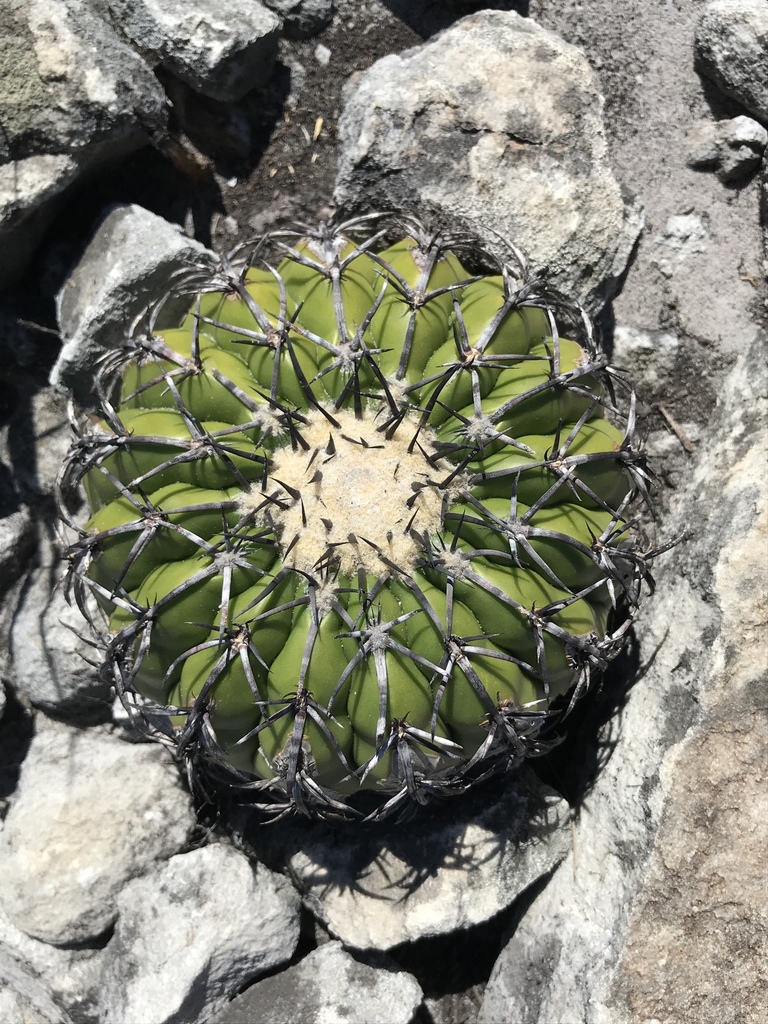
Discocactus placentiformis
Discocactus placentiformis is a species of flowering plant in the family Cactaceae. It is found in Brazil.
From the article Discocactus placentiformis on Wikipedia (CC BY-SA), quoted section by section
Description
Discocactus placentiformis is a small, solitary cactus characterized by its depressed, globular stem, which can reach 3.5 to 13.4 cm in height and 6 to 29 cm in diameter. Its epidermis is dark green and it possesses branched roots. The stem features 9 to 26 distinct ribs, arranged vertically or slightly spirally, divided into tubercles with shallow grooves between areoles. These oval to elongated, sunken areoles, measuring 0.3 to 1.5 cm long and 0.2 to 1.2 cm wide, are located above ground and there are typically 3 to 9 per rib. Spines are gray to brown and flattened or rounded in cross-section, consisting of a single central spine, sometimes absent, that is 0.9 to 2 cm long and 1 mm in diameter, along with 3 to 10 radial spines ranging from 0.5 to 4.5 cm long and 1 to 4 mm in diameter. Adult plants develop a woolly cephalium at their apex, measuring 0.5 to 7 cm high and 1 to 11 cm in diameter. This sometimes depressed structure, composed of white wool and dark bristles on its margin, protects the plant's sensitive tip from cold and intense UV radiation and is thought to attract pollinators due to its showy appearance even before flowering. The flowers, which emerge from the cephalium's edge, are white, fragrant, and funnel-shaped, opening at night and attracting moths. They can be solitary or in clusters of 2 to 16, reaching up to 8.5 cm in length and 7.5 to 8.5 cm in diameter. …
Range & habitat
Discocactus placentiformis is native to Brazil, specifically the states of Bahia, Minas Gerais, and Mato Grosso, where it grows in the seasonally dry tropical biome at elevations between 550 and 1275 meters. Morphological characteristics such as shape, size, and spines can vary significantly based on the substrate; plants are more globose and elongated on sandstone rocks, and more flattened in gravel or sandy soil.
Wikipedia: “Distribution”
Where it lives
Recorded sightings
—
geo-referenced records in GBIF, from museums, herbaria and field observers.
Drag the globe to turn it. Dots are where records exist, not a range map; darker means more records.
In the stacks
Searching the stacks…
Every page naming Discocactus placentiformis in the Biodiversity Heritage Library →
This page is assembled live from iNaturalist, GBIF, Wikipedia, the Source Library and the Internet Archive. It is not yet part of the hand-edited codex. iNaturalist taxon 191674.