- Plants
- ›Vascular Plants
- ›flowering plants
- ›Dicots
- ›Soapberries, Cashews, Mahoganies, and Allies
- ›soapberry family
- ›Dimocarpus
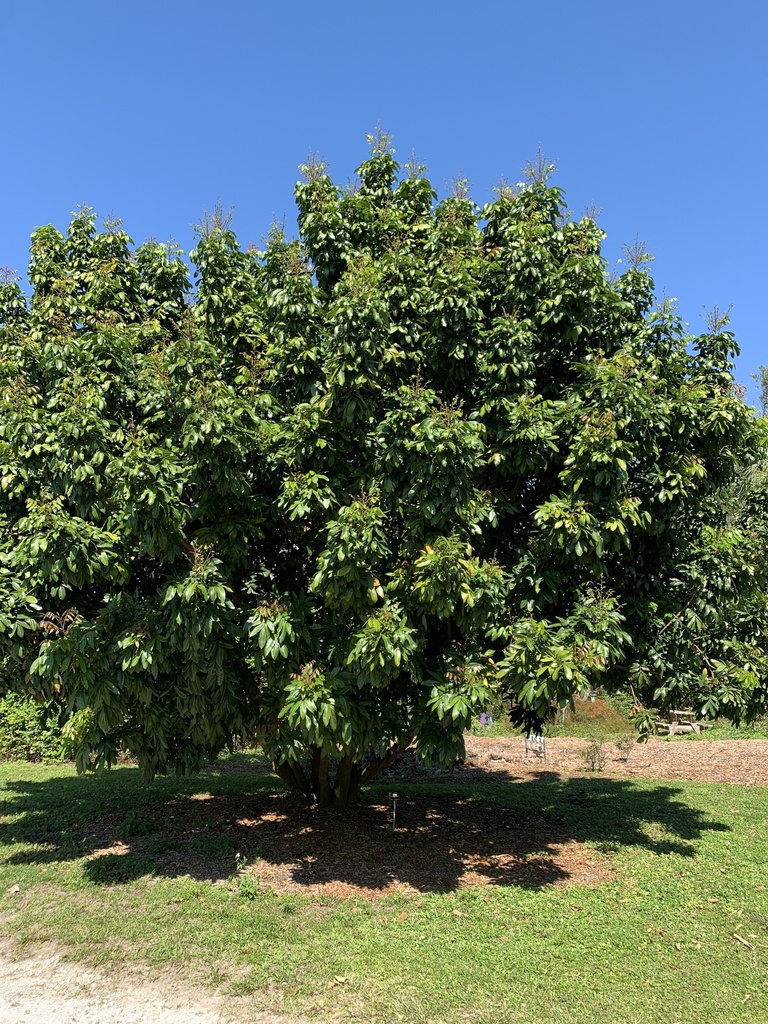
Longan
Dimocarpus longan
Longan (; Dimocarpus longan), also called lungan or dragon's eye, is a tropical tree species that produces edible fruit. It is one of the better-known tropical members of the soapberry family Sapindaceae, to which the lychee and rambutan also belong. The fruit of the longan is similar to lychee, but has a milder, and more subtle aroma and sweetness. The species is native to Southeast Asia and southern China. Today, China, Thailand, and Vietnam are the largest producers of longan fruit, together accounting for approximately 95% of global production.
From the article Longan on Wikipedia (CC BY-SA), quoted section by section
Description
Depending upon climate and soil type the tree may grow to over 30 metres (100 ft) in height, but it typically stands 9–12 m (30–40 ft) in height and the crown is round. The trunk is 80 cm (2+1⁄2 ft) thick with corky bark. The branches are long and thick, typically drooping. The leaves are oblong and blunt-tipped, usually 10–20 centimetres (4–8 in) long and 5 cm (2 in) wide. The leaves are pinnately compounded and alternate. There are 6 to 9 pairs of leaflets per leaf and the upper surface is wavy and a dark, glossy-green. The longan tree produces light-yellow inflorescences at the end of branches. The inflorescence is commonly called a panicle; they can be 10–46 cm (4–18 in) long, and widely branched. The small flowers have 5 to 6 sepals and brownish-yellow petals. The flower has a two-lobed pistil and 8 stamen. There are three flower types, distributed throughout the panicle; staminate (functionally male), pistillate (functionally female), and hermaphroditic flowers. Flowering occurs as a progression. The fruit are spherical and about 2.5 cm (1 in) wide; they hang in drooping clusters. The shell is tan, thin, and leathery with tiny hairs; when firm, it can be squeezed (as in the cracking of a sunflower seed) to shell the fruit. The flesh is translucent, and the seed is large and black with a circular white spot at the base. This gives the illusion of an eye. …
Range & habitat
Longan is found commonly in most of Asia, primarily in mainland China, Taiwan, Vietnam and Thailand. China, the main longan-producing country in the world, produced about 1.9 million metric tons (2.1 million short tons) of longan in 2015–2017, accounting for 70% of the world's longan production and more than 50% of the world's longan plots. Vietnam and Thailand produced around 500 and 980 thousand metric tons (550 and 1,080 thousand short tons), respectively. Like Vietnam, Thailand's economy relies heavily on the cultivation and shipments of longan as well as lychee. This increase in the production of longan reflects recent interest in exotic fruits in other parts of the world. However, the majority of the demand comes from Asian communities in North America, Europe and Australia.
Wikipedia: “Distribution”
At the table
Raw longan fruit is 83% water, 15% carbohydrates, 1% protein, and contains negligible fat (table). In a 100 g (3.5 oz) reference amount, raw longan supplies 60 calories of food energy, 93% of the Daily Value (DV) of vitamin C, 11% DV of riboflavin, and no other micronutrients in appreciable quantities (table).
Wikipedia: “Nutrition”
How it is grown
Currently, longan crops are grown in southern China, Taiwan, northern Thailand, Malaysia, Indonesia, Cambodia, Laos, Vietnam, India, Sri Lanka, the Philippines, Bangladesh, Mauritius, the United States, and Australia.
Growth. Longan, like its sister fruit lychee, thrives in humid areas or places with high rainfall, and can grow on most types of soil that does not induce issues with water drainage. Ample temperatures are also instrumental in longan growth: while longan can resist small stretches of cool temperatures, they can be damaged or killed in longer stretches of temperatures as high as −2 degrees Celsius. Younger plants tend to be more vulnerable to the cold than those more mature.
Harvest. During harvest, pickers must climb ladders to carefully remove branches of fruit from longan trees. Longan fruit remain fresher if still attached to the branch, so efforts are made to prevent the fruit from detaching too early. Mechanical picking would damage the delicate skin of the fruit, so the preferred method is to harvest by hand. Knives and scissors are the most commonly used tools. Fruit is picked early in the day to minimize water loss and to prevent high heat exposure, which would be damaging. The fruit is then placed into either plastic crates or bamboo baskets and taken to packaging houses, where the fruit undergo a series of checks for quality. …
Wikipedia: “Cultivation”
In human culture
The word Longan is derived from simplified Chinese: 龙眼; traditional Chinese: 龍眼; pinyin: lóngyǎn; Cantonese Yale: lung4 ngaan5. The character 龙 means "dragon" while 眼 means "eye", so together 龙眼 literally means "dragon eye". It is named this way as the black seed within the fruit is said to resemble the eyeball of a Loong. In Vietnamese, it is often called nhãn, which is a Sino-Vietnamese word derived from the Chinese character 眼 (“eye”), but typically dropping the Loong ("dragon") part in everyday usage.
Wikipedia: “Etymology”
Where it lives
Recorded sightings
—
geo-referenced records in GBIF, from museums, herbaria and field observers.
Drag the globe to turn it. Dots are where records exist, not a range map; darker means more records.
In the old herbals & bestiaries


In the stacks
Searching the stacks…
Every page naming Dimocarpus longan in the Biodiversity Heritage Library →
This page is assembled live from iNaturalist, GBIF, Wikipedia, the Source Library and the Internet Archive. It is not yet part of the hand-edited codex. iNaturalist taxon 191503.