- Animals
- ›Chordates
- ›Vertebrates
- ›Cartilaginous Fishes
- ›Sharks and Rays
- ›Sharks
- ›Galean Sharks
- ›Ground Sharks
- ›Requiem Sharks
- ›Carcharhinus
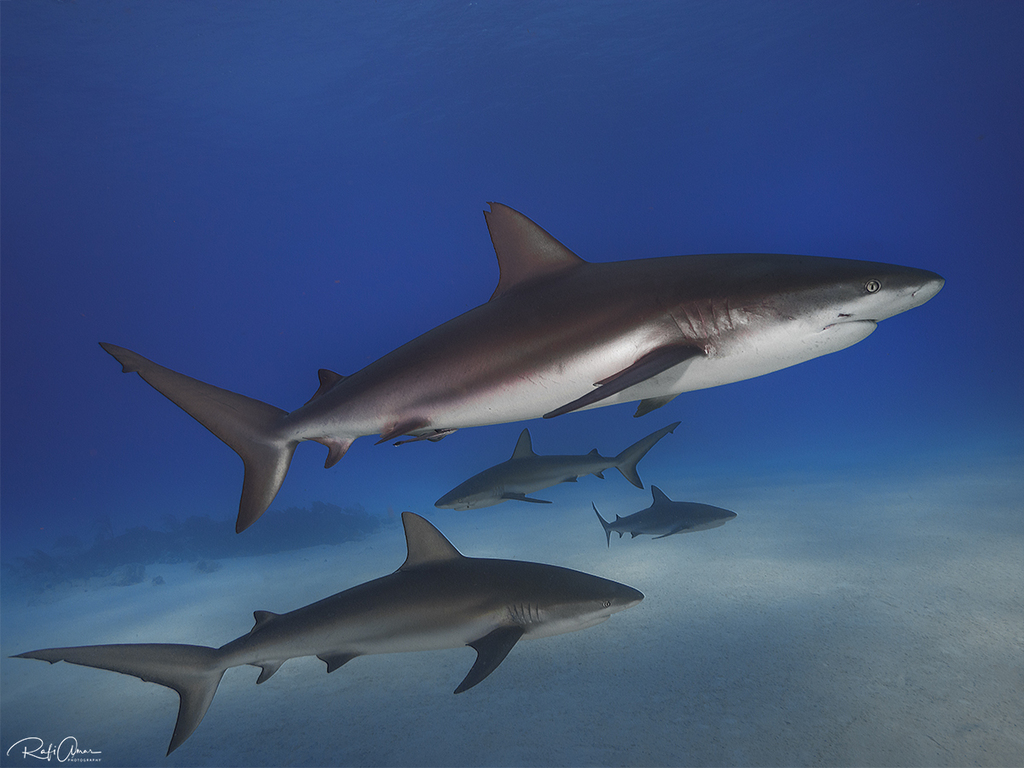
Caribbean Reef Shark
Carcharhinus perezii
The Caribbean reef shark (Carcharhinus perezi) is a species of requiem shark, belonging to the family Carcharhinidae. It is found in the tropical waters of the western Atlantic Ocean from Florida to Brazil, and is the most commonly encountered reef shark in the Caribbean Sea. With a robust, streamlined body typical of the requiem sharks, this species is difficult to tell apart from other large members of its family such as the dusky shark (C. obscurus) and the silky shark (C. falciformis). Distinguishing characteristics include dusky-colored fins without prominent markings, a short free rear tip on the second dorsal fin, and tooth shape and number.
Measuring up to 3 m (9.8 ft) long, the Caribbean reef shark is one of the largest apex predators in the reef ecosystem, feeding on a variety of fishes and cephalopods. They have been documented resting motionless on the sea bottom or inside caves, unusual behavior for an active-swimming shark. If threatened, it may perform a threat display in which it frequently changes direction and dips its pectoral fins. Like other requiem sharks, it is viviparous with females giving birth to 4–6 young every other year. Caribbean reef sharks are of some importance to fisheries as a source of meat, leather, liver oil, and fishmeal, but recently they have become more valuable as an ecotourist attraction. In the Bahamas and elsewhere, bait is used to attract them to groups of divers in controversial "shark feedings". This species is responsible for a small number of attacks on humans. The shark attacks usually happen in spring and summer.
From the article Caribbean reef shark on Wikipedia (CC BY-SA), quoted section by section
Description
A heavy-bodied shark with a "typical" streamlined shape, the Caribbean reef shark is difficult to distinguish from other large requiem shark species. It usually measures 2–2.5 m (6.6–8.2 ft) long; the maximum recorded length is 3 m (9.8 ft) and the maximum reported weight is 70 kg (150 lb). The coloration is dark gray or gray-brown above and white or white-yellow below, with an inconspicuous white band on the flanks. The fins are not prominently marked, and the undersides of the paired fins, the anal fin, and the lower lobe of the caudal fin are dusky. The snout is rather short, broad, and rounded, without prominent flaps of skin beside the nostrils. The eyes are large and circular, with nictitating membranes (protective third eyelids). There are 11–13 tooth rows in either half of both jaws. The teeth have broad bases, serrated edges, and narrow cusps; the front 2–4 teeth on each side are erect and the others increasingly oblique. The five pairs of gill slits are moderately long, with the third gill slit over the origin of the pectoral fins. The first dorsal fin is high and falcate (sickle-shaped). There is a low interdorsal ridge running behind it to the second dorsal fin, which is relatively large with a short free rear tip. …
Range & habitat
The Caribbean reef shark occurs throughout the tropical western Atlantic Ocean, from North Carolina in the north to Brazil in the south, including Bermuda, the northern Gulf of Mexico, and the Caribbean Sea. However, it is extremely rare north of the Florida Keys. It prefers shallow waters on or around coral reefs, and is commonly found near the drop-offs at the reefs' outer edges. This shark is most common in water shallower than 30 m (98 ft), but has been known to dive to 378 m (1,240 ft).
Wikipedia: “Distribution and habitat”
What it does
Despite its abundance in certain areas, the Caribbean reef shark is one of the least-studied large requiem sharks. They are believed to play a major role in shaping Caribbean reef communities. These sharks are more active at night, with no evidence of seasonal changes in activity or migration. Juveniles tend to remain in a localized area throughout the year, while adults range over a wider area. Caribbean reef sharks are sometimes seen resting motionless on the sea floor or inside caves; it is the first active shark species in which such a behavior was reported. In 1975, Eugenie Clark investigated the famed "sleeping sharks" inside the caves at Isla Mujeres off the Yucatan Peninsula, and determined that the sharks were not actually asleep as their eyes would follow divers. Clark speculated that freshwater upwellings inside the caves might loosen parasites on the sharks and produce an enjoyable "narcotic" effect. If threatened, Caribbean reef sharks sometimes perform a threat display, in which they swim in a short, jerky fashion with frequent changes in direction and repeated, brief (1–1.2 second duration) drops of the pectoral fins. This display is less pronounced than the better-known display of the grey reef shark (C. amblyrhynchos). Juvenile Caribbean reef sharks are preyed upon by larger sharks such as the tiger shark (Galeocerdo cuvier) and the bull shark (C. leucas). …
Wikipedia: “Biology and ecology”
Where it lives
Recorded sightings
—
geo-referenced records in GBIF, from museums, herbaria and field observers.
Drag the globe to turn it. Dots are where records exist, not a range map; darker means more records.
In the stacks
Searching the stacks…
Every page naming Carcharhinus perezii in the Biodiversity Heritage Library →
This page is assembled live from iNaturalist, GBIF, Wikipedia, the Source Library and the Internet Archive. It is not yet part of the hand-edited codex. iNaturalist taxon 188767.