- Plants
- ›Vascular Plants
- ›flowering plants
- ›Dicots
- ›carrots, ivies, and allies
- ›Pennantia family
- ›Pennantia
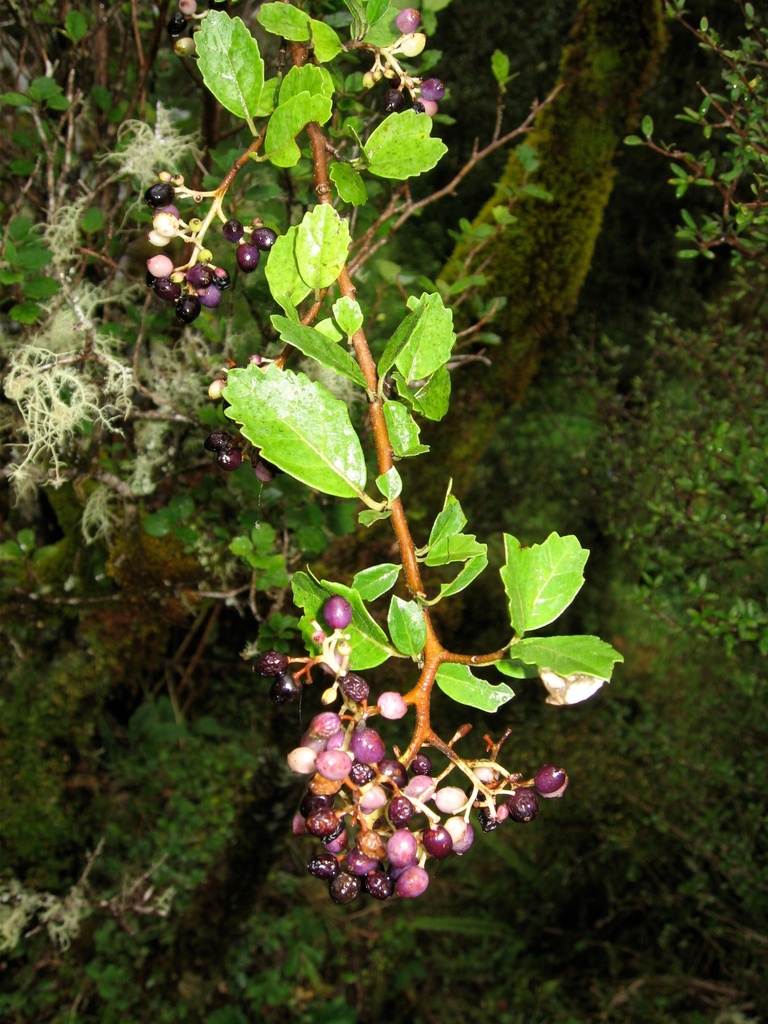
Pennantia corymbosa
Pennantia corymbosa, commonly known as kaikomako (from the Māori kaikōmako), is a small dioecious tree endemic to New Zealand.
Small, creamy flowers are produced between November and February, followed by a shiny black fruit in autumn. They are a favourite food of the New Zealand bellbird.
From the article Pennantia corymbosa on Wikipedia (CC BY-SA), quoted section by section
Description
Identifying P. corymbosa is different at each stage of its life. As a seedling, Kaikōmako has cotyledons which are entire and oval shaped, and are about 10 by 8 millimetres (0.39 by 0.31 in) in size. As the plant grows, the first true leaves are about 9 x 8mm and are three-toothed. As a juvenile, the plant grows into a dense shrub with branches that zig-zag and tangle. As a juvenile, it has small leaves that are about 7 to 15 millimetres (0.28 to 0.59 in) long. Kaikōmako leaves in juvenile form make it easy to identify as they look like duck feet, which is why Kaikōmako is also known as duck's foot. When Kaikōmako grows to adult size, which can be up to 10 meters high, and the plant grows into more of a tree form rather than a shrub, with one predominant branch growing into a single trunk. At its adult stage, Kaikōmako grows leaves that are about 5 cm long. Kaikōmako leaves are evergreen. When Kaikōmako is flowering, it has cream flowers that can completely cover the plant, and then small black/purple berries a few months later.
Range & habitat
Pennantia corymbosa is endemic to New Zealand, although other species that are in the Pennantiaceae family are found elsewhere, such as Pennantia cunninghamii which is found in Australia.
Wikipedia: “Natural global range”
What it does
Kaikōmako has three stages; juvenile, intermediate and adult. Kaikomako can fruit in its intermediate stage and even in its juvenile stage; this is known as precocious fruiting. Kaikōmako is described as a divaricate juvenile (spread out) which has heteroblastic development. Heteroblastic development occurs when the plant undergoes an abrupt change which can be in its form and its function. In Kaikōmako, this heteroblastic development happens from its intermediate stage to its adult stage at about 2 metres (6.6 ft), when the leaves change colour, shape and size becoming its adult form. One stem will eventually take over, rising upward and producing the larger adult leaves. Once Kaikōmako grows past 2 m and enters its adult stage Kaikōmako can grow to be up to 10 metres (33 ft) tall. Many of the Kaikōmako trees that are in their adult stage will still feature lower-level juvenile leaves whilst having upper-level adult leaves. Kaikōmako is said to have this juvenile divaricate phase because it may enhance the plant's chance at capturing light, which would be advantageous to the plant as it grows in forests which can be covered by the canopy of larger trees. Kaikōmako flowers from November to February and fruits from January to May. The fruits of the Kaikōmako tree are usually black but Beddie wrote that the fruits are certainly purple when ripe in the Wellington region. …
Wikipedia: “Life cycle and phenology”
At the table
Kaikōmako was used traditionally by Māori to generate fire. Māori made fire by friction and used Kaikomako as te hika (rubbing stick). Kaikōmako was used as it is a hard and durable wood and was rubbed with obsidian or a shell to make the stick sharp and then was used with Mahoe (another native New Zealand tree) by rubbing the Kaikōmako stick into the grooves of the Mahoe to make fire. Kaikōmako was used as te hika because in Māori mythology a Māori goddess of fire named Mahuika left her magic flame preserved in a Kaikōmako stick for the use of man-kind to make fire.
== References ==
Wikipedia: “Cultural uses”
Where it lives
Recorded sightings
—
geo-referenced records in GBIF, from museums, herbaria and field observers.
Drag the globe to turn it. Dots are where records exist, not a range map; darker means more records.
In the stacks
Searching the stacks…
Every page naming Pennantia corymbosa in the Biodiversity Heritage Library →
This page is assembled live from iNaturalist, GBIF, Wikipedia, the Source Library and the Internet Archive. It is not yet part of the hand-edited codex. iNaturalist taxon 185249.