- Plants
- ›Vascular Plants
- ›flowering plants
- ›Dicots
- ›carrots, ivies, and allies
- ›Pennantia family
- ›Pennantia
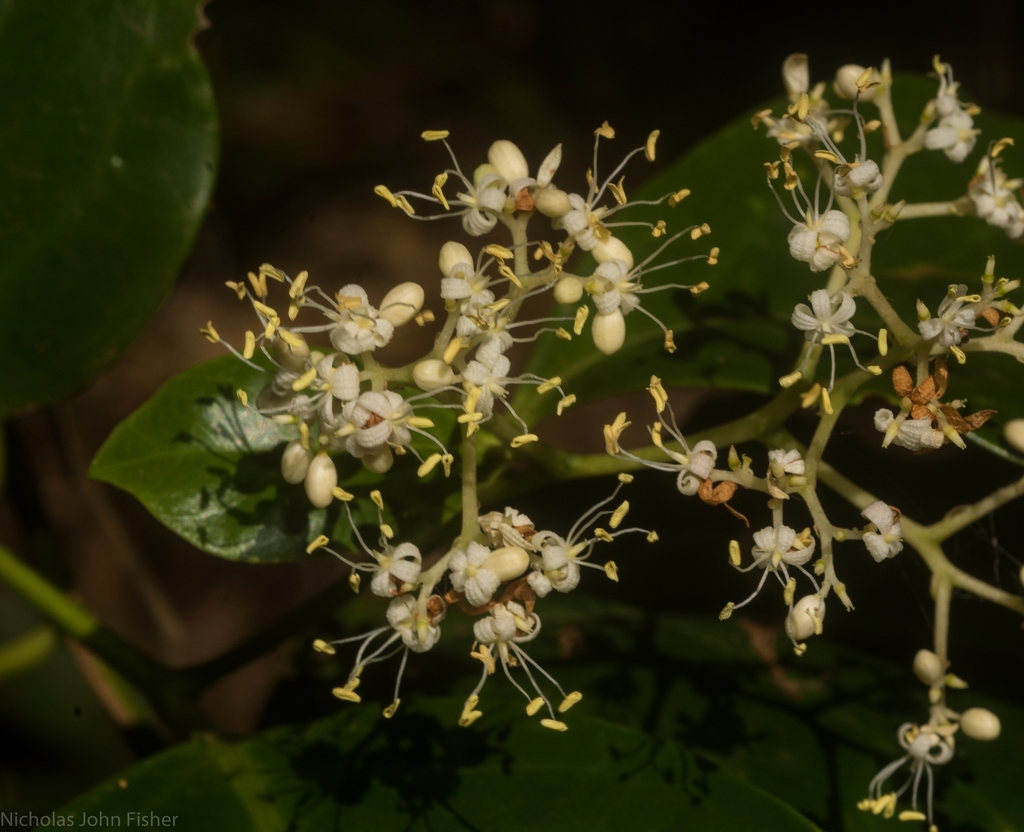
brown beech
Pennantia cunninghamii
Pennantia cunninghamii, commonly known as brown beech, is a species of flowering plant in the family Pennantiaceae. It is a tree with a fluted trunk, often scaly bark, glossy, elliptic or oblong leaves, panicles of bisexual or male flowers, and fleshy black drupes.
From the article Pennantia cunninghamii on Wikipedia (CC BY-SA), quoted section by section
Description
Pennantia cunninghamii is a tree that typically grows to a height of up to 30 m (98 ft) and has an irregularly fluted trunk with dark grey to brown, often scaly bark and a flanged base. The leaves are elliptic or oblong, 70–180 mm (2.8–7.1 in) long and 40–80 mm (1.6–3.1 in) wide on a petiole 10–20 mm (0.39–0.79 in) long and arranged along zig-zagging branchlets. Both sides of the leaves are glossy with prominent domatia on the veins. The flowers are bisexual or male, arranged in panicles on the ends of branches or in upper leaf axils, the sepals insignificant, the petals glabrous, 3–4 mm (0.12–0.16 in) long and 1.0–1.5 mm (0.039–0.059 in) wide. Flowering occurs from November to January and the fruit is a fleshy black drupe 10–15 mm (0.39–0.59 in) long and 7–9 mm (0.28–0.35 in) wide containing a single seed.
Range & habitat
Brown beech grows in rainforest from Clyde Mountain near Batemans Bay (35° S) in southern New South Wales to Atherton (17° S) in tropical Queensland.
Wikipedia: “Distribution and habitat”
What it does
The fruit of P. cunninghamii is eaten by grey-headed flying fox and a variety of bird species including brown cuckoo dove, green catbird, topknot pigeon, wompoo fruit-dove and white-headed pigeon. The larva of the moth Cardamyla carinentalis pupates between leaves of this species.
== References ==
Wikipedia: “Ecology”
Where it lives
Recorded sightings
—
geo-referenced records in GBIF, from museums, herbaria and field observers.
Drag the globe to turn it. Dots are where records exist, not a range map; darker means more records.
In the stacks
Searching the stacks…
Every page naming Pennantia cunninghamii in the Biodiversity Heritage Library →
This page is assembled live from iNaturalist, GBIF, Wikipedia, the Source Library and the Internet Archive. It is not yet part of the hand-edited codex. iNaturalist taxon 185248.