- Plants
- ›Vascular Plants
- ›flowering plants
- ›Dicots
- ›pinks, cactuses, and allies
- ›cacti
- ›globular cacti, moonlight cacti, torch cacti, and allies
- ›Cereeae
- ›Cipocereus
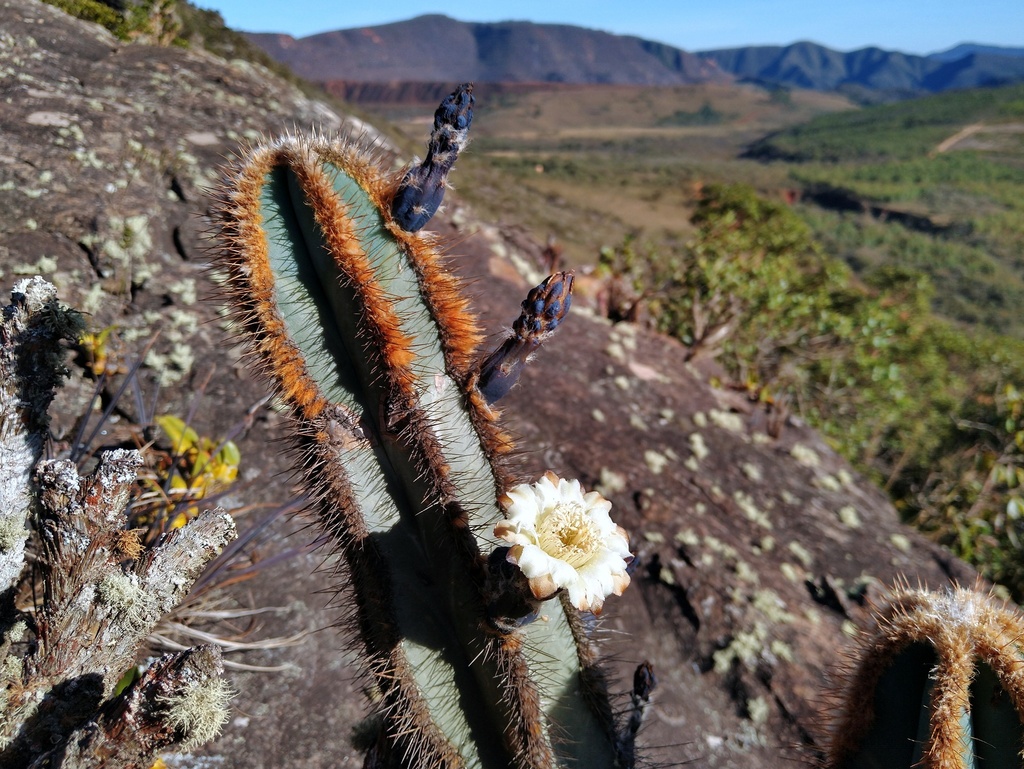
Cipocereus laniflorus
Cipocereus laniflorus is a species of succulent flowering plant in the genus Cipocereus, within the family Cactaceae. It is endemic to southeastern Brazil.
From the article Cipocereus laniflorus on Wikipedia (CC BY-SA), quoted section by section
Description
Cipocereus laniflorus is a species of cactus with a treelike habit. Its stems, which branch out from the base of the plant, are columnar and olive-green in color. They can reach 2 m in height and 4 cm in diameter. The stems have 5-7 triangular ribs, on which the light brown to black areoles are situated. From the areoles emerge long, white hairs; over time, the areoles fuse and form continuous bands on the ribs. Furthermore, the areoles have translucent, dark brown spines, among which are 7-9 central spines, which measure 1.5-3 cm long. 10-14 marginal spines (up to 1 cm long) are also present per areole. The flowers are woolly and spiny. They are white to light creamy yellow in color, and measure 7 cm long and 3.5 cm wide. The fruits are ovoid, grooved, more or less blue-purple in color, and like the flowers, woolly and spiny. The seeds are brown in color.
Range & habitat
Cipocereus laniflorus is native to the state of Minas Gerais in southeastern Brazil. It is mainly found in the seasonally-dry tropical biome.
Wikipedia: “Distribution and habitat”
How it is grown
Cipocereus laniflorus is mainly cultivated as an ornamental plant. It can be propagated vegetatively by cuttings, or by seeds.
== References ==
Wikipedia: “Cultivation”
Where it lives
Recorded sightings
—
geo-referenced records in GBIF, from museums, herbaria and field observers.
Drag the globe to turn it. Dots are where records exist, not a range map; darker means more records.
In the stacks
Searching the stacks…
Every page naming Cipocereus laniflorus in the Biodiversity Heritage Library →
This page is assembled live from iNaturalist, GBIF, Wikipedia, the Source Library and the Internet Archive. It is not yet part of the hand-edited codex. iNaturalist taxon 184187.