- Plants
- ›Vascular Plants
- ›flowering plants
- ›Dicots
- ›pinks, cactuses, and allies
- ›cacti
- ›globular cacti, moonlight cacti, torch cacti, and allies
- ›Trichocereeae
- ›Discocactus
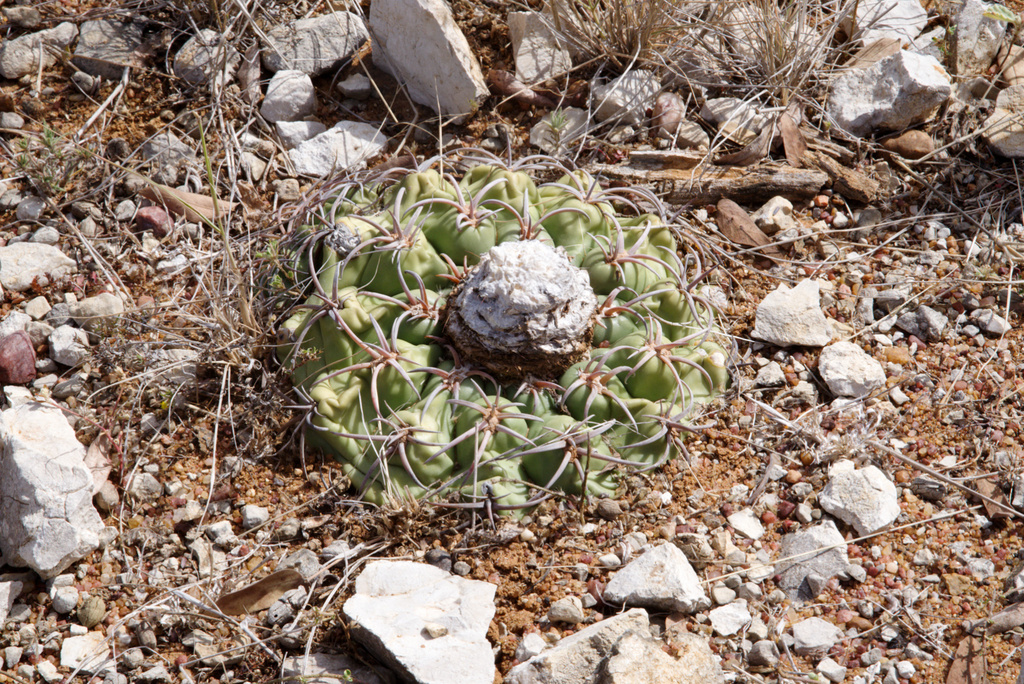
Discocactus bahiensis
Discocactus bahiensis is a species of Discocactus from Brazil.
From the article Discocactus bahiensis on Wikipedia (CC BY-SA), quoted section by section
Description
Discocactus bahiensis grows solitary and rarely clumping, with heavily spined. The stems are pale green, depressed spherical to spherical bodies that reach diameters of 5.5 to 18 cm (2.2 to 7.1 in) and 3 to 7 cm (1.2 to 2.8 in) tall. They usually grow with the stem buried in the soil, either partially or completely, and their roots are somewhat thickened, and napiform. There are 10 to 15 ribs with well-developed tubercles and 2 to 5 oval areole per rib. The areoles are 3 to 10 mm (0.12 to 0.39 in) long and 3 to 8 mm (0.12 to 0.31 in) wide, woolly becoming glabrous with age, with 5 to 14 backward-curved spines. The spines are stiff, woody and creamy to gray-brown and measure 0.6 to 4.5 cm (0.24 to 1.77 in) long and 0.5 to 3 mm (0.020 to 0.118 in) wide. The prominent cephalium is formed of white wool and a few short bristles measuring 2.2 to 4.7 cm (0.87 to 1.85 in) tall and 0.9 to 2.1 cm (0.35 to 0.83 in) wide. The slender, funnel-shaped, sweet-scented, yellowish white flowers arise from the edge of the cephalium. The flowers open at night and are 4–7 cm (1.6–2.8 in) long and 2.3–5.4 cm (0.91–2.13 in) in diameter, and the buds are green to brown. Flowering occurs between November and February, peaking in January, when most plants bear 1–5 flowers at a time. …
Range & habitat
Discocactus bahiensis is a cactus species native to the Brazilian states of Bahia, Ceará, Pernambuco, and Piauí at altitudes between 380 and 650 meters. Plants are found growing in rocky and sandy loam, among iron-stained limestone or quartzite formations, near rivers and flood plains.
Wikipedia: “Distribution”
Where it lives
Recorded sightings
—
geo-referenced records in GBIF, from museums, herbaria and field observers.
Drag the globe to turn it. Dots are where records exist, not a range map; darker means more records.
In the stacks
Searching the stacks…
Every page naming Discocactus bahiensis in the Biodiversity Heritage Library →
This page is assembled live from iNaturalist, GBIF, Wikipedia, the Source Library and the Internet Archive. It is not yet part of the hand-edited codex. iNaturalist taxon 183680.