- Animals
- ›Chordates
- ›Vertebrates
- ›Mammals
- ›Therians
- ›Placental Mammals
- ›Ungulates, Carnivorans, and Allies
- ›Bats
- ›Yangochiroptera
- ›Vespertilionoid Bats
- ›Evening Bats
- ›Vesper Bats
- ›Tricolored and Canyon Bats
- ›Perimyotis
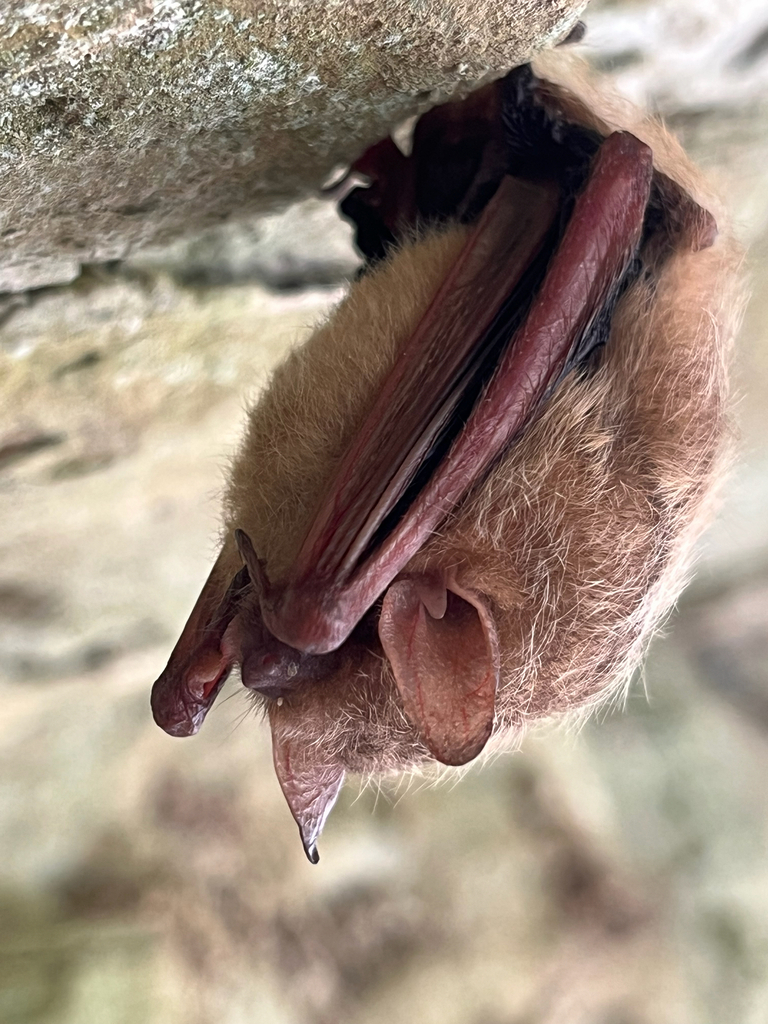
Tri-coloured Bat
Perimyotis subflavus
The tricolored bat (Perimyotis subflavus) or American perimyotis is a species of microbat native to eastern North America. Formerly known as the eastern pipistrelle, based on the incorrect belief that it was closely related to European Pipistrellus species, the closest known relative of the tricolored bat is now recognized as the canyon bat. Its common name "tricolored bat" derives from the coloration of the hairs on its back, which have three distinct color bands. It is the smallest bat species in the eastern and midwestern US, with individuals weighing only 4.6–7.9 g (0.16–0.28 oz). This species mates in the fall before hibernation, though due to sperm storage, females do not become pregnant until the spring. Young are born helpless, though rapidly develop, flying and foraging for themselves by four weeks old. It has a relatively long lifespan, and can live nearly fifteen years.
In the summer, females roost in small groups and males roost solitarily in tree foliage or beard lichen. It eats a diverse array of insects, foraging with a slow, erratic flight and navigating via echolocation. Though once considered one of the most common bat species in its range, its populations have declined rapidly since 2006 with the introduction of the fungal disease white-nose syndrome. It was listed as an endangered species in 2012 in Canada, and has been petitioned for inclusion on the US endangered species list.
From the article Tricolored bat on Wikipedia (CC BY-SA), quoted section by section
Description
The tricolored bat has blond fur that is distinctly tricolored on its back. Individual hairs tricolored: dark gray at the base, buffy (yellowish brown) in the middle, and brown or reddish brown at the tip. It is the smallest bat species found in the eastern and midwestern US. Individuals have a forearm length of 31.4–34.1 mm (1.24–1.34 in) and weigh 4.6–7.9 g (0.16–0.28 oz). Its forearms are reddish, contrasting sharply with the black membranes of its wings. Its wingspan is 21–26 cm (8.3–10.2 in). It has a dental formula of 2.1.2.33.1.2.3 for a total of 34 teeth.
Range & habitat
The tricolored bat is common throughout eastern North America, with the southern extent of its range in Central America and the northern extent in southern Canada. Its range has expanded since the 1980s, with westward expansion reaching the US states of Colorado, New Mexico, South Dakota, and Wyoming. Additionally, its range started to include the Great Lakes Basin.
Wikipedia: “Range and habitat”
What it does
The tricolored bat is a seasonal breeder, with copulation (mating) occurring in the fall before hibernation. Ovulation does not occur until the spring, however, and females store the males' sperm in their uteruses through the winter. Gestation (pregnancy) length is about forty-four days, with females giving birth in June or July. The litter size is typically two individuals. As newborns, the combined mass of twin pups can be as great as 58% of the mother's postpartum mass. At birth, the young lack fur and their eyes are closed. The mother leaves the offspring behind at the roost while she forages at night. Offspring develop rapidly, beginning to fly at three weeks old. By four weeks old, they are foraging for themselves. Young do not reach sexual maturity in their first fall; they do not breed until their second fall. Individuals can live at least 14.8 years in the wild; juveniles have higher mortality rates than adults, and females have higher mortality rates than males.
Wikipedia: “Reproduction and life cycle”
Listen
Looking for field recordings…
Where it lives
Recorded sightings
—
geo-referenced records in GBIF, from museums, herbaria and field observers.
Drag the globe to turn it. Dots are where records exist, not a range map; darker means more records.
In the stacks
Searching the stacks…
Every page naming Perimyotis subflavus in the Biodiversity Heritage Library →
This page is assembled live from iNaturalist, GBIF, Wikipedia, the Source Library and the Internet Archive. It is not yet part of the hand-edited codex. iNaturalist taxon 183166.