virola nut
Virola sebifera
Virola sebifera is a species of tree in the family Myristicaceae, from North and South America.
From the article Virola sebifera on Wikipedia (CC BY-SA), quoted section by section
Description
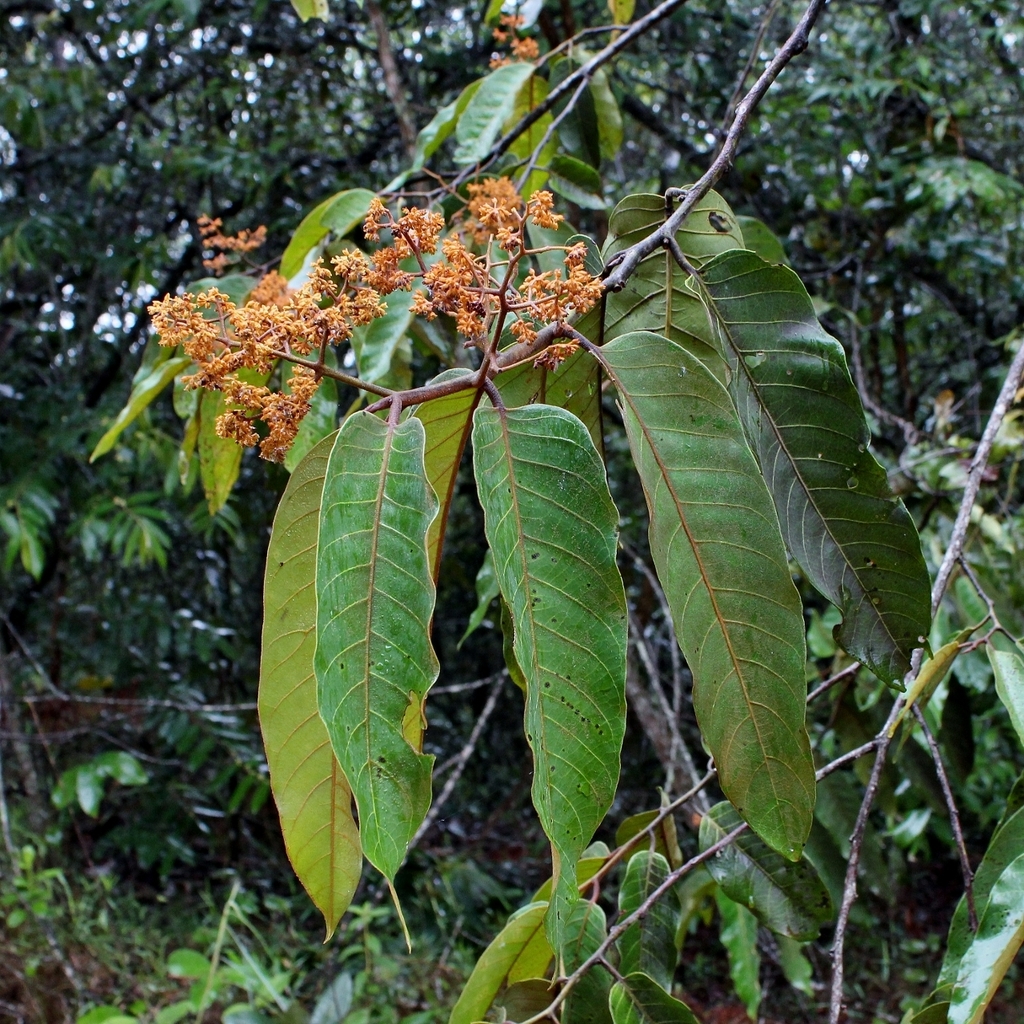
V. sebifera is a tall, thin tree which grows 5–30 m (16–98 ft) tall. The leaves are simple and grow up to 30 cm (12 in) long. The small flowers are single-sexed and are found in panicles. The fruit is reddish, oval-shaped, and about 10–15 mm (0.39–0.59 in) long and about 11 mm (0.43 in) in diameter. The individual Virola trees, which include 40 to 60 species, are difficult to differentiate from one another.
At the table
Seeds from V. sebifera are processed to obtain the fats, which are yellow and aromatic. They smell like nutmeg. The fats also become rancid quickly. They are used industrially in the production of fats, candles, and soaps. This virola fat possesses properties similar to cocoa butter and shea butter. The wood of V. sebifera has a density around 0.37 g/cm3 (0.013 lb/cu in).
Wikipedia: “Industrial uses”
In medicine
The smoke of the inner bark of the tree is used by shamans of the indigenous people of Venezuela in cases of fever conditions, or cooked for driving out evil ghosts. The homeopathic concoction Myristica sebifera (abbreviation: Myris) is derived from the fresh, red juice from the injured bark of the tree. Homeopathic practice uses it for such ailments as abscesses, phlegmon, paronychia, furuncle, anal fissures, infections of the parotid gland, bacterially infected tonsillitis, and others. As of date, there is no empirical evidence supporting any medical effectiveness of Myristica sebifera. Any physiological efficacy would be highly implausible from a biochemical standpoint.
Wikipedia: “Homeopathy and traditional uses”
Where it lives
Recorded sightings
—
geo-referenced records in GBIF, from museums, herbaria and field observers.
Drag the globe to turn it. Dots are where records exist, not a range map; darker means more records.
In the stacks
Searching the stacks…
Every page naming Virola sebifera in the Biodiversity Heritage Library →
This page is assembled live from iNaturalist, GBIF, Wikipedia, the Source Library and the Internet Archive. It is not yet part of the hand-edited codex. iNaturalist taxon 182225.