- Plants
- ›Vascular Plants
- ›flowering plants
- ›Dicots
- ›Legumes, Milkworts, and Allies
- ›soapbark family
- ›Quillaja
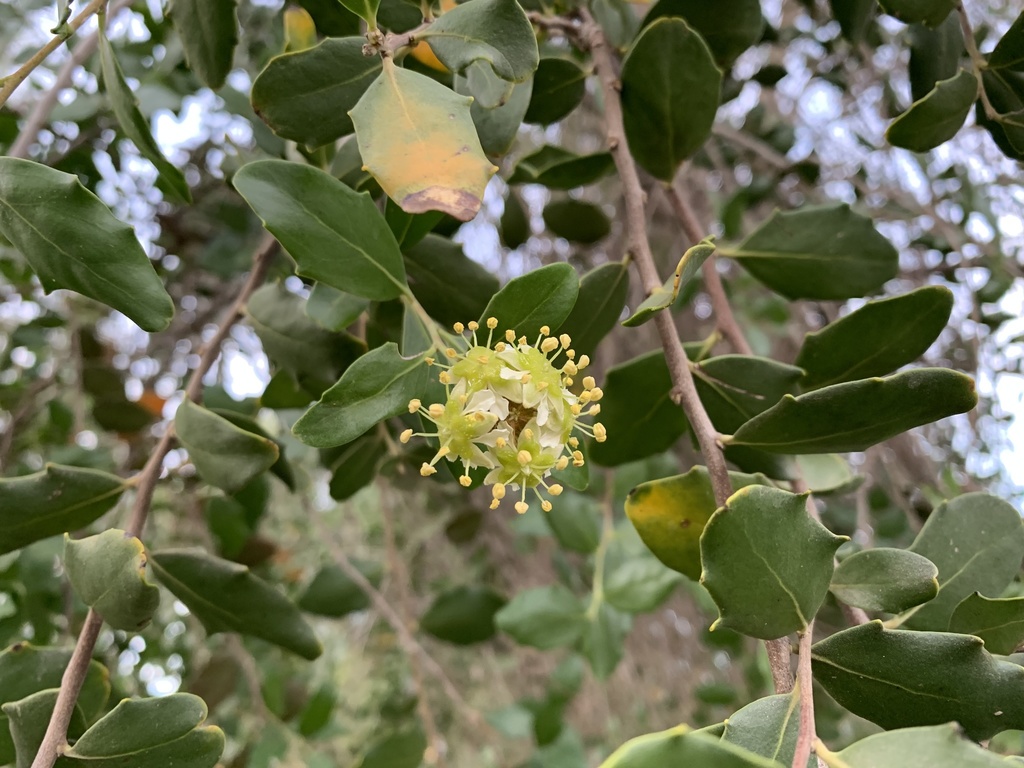
soapbark tree
Quillaja saponaria
Quillaja saponaria, the soap bark tree or soapbark, is an evergreen tree in the family Quillajaceae, native to warm temperate central Chile. In Chile it occurs from 32 to 40° South Latitude approximately and at up to 2000 m (6500 ft) above sea level. It can grow to 15–20 m (50–65 ft) in height. The tree has thick, dark bark; smooth, leathery, shiny, oval evergreen leaves 3–5 cm long; white star-shaped flowers 15 mm in diameter borne in dense corymbs; and a dry fruit with five follicles each containing 10–20 seeds. The tree has several practical and commercial uses.
From the article Quillaja saponaria on Wikipedia (CC BY-SA), quoted section by section
Range & habitat
This tree occurs at elevations up to 2000 metres. The species is drought resistant, and tolerates about −12 °C (10 °F) in its natural habitat. Examples of specific occurrences are in central Chile in the forests of La Campana National Park and Cerro La Campana, in which locales it is associated with the Chilean wine palm, Jubaea chilensis. It is often used for reforestation on arid soils. The plant has been introduced as an ornamental in California, and has been acclimatized in Spain but is rarely cultivated there.
Wikipedia: “Habitat”
At the table
The wood is used in cabinetry, and scents derived from the tree are used in perfumes and cosmetics. The inner bark of Quillaja saponaria can be reduced to powder and employed as a substitute for soap, since it forms a lather with water, owing to the presence of a glycoside saponin, sometimes distinguished as quillaia saponin. The same, or a closely similar substance, is found in soapwort (Saponaria officinalis), in senega root (Polygala senega) and in sarsaparilla; it appears to be chemically related to digitonin, which occurs in digitalis.
Uses of the saponins. Soap bark tree has a long history of medicinal use with the Andean people who used it as a treatment for various chest problems. The saponin content of the bark helps to stimulate the production of a more watery mucus in the airways, thus facilitating the removal of phlegm through coughing. The bark is the source of quillaia, the extract of which is used as a food additive and as an ingredient in pharmaceuticals, pesticides, personal care products, fire-fighting foam, and applied as an agricultural spray adjuvant. …
Wikipedia: “Uses”
In human culture
Quillaja is derived from the indigenous Mapuche name küllay, which means soap, and the Chilean vernacular name for this species, culay. Saponaria means 'soap-like'.
Wikipedia: “Etymology”
Where it lives
Recorded sightings
—
geo-referenced records in GBIF, from museums, herbaria and field observers.
Drag the globe to turn it. Dots are where records exist, not a range map; darker means more records.
In the stacks
Searching the stacks…
Every page naming Quillaja saponaria in the Biodiversity Heritage Library →
This page is assembled live from iNaturalist, GBIF, Wikipedia, the Source Library and the Internet Archive. It is not yet part of the hand-edited codex. iNaturalist taxon 181934.