- Plants
- ›Vascular Plants
- ›flowering plants
- ›monocots
- ›grasses, sedges, cattails, and allies
- ›grasses
- ›Panicums, Bluestems, Paspalums, and Allies
- ›bluestems, lemon grasses, silvergrasses, and allies
- ›Tripsacinae
- ›Zea
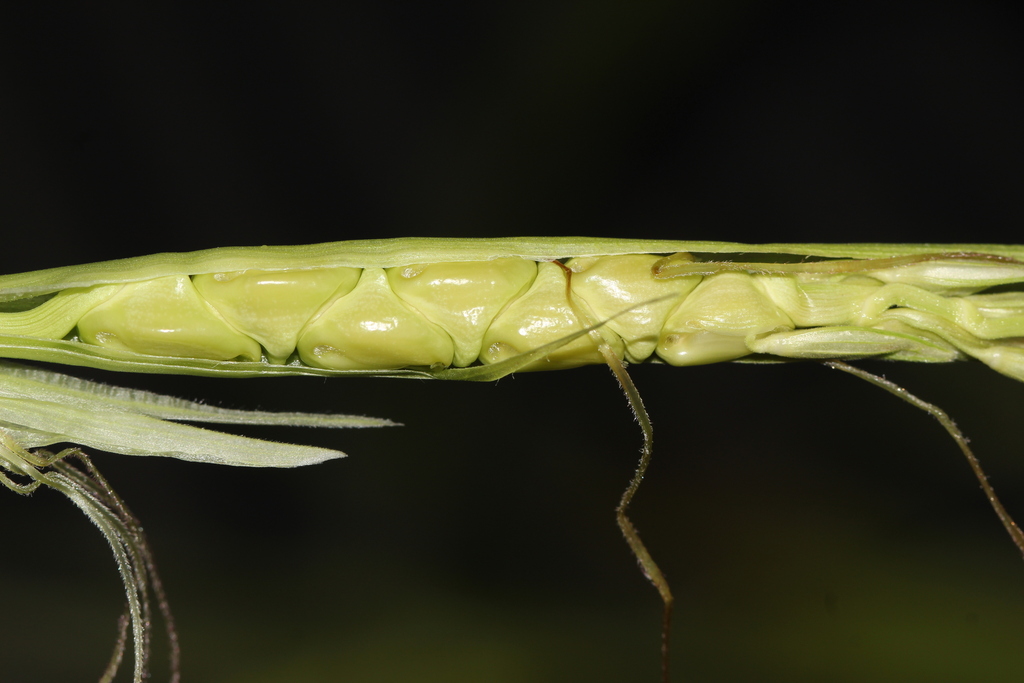
Mexican teosinte
Zea mexicana
Zea is a genus of flowering plants in the grass family. The best-known species is Z. mays subsp. mays (variously called maize, corn, or Indian corn), one of the most important crops for human societies throughout much of the world. The wild species are commonly known as teosintes and are native to Mesoamerica.
From the article Zea (plant) on Wikipedia (CC BY-SA), quoted section by section
Description
Both annual and perennial teosinte species occur. Z. diploperennis and Z. perennis are perennial, while all other species are annual. All species are diploid (n=10) with the exception of Z. perennis, which is tetraploid (n=20). The different species and subspecies of teosinte can be readily distinguished based on morphological, cytogenetic, protein, and DNA differences and on geographic origin. The two perennials are sympatric and very similar and some consider them to be one species. What many consider to be the most puzzling teosinte is Z. m. huehuetenangensis, which combines a morphology rather like Z. m. parviglumis with many terminal chromosome knobs and an isozyme position between the two sections. Considered to be phenotypically the most distinctive, as well as the most threatened, teosinte is Zea nicaraguensis. This teosinte thrives in flooded conditions along 200 m (660 ft) of a coastal estuarine river in northwest Nicaragua. Teosintes strongly resemble maize in many ways, notably their tassel (male inflorescence) morphology. Teosintes are distinguished from maize most obviously by their numerous branches each bearing bunches of distinctive, small female inflorescences. These spikes mature to form a two-ranked 'ear' of five to 10 triangular or trapezoidal, black or brown disarticulating segments, each with one seed. …
What it does
Zea species are used as food plants by the larvae (caterpillars) of some Lepidopteran species including (in the Americas) the fall armyworm (Spodoptera frugiperda), the corn earworm (Helicoverpa zea), and the stem borers Diatraea and Chilo; in the Old World, it is attacked by the double-striped pug, the cutworms heart and club and heart and dart, Hypercompe indecisa, the rustic shoulder-knot, the setaceous Hebrew character and turnip moths, and the European corn borer (Ostrinia nubilalis), among many others. Virtually all populations of teosintes are either threatened or endangered: Z. diploperennis exists in an area of only a few square miles; Z. nicaraguensis survives as about 6000 plants in an area of 200 × 150 m. The Mexican and Nicaraguan governments have taken action in recent years to protect wild teosinte populations, using both in situ and ex situ conservation methods. Currently, a large amount of scientific interest exists in conferring beneficial teosinte traits, such as nitrogen fixation, insect resistance, perennialism, and flood tolerance, to cultivated maize lines, although this is very difficult due to linked deleterious teosinte traits.
Wikipedia: “Ecology”
In human culture
Zea is derived from the Greek name (ζειά) for another cereal grain (possibly spelt).
Wikipedia: “Etymology”
Where it lives
Recorded sightings
—
geo-referenced records in GBIF, from museums, herbaria and field observers.
Drag the globe to turn it. Dots are where records exist, not a range map; darker means more records.
In the stacks
Searching the stacks…
Every page naming Zea mexicana in the Biodiversity Heritage Library →
This page is assembled live from iNaturalist, GBIF, Wikipedia, the Source Library and the Internet Archive. It is not yet part of the hand-edited codex. iNaturalist taxon 170410.