- Plants
- ›Vascular Plants
- ›flowering plants
- ›Dicots
- ›Mallows, Rock Roses, and Allies
- ›Mallow and Hibiscus Family
- ›Malvoideae
- ›Malveae
- ›Wissadula
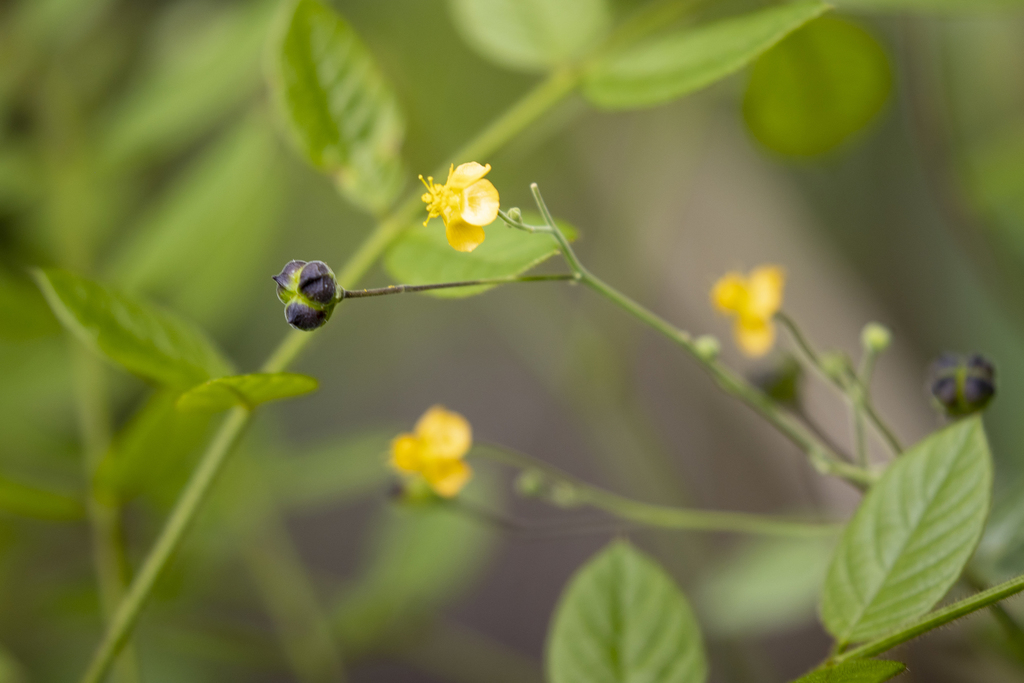
big yellow velvetleaf
Wissadula amplissima
Wissadula amplissima, the big yellow velvetleaf, is a species of shrub native to the American tropics, including Mexico. It may also occur in Cape Verde and Tropical Africa, depending on whether the African plants are a variety of this species or Wissadula rostrata. It belongs to the family Malvaceae.
From the article Wissadula amplissima on Wikipedia (CC BY-SA), quoted section by section
Description
Big yellow velvetleaf is a large, hairy shrub with heart-shaped leaves and topped with a diffuse gathering of clusters of small flowers and fruits. Distinguishing the species from numerous similar ones is mainly a matter of noting features of the schizocarp-type fruits and flower color. Here are its key identification features:
The shrubs are up to 3 m (10 ft) tall. Leaves have hairy petioles up to 16 cm (6+1⁄4 in) long and hairy, heart-shaped, velvety-feeling blades up to 20 cm (7+3⁄4 in) long, and nearly as wide. Blade margins bear no teeth or indentations, but may be wavy. Lobes at blade bases may overlap one another. The blades are much paler below than above. The flowering/fruiting part atop the plant consists of a complex system of inflorescences acting as a single unit, sometimes known as a "synflorescence." Within this grouping, individual small flowers are held in clusters of 2 or 3 at tips of long inflorescence branches, the structure thus appearing somewhat diffuse. Flowers have yellow corollas up to 11 mm (7⁄16 in) in diameter, and calyces up to 4 mm (3⁄16 in), which grow as the fruit develops. The schizocarp-type fruits, up to 1 cm (3⁄8 in) in diameter, split into divisions called "mericarps," with each mericarp producing 3 seeds. The mericarps are well distinct from one another and each is topped with a conspicuous point.
Range & habitat
In the Americas, big yellow velvetleaf occurs throughout most of Mexico except for the drier areas, the Caribbean and south through Central America into Peru and most of Brazil in South America. Plants of the World Online places the species in tropical Africa, on the basis that the taxon known as Wissadula rostrata should be treated as a subspecies of Wissadula amplissima. A 2010 paper suggests that the African plants merit recognition as a distinct species.
Wikipedia: “Distribution”
In medicine
In the Ashanti Region of Ghana, big yellow velvetleaf's variety rostrata (sometimes considered the species W. rostrata) is used to treat stings of spiders, wasps and bees. Laboratory analysis of extracts of powdered dried leaves of the species gave "... scientific credence to the local use of Wissadula amplissima to modulate inflammation induced by stings of animals."
Wikipedia: “In traditional medicine”
In human culture
The genus name Wissadula is thought to be based on the Sinhalese words wissa, meaning "poison" and duvili, meaning "dust or powder." The resulting name wissaduli was used for the plant Centipeda minima but in 1787 was misapplied here when Friedrich Kasimir Medikus erected the genus. The species name amplissima is from Latin, an adjective of the 1st declension, meaning "great, large, spacious, wide, ample," and more. This refers to the leaf's width, maybe because the species has the largest leaves among the genus Sida, to which formerly the taxon belonged.
== References ==
Wikipedia: “Etymology”
Where it lives
Recorded sightings
—
geo-referenced records in GBIF, from museums, herbaria and field observers.
Drag the globe to turn it. Dots are where records exist, not a range map; darker means more records.
In the stacks
Searching the stacks…
Every page naming Wissadula amplissima in the Biodiversity Heritage Library →
This page is assembled live from iNaturalist, GBIF, Wikipedia, the Source Library and the Internet Archive. It is not yet part of the hand-edited codex. iNaturalist taxon 170328.