- Plants
- ›Vascular Plants
- ›flowering plants
- ›Dicots
- ›Mints, Plantains, Olives, and Allies
- ›figwort family
- ›Scrophularieae
- ›Verbascum
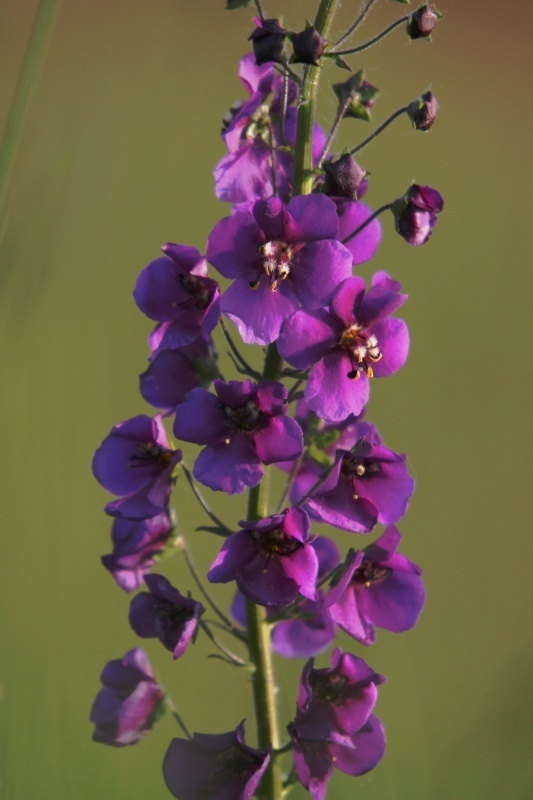
Purple Mullein
Verbascum phoeniceum
Verbascum phoeniceum, known as purple mullein or temptress purple, is a species of mullein that is part of the Scrophulariaceae family native to Central Europe, Central Asia and Western China. It is also naturalized in certain regions of the US and Canada. It successfully grows in USDA’s zones 4 to 8. It is a short-lived perennial species, and blooms earlier than other mullein species on average, producing vibrant purple-pink flowers; it can grow up to 1m...
From the article Verbascum phoeniceum on Wikipedia (CC BY-SA), quoted section by section
Description
Verbascum phoeniceum is a dicot plant that begins with rosette growth in late spring and into summer. The initial lower rosette shows whorled basal leaves with pinnate venation and as growth continues, simple leaves grow in an alternating fashion on the stem. The shape of the leaf blades of the V. phoeniceum can be elliptical, ovate, chordate or lanceolate depending on the environment in which it grows in. Five-petaled flowers appear when in bloom, where it grows as an inflorescence with multiple flowers on a spike starting with the first blooms on the bottom of the spike and newer ones upwards of the spike. V. phoeniceum exhibits pentamerous growth of perianth and corolla that is characteristic of the dicotyledonous mulleins. The flowers can be deep purple in color (violetta) to pink (rosetta) and white (flush of white). The variation in shades for V. phoeniceum makes it ideal for hybridization with other mulleins. Hybrids may have flower colors ranging from white to various shades of pink and plum; as well as the advantage of a longer growing season due to its perennial nature. In the center of each flower are fuzzy golden-yellow stamens. The height of V. phoeniceum is shorter than most mulleins but can range between 0.9m – 1.2m in an herbaceous habit.
Range & habitat
Verbascum phoeniceum is found in southern Europe, northern Africa and central Asia. It thrives in dry soils with full sunlight. Although they can tolerate moderate shade, they are unable to withstand soggy soils thereby requiring efficient water drainage. It can be found growing wild on hillsides, disturbed sites and woodlands in their native habitats. V. phoeniceum has been brought over to the US among other temperate regions and cultivated as an ornamental garden plant. It thrives in USDA’s hardiness zones 4-8, with possible natural occurrence in New York and Ohio where the winter temperatures are also required for seed germination after dormancy.
Wikipedia: “Distribution”
What it does
Verbascum phoeniceum is pollinated by hoverflies and bees although it is suspected that moths also take part in pollinating the mulleins. The flowers expel a fragrance early in the day believed to attract moths and close up midday. In a study by Branimir Petkovic et al. 2004, V. phoeniceum were planted on three different substratum soil types, serpentine, andesite and limestone. Results showed that plant morphology and anatomy varies with soil type. Plants grown on serpentine substratum produced smaller stem leaves with the blades chordate shaped and dentate margins; plants grown on limestone substratum featured lanceolate stem leaves with entire margins and plants grown on andesite substratum featured even narrower chordate stem leaves with dentate margins. Serpentine soil produces an overall decrease in average values of the V. phoeniceum while limestone yields the highest values with andesite an intermediate, these values includes plant height, inflorescent length, flower numbers, and pedicel length. The first observation of self-incompatibility in plants was made on V. phoeniceum in the late 18th century and published by Joseph Gottlieb Kölreuter. Unlike other mulleins V. thapsus and V. lychnitis which are able to self-pollinate, V. phoeniceum pollinated with their own pollen do not set seed but are cross-fertile; this had been attributed to the allotetraploidy of the plant. …
Wikipedia: “Ecology”
How it is grown
Verbascum phoeniceum is cultivated as an ornamental plant, useful for adding vertical accents to the garden. It prefers alkaline or poor soil in a sunny position. Several cultivars have been developed in a range of shades, including:
Wikipedia: “Cultivation”
Where it lives
Recorded sightings
—
geo-referenced records in GBIF, from museums, herbaria and field observers.
Drag the globe to turn it. Dots are where records exist, not a range map; darker means more records.
In the stacks
Searching the stacks…
Every page naming Verbascum phoeniceum in the Biodiversity Heritage Library →
This page is assembled live from iNaturalist, GBIF, Wikipedia, the Source Library and the Internet Archive. It is not yet part of the hand-edited codex. iNaturalist taxon 170141.