- Plants
- ›Vascular Plants
- ›flowering plants
- ›monocots
- ›lilies, supplejacks, and allies
- ›Herb-Paris, False Hellebores, Trilliums and allies
- ›Parideae
- ›Trillium
- ›Sessilia
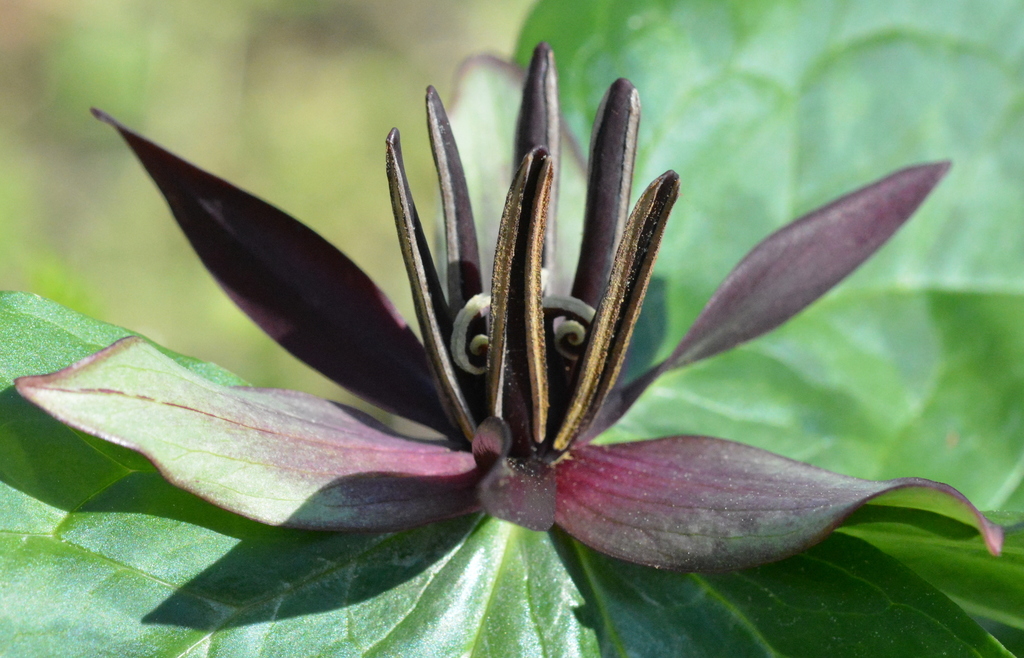
Twisted Trillium
Trillium stamineum
Trillium stamineum, the twisted trillium, also known as the Blue Ridge wakerobin, is a species of flowering plant in the family Melanthiaceae. It is native to the southeastern United States, in Alabama, Mississippi and Tennessee. Its natural habitat is calcareous woodlands.
From the article Trillium stamineum on Wikipedia (CC BY-SA), quoted section by section
Description
Trillium stamineum is a perennial herbaceous plant that spreads by means of underground rhizomes. The plant has three sessile bracts (leaves) arranged in a whorl about a pubescent scape (stem) that rises directly from the rhizome 15 to 30 cm (5.9 to 11.8 in) high. The ovate leaves, 6.3 to 7.6 cm (2.5 to 3.0 in) long by 3.3 to 5 cm (1.3 to 2.0 in) wide, are bluish-green with strong mottling that fades with age. T. stamineum flowers between March and May, depending on latitude. A solitary flower is carried directly on the leaves. Unlike other sessile-flowered trilliums, the petals spread horizontally (instead of vertically) exposing stiffly erect stamens 16 to 24 mm (0.6 to 0.9 in) long. The dark maroon petals, 1.5 to 2.8 cm (0.6 to 1.1 in) long by 0.3 to 0.6 cm (0.1 to 0.2 in) wide, have a distinctive twist along their major axis. The carrion-scented flower of this species attracts scavenging flies and other insects for pollination. All flower parts (stamens, filaments, anthers, ovary, stigmas) are purple or dark purple. Even the fruit is purple. In 1975, Freeman described a form that is devoid of purple pigment, which he called Trillium stamineum f. luteum. That name is now regarded as a synonym. In 1901, Harbison compared Trillium stamineum to Trillium sessile. The former is distinguished by its pubescent stem, unusual petals, long erect stamens, and very short filaments.
Where it lives
Recorded sightings
—
geo-referenced records in GBIF, from museums, herbaria and field observers.
Drag the globe to turn it. Dots are where records exist, not a range map; darker means more records.
In the stacks
Searching the stacks…
Every page naming Trillium stamineum in the Biodiversity Heritage Library →
This page is assembled live from iNaturalist, GBIF, Wikipedia, the Source Library and the Internet Archive. It is not yet part of the hand-edited codex. iNaturalist taxon 170001.