- Plants
- ›Vascular Plants
- ›flowering plants
- ›monocots
- ›lilies, supplejacks, and allies
- ›Herb-Paris, False Hellebores, Trilliums and allies
- ›Parideae
- ›Trillium
- ›Sessilia
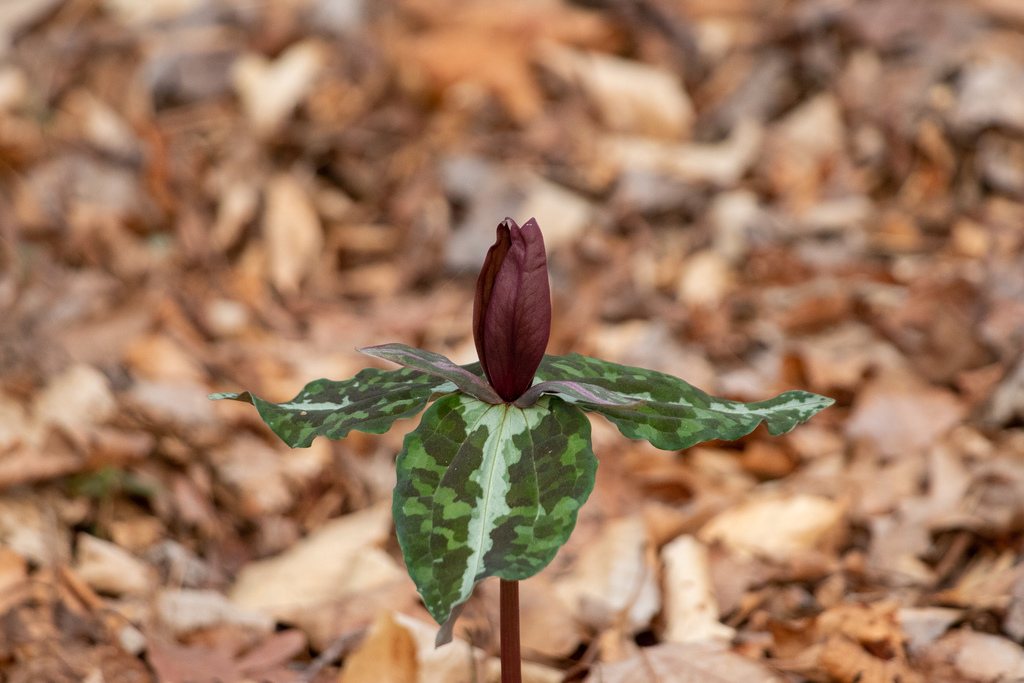
Chattahoochee River wakerobin
Trillium decipiens
Trillium decipiens, also known as Chattahoochee River wakerobin or deceiving trillium, is a spring-flowering perennial plant. It occurs mostly near the Chattahoochee River in Alabama, Florida and Georgia. Scattered populations are found elsewhere in these three states, all within the Atlantic Coastal Plain or Gulf Coastal Plain. Rich deciduous woods of bluffs, ravines, and alluvial land provide its most favored habitat.
From the article Trillium decipiens on Wikipedia (CC BY-SA), quoted section by section
Description
Trillium decipiens is a sessile-flowered trillium, that is, it has no flower stalk. The flower has three purple, brown, or green (rarely yellow) petals that stand upright at the junction of the three strikingly mottled leaves. It is one of the earliest trilliums, often starting to bloom in January or February. Trillium decipiens is often confused with Trillium underwoodii but the two species are easily distinguished by plant height. In the case of T. underwoodii, the stem is 1–1.5 times longer than the leaves at flowering, whereas with T. decipiens, the stem is 2.5–3 times longer than the leaves.
Where it lives
Recorded sightings
—
geo-referenced records in GBIF, from museums, herbaria and field observers.
Drag the globe to turn it. Dots are where records exist, not a range map; darker means more records.
In the stacks
Searching the stacks…
Every page naming Trillium decipiens in the Biodiversity Heritage Library →
This page is assembled live from iNaturalist, GBIF, Wikipedia, the Source Library and the Internet Archive. It is not yet part of the hand-edited codex. iNaturalist taxon 169985.