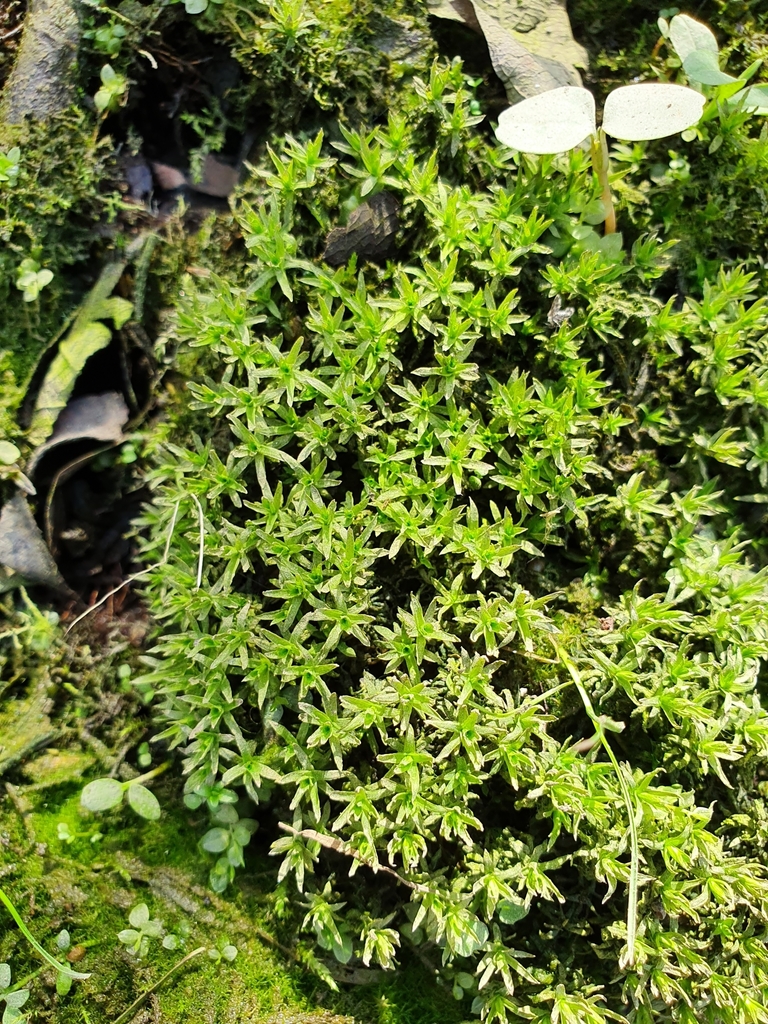
Warrior Moss
Timmia megapolitana
Timmia megapolitana, also known as Indian feather moss and warrior moss, is a genus of moss in the family Timmiaceae and order Timmiales.
From the article Timmia megapolitana on Wikipedia (CC BY-SA), quoted section by section
Description
Timmia megapolitana is a medium sized and deep green moss that has large leaves that are coarsely serrated in the free portion of the leaf and entirely in the sheathing part of the leaf. The leaves are on average 4–5 mm long with the adaxial leaf surface bulging mammilose while the abaxial surface is not. It can be found in loose aggregations or individual stems. The stems are on average 2–6 cm high following a simple or branched pattern. When the leaves become dry they curl up into a tubular shape but spread when moist. The spores are on average 10-14 μm in diameter with a yellow color and rough surface. The stems are on average 2–6 cm high following a simple or branched pattern. When the leaves become dry they curl up into a tubular shape but spread when moist. The spores are on average 10-14 μm in diameter with a yellow color and rough surface.
Wikipedia: “Morphology”
Range & habitat
Timmia megapolitana is found in North America, Europe, China, Japan, Mongolia and Russia While the family Timmiaceae is mostly found in the northern hemisphere T. megapolitana has been identified to follow an Arctic-montane distribution pattern and can easily be found in mountainous regions. It has also been found to be common in temperate regions in North America near rivers and in Europe within lowland areas near the Baltic sea.
Wikipedia: “Distribution”
What it does
Near marshes or locations of high water content, on wet soil or rocks near streams, grasslands or in bogs, needs constant water supply. It is commonly found around habitats with large water content as it needs a constant water supply. It can be found on wet soil, rock near streams, grasslands, marshes or bogs. T. megapolitana has been found growing in wet horizontal willow steps, roots, and fallen branches within ditches that contain clay. It was also found to be surrounded by many other bryophytes in abundance. Timmia megapolitana can also be found at upper elevations in mixed conifer forests. It was found in the northern part of Estonia within moist and shady forest near coastal calcareous cliffs and found in Pine forests that have been exposed to calcareous dust from nearby quarries on the decaying tree stumps of Salix caprea. In Germany and Poland the species was found to be in calcareous marshy meadows, hayfield, and on slopes of marl. In eastern North America, T. megapolitana is found in river bottoms swamps, moist and shaded soil or humus, and rarely at the base of trees. It has also been identified on the banks of ravines or on the crevices of cliffs. Both Siberia and the Netherlands share similar habitats for T. megapolitana in which the species is found on mud-covered willows in forests along rivers. …
Wikipedia: “Habitat and ecology”
In medicine
Many species of moss are used for medicinal purposes. It has been most often used as a way to treat various ailments such as the common cold and hypertension due to its diuretic properties.
== References ==
Wikipedia: “Medicinal”
Where it lives
Recorded sightings
—
geo-referenced records in GBIF, from museums, herbaria and field observers.
Drag the globe to turn it. Dots are where records exist, not a range map; darker means more records.
In the stacks
Searching the stacks…
Every page naming Timmia megapolitana in the Biodiversity Heritage Library →
This page is assembled live from iNaturalist, GBIF, Wikipedia, the Source Library and the Internet Archive. It is not yet part of the hand-edited codex. iNaturalist taxon 169771.