- Animals
- ›Chordates
- ›Vertebrates
- ›Mammals
- ›Therians
- ›Placental Mammals
- ›Ungulates, Carnivorans, and Allies
- ›Even-toed Ungulates and Cetaceans
- ›Ruminants
- ›Bovids
- ›Bovines
- ›Cattle and Bison
- ›Bos
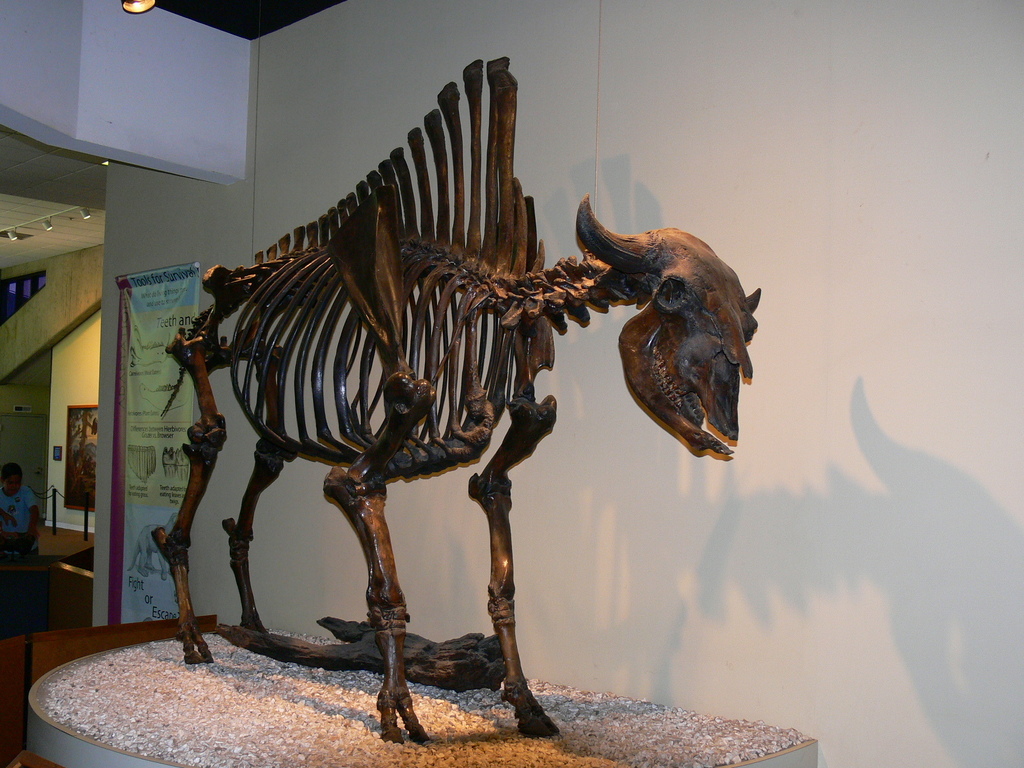
Fossil Bison
Bos antiquus
Bison antiquus is an extinct species of bison that lived in North America during the Late Pleistocene and the beginning of the Holocene from over 60,000 years ago until around 10,000 years ago. Bison antiquus was one of the most common large herbivores in North America during this time period. It is the direct ancestor of the living American bison.
From the article Bison antiquus on Wikipedia (CC BY-SA), quoted section by section
Description
Compared to the living American bison (Bison bison), B. antiquus was considerably larger and had longer limbs, with the upper limbs being more slender while the lower limbs were more robust. The skull was also somewhat more elongate and less domed than that of American bison. It reached up to 2.27 m (7.4 ft) tall, 4.6 m (15 ft) long, and a weight of 1,588 kg (3,501 lb), with an average of around 800 kg (1,800 lb). The horns were also considerably larger than those of living American bison and differed somewhat in shape, being on average 87 centimetres (2.85 ft) across tip to tip, but could be as much as 106.7 centimetres (3.50 ft) across.
Range & habitat
Bison antiquus is known from fossils found across North America south of the Laurentide Ice Sheet (whose southernmost extent is around the modern United States-Canada border), ranging from southern Canada (southern Alberta and Ontario) in the north, and Washington State and California in the west, southwards to Lake Nicaragua and eastwards to South Carolina and Florida.
Wikipedia: “Distribution”
What it does
B. antiquus was likely preyed upon by large carnivores, which may have included the American lion (Panthera atrox), the sabertooth cat Smilodon fatalis, and dire wolves (Aenocyon dirus).
Diet. Unlike living American bison, which are almost exclusively grazers, dental wear analysis suggests that Bison antiquus was a variable mixed feeder (both browsing and grazing) with an adaptable diet depending on geographical location, with diets varying from strict grazing to mixed feeding. Paired dental mesowear and microwear from specimens of B. antiquus from the Southwestern United States dating back to the end of the Last Glacial Period, after the Last Glacial Maximum, has found that they competed with horses for resources and may have been one of the contributing factors in the extirpation of equids from the North American continent. Dental mesowear analysis of B. antiquus from Rancho La Brea has found that its diet remained stable and did not experience significant change over the terminal Pleistocene, suggesting it was minimally impacted by shifts in climate.
Wikipedia: “Ecology”
Listen
Looking for field recordings…
Where it lives
Recorded sightings
—
geo-referenced records in GBIF, from museums, herbaria and field observers.
Drag the globe to turn it. Dots are where records exist, not a range map; darker means more records.
In the stacks
Searching the stacks…
Every page naming Bos antiquus in the Biodiversity Heritage Library →
This page is assembled live from iNaturalist, GBIF, Wikipedia, the Source Library and the Internet Archive. It is not yet part of the hand-edited codex. iNaturalist taxon 1696541.