- Animals
- ›Chordates
- ›Vertebrates
- ›Mammals
- ›Therians
- ›Placental Mammals
- ›Ungulates, Carnivorans, and Allies
- ›Even-toed Ungulates and Cetaceans
- ›Ruminants
- ›Bovids
- ›Bovines
- ›Cattle and Bison
- ›Bos
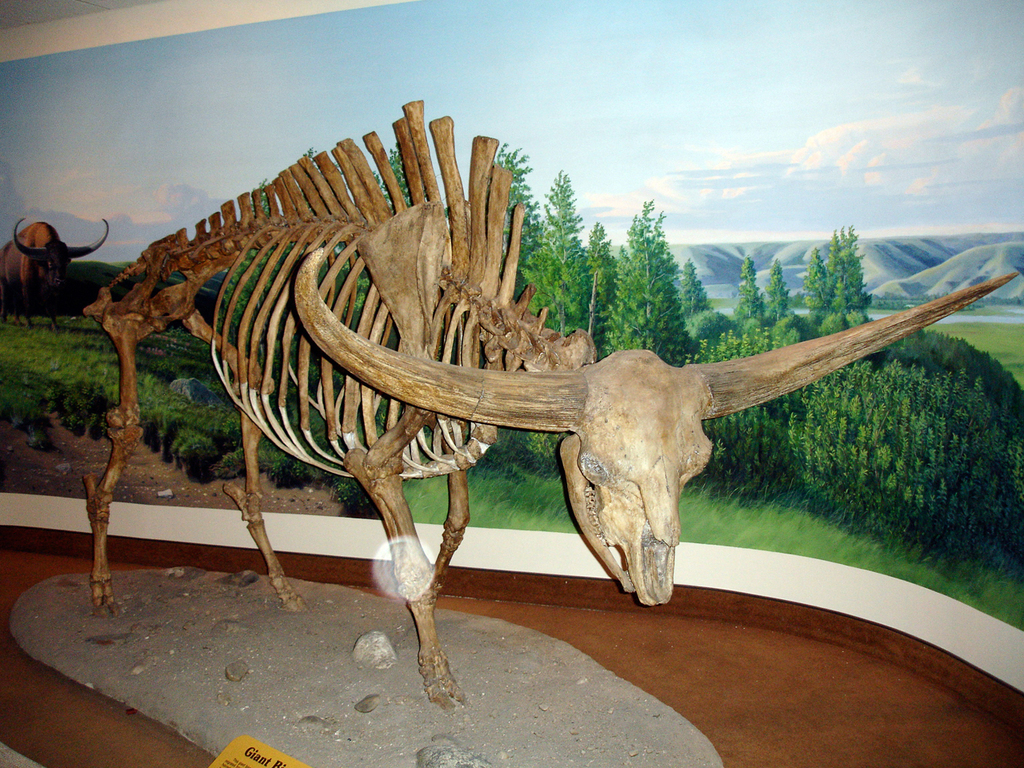
Giant Bison
Bos latifrons
Bison latifrons, also known as the giant bison or long-horned bison, is an extinct species of bison that lived in North America during the Late Pleistocene epoch ranging from southern Canada to Mexico. It is noted for its large body size and distinctive long horns.
From the article Bison latifrons on Wikipedia (CC BY-SA), quoted section by section
Description
Because only skulls and horns of this species have been found well preserved, the size of B. latifrons is currently not clearly known. Based on leg bones, the mass of B. latifrons has been estimated to be 25-50% larger than that of modern B. bison, making it undoubtedly one of the largest-ever ruminants. The known dimensions of the species are on average larger than any extinct and extant bovids, including both the American bison and the European bison, making it the largest known bovid. Overall, it was probably around 4.75 m (15.6 ft) in length and stood about 2.3 m (7.5 ft) or up to 2.5 m (8.2 ft) tall at the withers. With an estimated weight of 1,250 kg (2,760 lb), or possibly over 2,000 kg (4,400 lb) in very large males. The horns of B. latifrons measured as great as 213 cm (84 in) from tip to tip, compared with 66 cm (26 in) to 90 cm (35 in) in modern Bison bison.
Range & habitat
Bison latifrons ranged across much of North America, extending from southern Mexico to southern Canada, as far west as California and as far east as Florida and the American Midwest. Though it was primarily a grazer, B. latifrons exhibited a high degree of dietary flexibility and adaptability across its range. Isotopic analysis from specimens found in Florida suggests a largely grazing based diet, while isotopic analysis of specimens from Clark Quarry, Georgia, suggest that these specimens had a mixed feeding diet (both browsing and grazing), with their diet varying according to the seasons.
Wikipedia: “Habitat and behavior”
Listen
Looking for field recordings…
Where it lives
Recorded sightings
—
geo-referenced records in GBIF, from museums, herbaria and field observers.
Drag the globe to turn it. Dots are where records exist, not a range map; darker means more records.
In the stacks
Searching the stacks…
Every page naming Bos latifrons in the Biodiversity Heritage Library →
This page is assembled live from iNaturalist, GBIF, Wikipedia, the Source Library and the Internet Archive. It is not yet part of the hand-edited codex. iNaturalist taxon 1696540.