- Plants
- ›Vascular Plants
- ›flowering plants
- ›Dicots
- ›Heathers, Balsams, Primroses, and Allies
- ›camellia family
- ›Stewartia
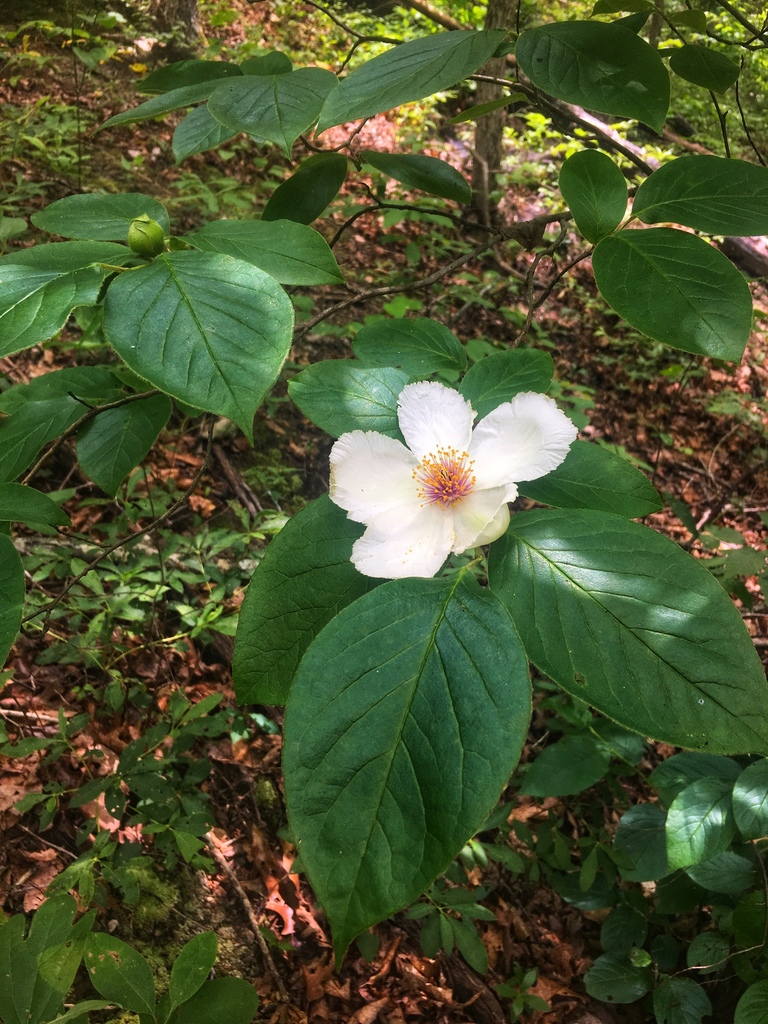
mountain camellia
Stewartia ovata
Stewartia ovata, known commonly as mountain camellia, is a small tree native to low to mid-elevations in the southern Appalachian Mountains and nearby regions from Mississippi to Virginia. It is a member of the Theaceae, the tea family.
Although not endangered, the plant does have a limited range and is uncommon throughout its range. Mountain camellia grows in the understory of predominantly hardwood forests and tends to be found near streams, usually at elevations below 800 m (2,600 ft).
From the article Stewartia ovata on Wikipedia (CC BY-SA), quoted section by section
Description
Stewartia ovata is a deciduous flowering shrub or small tree growing to 5 meters (16 2/3 feet) tall, with smooth, flaking grayish-orange bark. The leaves are oval with an acute apex, 7–13 cm (2.8–5.1 in) long and 3–6 cm (1.2–2.4 in) broad, and turn orange, red, or gold when the tree becomes dormant in the fall. The flowers are camellia-like, 6–12 cm (2.4–4.7 in) in diameter, with five white petals and numerous white, yellow or purple stamens; they appear in early to mid-summer.
Varieties There are two varieties:
Stewartia ovata var. ovata — flowers 6–8 cm diameter, stamens white to yellow. Stewartia ovata var. grandiflora (W.J.Bean) Weatherby — flowers up to 12 cm diameter, stamens purple.
Where it lives
Recorded sightings
—
geo-referenced records in GBIF, from museums, herbaria and field observers.
Drag the globe to turn it. Dots are where records exist, not a range map; darker means more records.
In the stacks
Searching the stacks…
Every page naming Stewartia ovata in the Biodiversity Heritage Library →
This page is assembled live from iNaturalist, GBIF, Wikipedia, the Source Library and the Internet Archive. It is not yet part of the hand-edited codex. iNaturalist taxon 169392.