- Plants
- ›Vascular Plants
- ›flowering plants
- ›Dicots
- ›nightshades, bindweeds, gooseweeds, and allies
- ›nightshade family
- ›nightshades and allies
- ›nightshades and jaltomatas
- ›Solanum
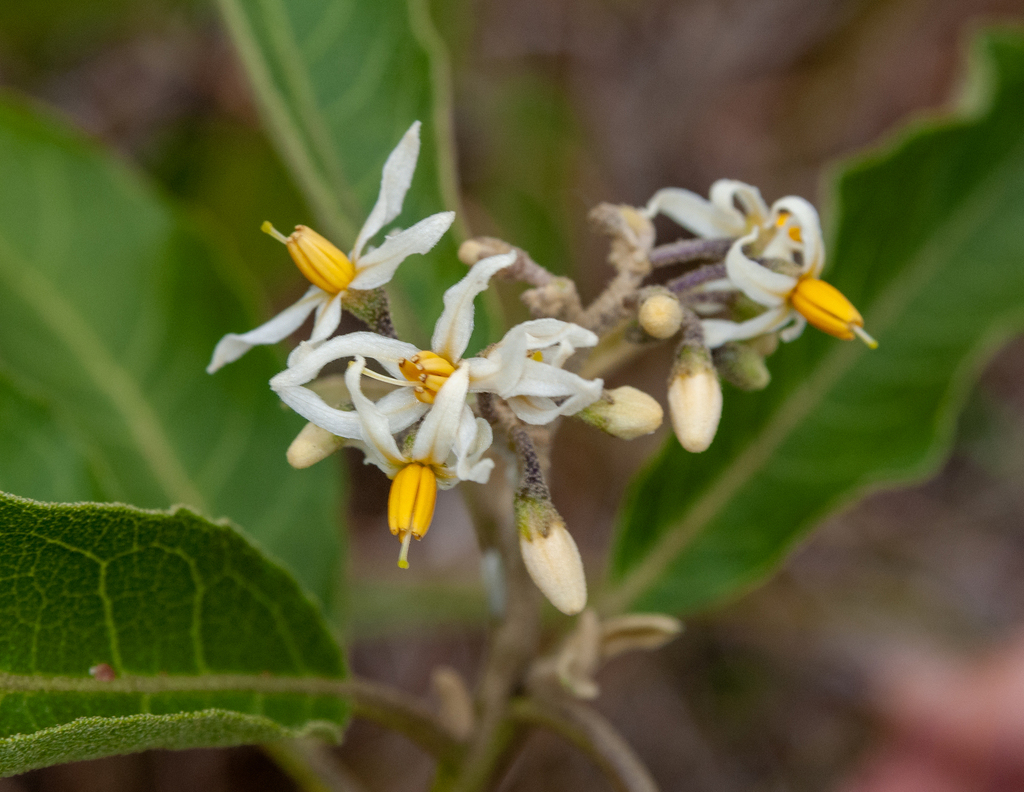
mullein nightshade
Solanum donianum
Solanum donianum, often known as the mullein nightshade, is a species of flowering plant in the nightshade, tomato or potato family, the Solanaceae.
From the article Solanum donianum on Wikipedia (CC BY-SA), quoted section by section
Description
The mullein nightshade is an erect shrub growing to 2.5 m (8 ft 2 in) tall. Young plant are sparsely armed with brownish, straight prickles up to 3 mm (0.12 in) long, but these may be absent on older plants. The plant's green parts are moderately to densely covered with branched "stellate" hairs. Leaves have petioles up to 3 cm (1.2 in) long, with the egg-shaped to elliptic blades developing no teeth or indentations along the margins; leaves are up to 5.5 cm (2.2 in) long. Flowers are arranged in much-branched inflorescences at stem tips and arising in the angles where petioles attach to their stems. The flowers' petals are white, with the stamens' relatively large, yellow, pollen-producing anthers conspicuously occupying the corollas' centers. The berry-type fruits are red and fleshy like small tomatoes.
Range & habitat
Solanum donianum is native to Mexico, Guatemala, southern Florida and the Bahamas.
Wikipedia: “Distribution”
At the table
In warmer areas, mullein nightshade is grown in butterfly gardens, used in natural landscaping, and for restoring habitats. It's regarded as fast growing, and spreading from rhizomes to form small patches broader than tall. Along Mexico's Yucatan coast among the Maya people, Solanum donianum has been reported as used for treating diabetes; the fruit is blended, strained and drunk on an empty stomach. Laboratory analysis of 12 plant species known among the Yucatan's Maya people having medicinal value determined that Solanum donianum was potentially useful as:
an ACE inhibitor (for high blood pressure and hearth failure an antimicrobial for human use an antifungal for use with plants
Wikipedia: “Human uses”
In human culture
The derivation of the genus name Solanum is uncertain, though it's interesting to reflect that the New Latin solis means "of the sun", possibly alluding to the sunny habitats in which various species grows. Or maybe Solanum is based on the Latin solor, among the meanings of which are "to soothe", with the -anum from the Latin anus, meaning "anus", so it could refer to the soothing narcotic effect (maybe on a sore anus) produced by certain Solanum species. The species name, donianum most likely is meant to honor the Scottish botanist George Don. On page 54 of the volume in which the formal description of Solanum donianum was published in 1842 by Wilhelm Gerhard Walpers, a specimen collected by "G. Don" was listed as S. Bahamense Mill., which Walpers treated as a synonym of S. donianum. George Don is known to have collected plants in Cuba and Cayman Islands in 1822, and well could have collected a plant named S. Bahamense.
== References ==
Wikipedia: “Etymology”
Where it lives
Recorded sightings
—
geo-referenced records in GBIF, from museums, herbaria and field observers.
Drag the globe to turn it. Dots are where records exist, not a range map; darker means more records.
In the stacks
Searching the stacks…
Every page naming Solanum donianum in the Biodiversity Heritage Library →
This page is assembled live from iNaturalist, GBIF, Wikipedia, the Source Library and the Internet Archive. It is not yet part of the hand-edited codex. iNaturalist taxon 169061.