- Plants
- ›Vascular Plants
- ›flowering plants
- ›monocots
- ›grasses, sedges, cattails, and allies
- ›grasses
- ›Paniceae, andropogoneae, paspaleae, and allies
- ›bristle, rosette, and barnyard grasses, and allies
- ›Cenchrinae
- ›Setaria
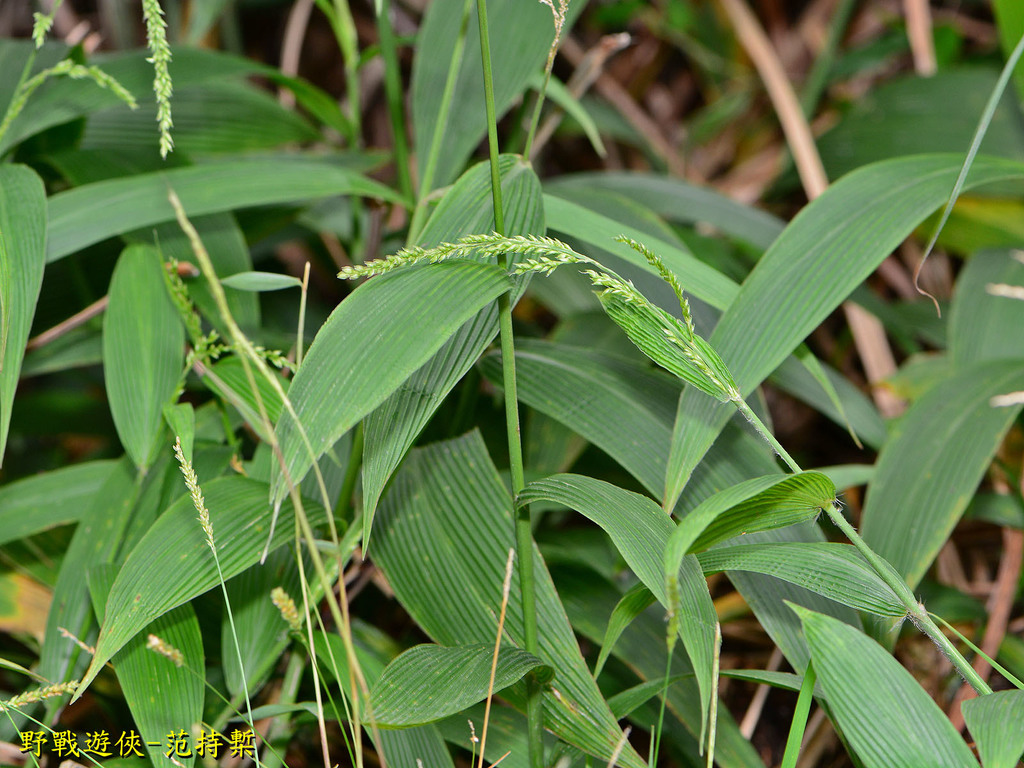
Palmgrass
Setaria palmifolia
Setaria palmifolia is a species of grass known by the common names palmgrass, highland pitpit, hailans pitpit, short pitpit, broadleaved bristlegrass, and knotroot. In Spanish it is called pasto de palma and in Samoan vao 'ofe 'ofe. It is native to temperate and tropical Asia. It is known elsewhere as an introduced, and often invasive, species, including in Australia, New Zealand, many Pacific Islands, and the Americas.
From the article Setaria palmifolia on Wikipedia (CC BY-SA), quoted section by section
Description
This species is a perennial grass with stems growing up to 2 or 3 metres (6+1⁄2 or 10 ft) long from a knotty rhizome. The stems can be up to 1 centimetre thick. The leaf sheaths are sparsely to totally hairy. The leaf blades are linear, oval, or lance-shaped and up to 60 to 80 cm (24 to 31 in) long by 7 or 8 cm wide. They have a pleated texture and are hairless or with some rough hairs. The panicle is loose, open and spreading, reaching up to 80 cm long. The spikelet is a few millimetres long but is often accompanied by a bristle which can be 1.5 cm long.
Range & habitat
It is native to temperate and tropical Asia. It is known elsewhere as an introduced, and often invasive, species, including in Australia, New Zealand, many Pacific Islands, and the Americas.
Wikipedia: “Distribution and habitat”
What it does
The grass has been introduced to many areas, often as an ornamental. It is widespread in the Pacific Islands. It has become an invasive plant on Lord Howe Island, Norfolk Island, Rapa Nui, Fiji, and the Solomon Islands, and in Samoa and Hawaii. It is also invasive in New Zealand and Queensland. The grass is robust and spreads via rhizome and seed banks, forming monotypic stands. It is a tall plant with wide leaves that shade out other vegetation. The rampant feral pigs of Hawaii facilitate its spread there by uprooting the surrounding plants while feeding on its thick stems. It is also spread by seed-eating birds. This species is host to the fungi Cercospora setariae and Phacellium paspali.
Wikipedia: “Ecology”
At the table
The grass is cultivated as an ornamental plant for its palm-like pleated leaves. Some cultivars have striped leaves and 'Rubra' has purple midribs. It is grown as a vegetable crop in Papua New Guinea, where that is known as highland pitpit. The stem of the grass is eaten after cooking. The grain can be eaten as a rice substitute.
Wikipedia: “Uses”
In human culture
A folk belief in Taiwan holds that the number of latitudinal creases on the leaf predicts the number of typhoons that will hit the area in the coming or current typhoon season. It is known locally as typhoon grass.
Wikipedia: “In culture”
Where it lives
Recorded sightings
—
geo-referenced records in GBIF, from museums, herbaria and field observers.
Drag the globe to turn it. Dots are where records exist, not a range map; darker means more records.
In the stacks
Searching the stacks…
Every page naming Setaria palmifolia in the Biodiversity Heritage Library →
This page is assembled live from iNaturalist, GBIF, Wikipedia, the Source Library and the Internet Archive. It is not yet part of the hand-edited codex. iNaturalist taxon 168884.