- Plants
- ›Vascular Plants
- ›flowering plants
- ›Dicots
- ›Nances, Willows, and Allies
- ›willow family
- ›Salix
- ›Vetrix
- ›Daphnella
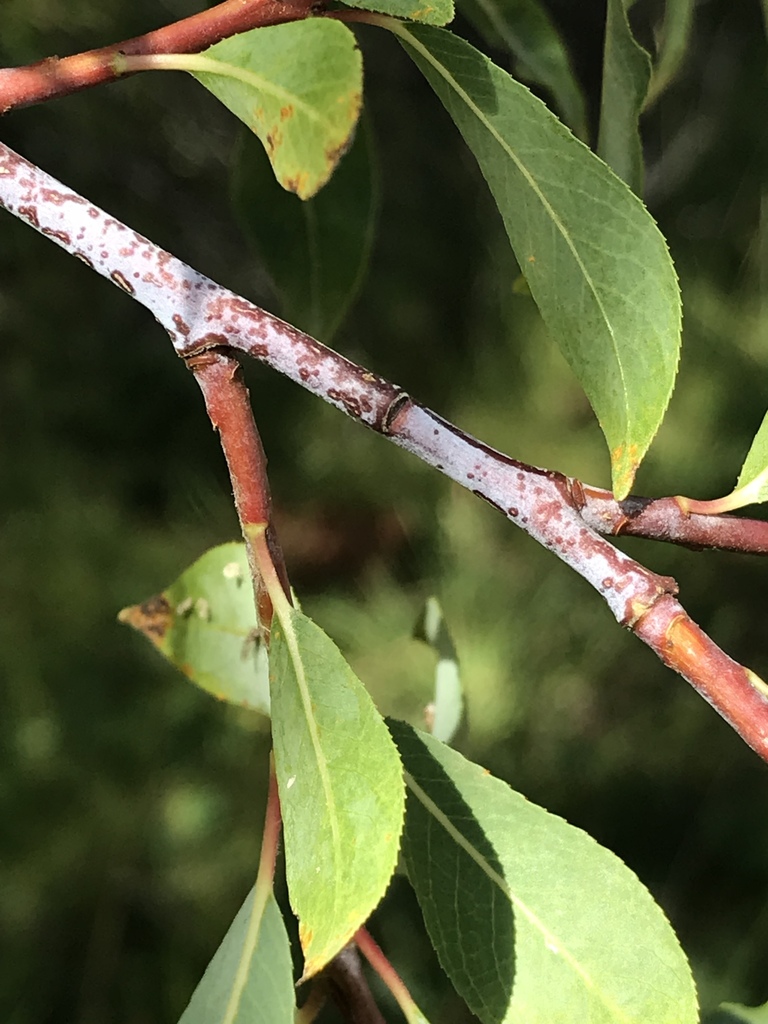
Violet Willow
Salix daphnoides
Salix daphnoides, the European violet willow, is a species of plant in the family Salicaceae. It can grow as a large shrub or small tree, normally reaching a height of
6–8 m (20–26 ft), but can grow up to 12 m (39 ft) tall.
From the article Salix daphnoides on Wikipedia (CC BY-SA), quoted section by section
Description
It has a rounded crown with spreading branches with smooth, grey bark. The twigs are dark red/brown in colour, hairless and somewhat shiny. It has large buds, either hairless or with stiff, erect hairs. The leaves are oblong to narrow/obovate, normally between 7 and 12 cm long and 2 to 3 cm in width. They are hairy at first, but soon become glabrous, being a dark shiny green on their upper surfaces, and glaucous on their undersides. The catkins appear in February–March.
Range & habitat
Salix daphnoides occurs scattered across central Europe between the Baltic states and Piedmont, and from the Balkans to eastern France. It is native in the Alps, Pyrenees and the Carpathians, but has been naturalised by cultivation across a much wider area. It occurs at altitudes of 100–2,000 metres (330–6,560 ft). It grows along the banks of rivers and wetlands in alpine areas, preferring sand, pebbly or bolder-rich alluvial substrates. It also descends into lowland areas, occurring along main rivers such as the Visla and the Rhine (often with Salix eleagnos and Myricaria germanica) as well as in loose sand dunes.
Wikipedia: “Distribution and habitat”
At the table
It is planted to provide reinforcement to coastal and continental sand dunes, but is also widely planted as an ornamental species in parks and along roads. The cultivar 'Aglaia' has won the Royal Horticultural Society's Award of Garden Merit.
Wikipedia: “Uses”
Where it lives
Recorded sightings
—
geo-referenced records in GBIF, from museums, herbaria and field observers.
Drag the globe to turn it. Dots are where records exist, not a range map; darker means more records.
In the stacks
Searching the stacks…
Every page naming Salix daphnoides in the Biodiversity Heritage Library →
This page is assembled live from iNaturalist, GBIF, Wikipedia, the Source Library and the Internet Archive. It is not yet part of the hand-edited codex. iNaturalist taxon 168328.