- Plants
- ›Vascular Plants
- ›flowering plants
- ›Dicots
- ›Nances, Willows, and Allies
- ›willow family
- ›Salix
- ›Vetrix
- ›Vetrix
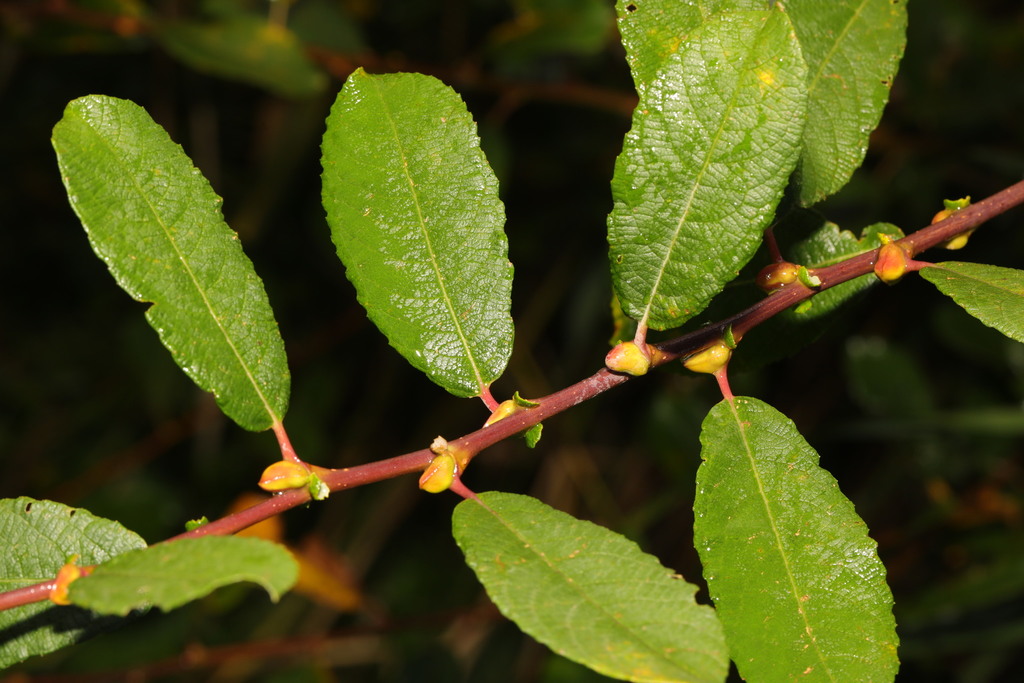
Grey Willow
Salix cinerea
Salix cinerea (common sallow, grey sallow, grey willow, grey-leaved sallow, large grey willow, pussy willow, rusty sallow) is a species of willow native to Europe and western Asia.
The plant provides a great deal of nectar for pollinators. It was rated in the top 10, with a ranking of second place, for most nectar production (nectar per unit cover per year) in a UK plants survey conducted by the AgriLand project which is supported by the UK Insect Pollinators Initiative.
From the article Salix cinerea on Wikipedia (CC BY-SA), quoted section by section
Description
It is a deciduous shrub or small tree growing 4–10 metres (13–30 ft) tall. The leaves are spirally arranged, 2–9 cm (1–3+1⁄2 in) long and 1–3 cm (1⁄2–1+1⁄2 in) broad (exceptionally up to 16 cm long and 5 cm broad), green above, hairy below, with a crenate margin. The flowers are produced in early spring in catkins 2–5 cm long; it is dioecious with male and female catkins on separate plants. The male catkins are silvery at first, turning yellow when the pollen is released; the female catkins are greenish grey, maturing in early summer to release the numerous tiny seeds embedded in white cottony down which assists wind dispersal.
What it does
Grey willow grows in wetlands, moist depressions, ditches, embankments, banks of stagnant or slow-moving water bodies, and forest edges, where it encounters low-lying damp situations with waterlogged and nutrient-poor soils. S. cinerea is a pioneer species that rapidly colonizes disturbed sites. A common herbivore of Salix cinerea is Phratora vulgatissima, which prefers and is more common on female plants. Anthocoris nemorum, a natural enemy of Phratora vulgatissima, is also more common on S. cinerea.
Wikipedia: “Ecology”
Where it lives
Recorded sightings
—
geo-referenced records in GBIF, from museums, herbaria and field observers.
Drag the globe to turn it. Dots are where records exist, not a range map; darker means more records.
In the stacks
Searching the stacks…
Every page naming Salix cinerea in the Biodiversity Heritage Library →
This page is assembled live from iNaturalist, GBIF, Wikipedia, the Source Library and the Internet Archive. It is not yet part of the hand-edited codex. iNaturalist taxon 168326.