- Plants
- ›Vascular Plants
- ›flowering plants
- ›Dicots
- ›pinks, cactuses, and allies
- ›knotweed family
- ›Polygonoideae
- ›Docks, Sorrels and Rhubarbs
- ›Rumex
- ›Rumex
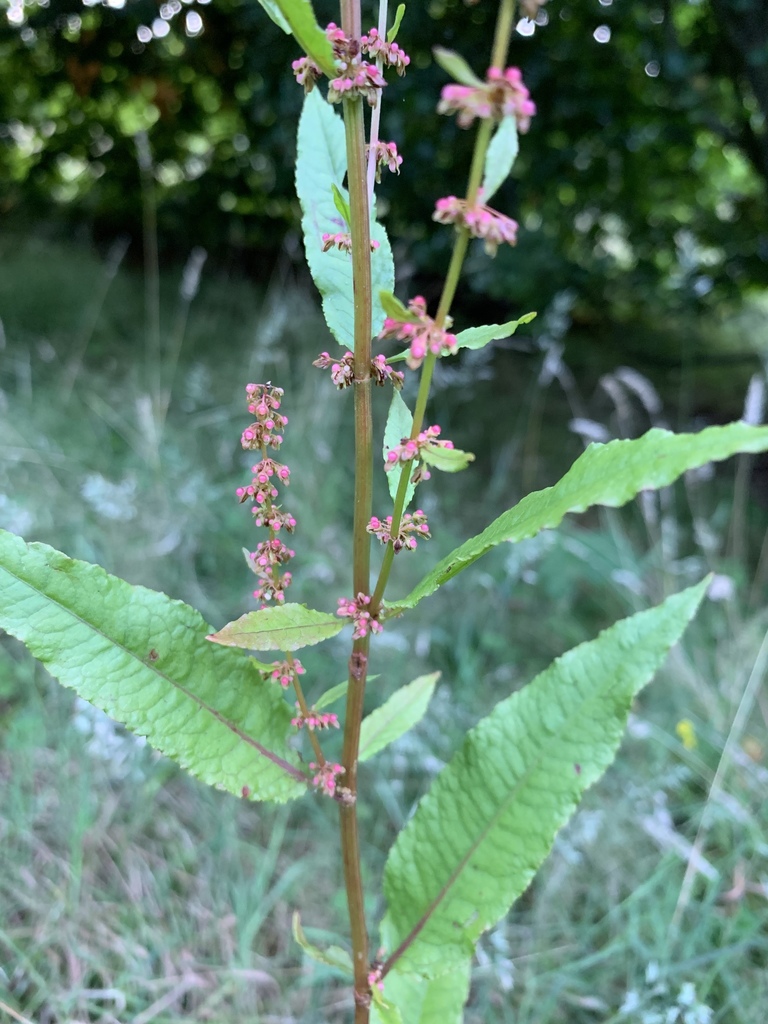
Wood Dock
Rumex sanguineus
Rumex sanguineus, commonly known as wood dock, bloody dock or red-veined dock, is a perennial flowering plant species in the family Polygonaceae. Rumex sanguineus is a dicot and can be observed in Europe with at least two varieties.
From the article Rumex sanguineus on Wikipedia (CC BY-SA), quoted section by section
Description
In var sanguineus (red-veined or bloody dock) the leaf veins are bright red, and in var viridis (wood dock) the whole leaf is green. The leaf blade is lanceolate with a more or less pointed tip, and averages 10 to 30 cm (3.9 to 11.8 in) long by 2.5 to 6 cm (0.98 to 2.36 in) wide. Rumex sanguineus grows in shaded or damp habitats, and flowers in summer. The inflorescence occupies the upper two thirds of the stem. The inflorescence is lax, interrupted, and broadly paniculate. There are normally ten to twenty flowers in each well-spaced whorl. The achenes are dark reddish brown to almost black. The red-veined form is very distinctive. The green form is distinguished from the very similar Rumex conglomeratus by a more slender and erect habit.
Range & habitat
Rumex sanguineus is common in most of Europe south of about 60 degrees north, but not in Russia and rarely in the Mediterranean. It inhabits damp, shady places, especially in woodland. It is an agricultural weed that can be found in the vegetation surrounding arable fields. Rumex sanguineus is not native to North America with most reports of Rumex sanguineus being confused with R. conglomeratus or immature R. obtusifolius.
Wikipedia: “Distribution”
Where it lives
Recorded sightings
—
geo-referenced records in GBIF, from museums, herbaria and field observers.
Drag the globe to turn it. Dots are where records exist, not a range map; darker means more records.
In the stacks
Searching the stacks…
Every page naming Rumex sanguineus in the Biodiversity Heritage Library →
This page is assembled live from iNaturalist, GBIF, Wikipedia, the Source Library and the Internet Archive. It is not yet part of the hand-edited codex. iNaturalist taxon 168250.